Where are the graves? An evidence-based challenge to Hamas’s casualty claims
While the Strip has suffered severely, Gaza’s population has not vanished, and the infrastructure necessary to hide mass death does not exist.
By Ardie Geldman
JNS
Feb 1, 2026
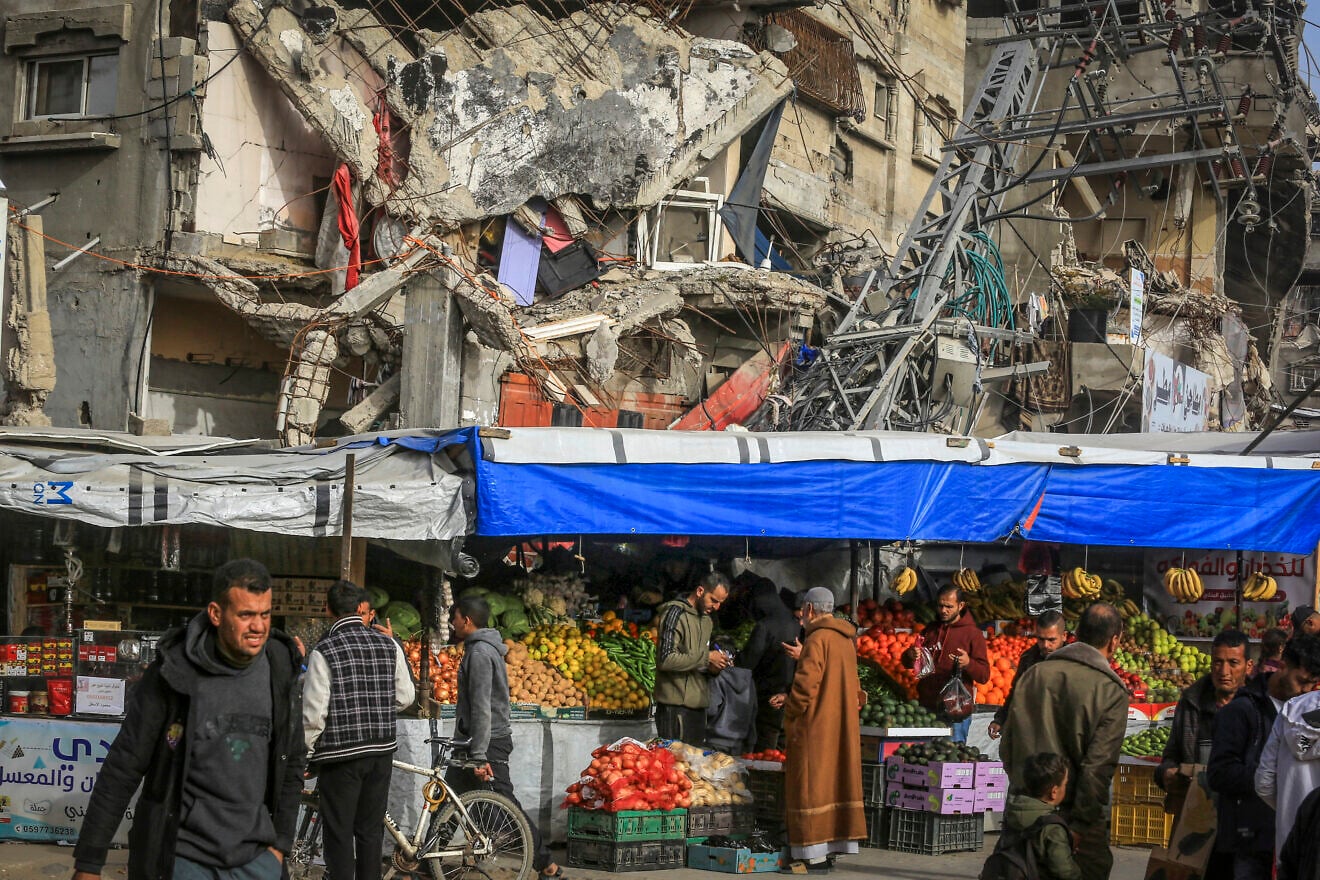
In propaganda wars, facts and truth have no value. This has again been demonstrated in Israel’s war with the terrorist group Hamas, in which millions of people around the world have accepted myriad lies about Israel and Jews manufactured by the pro-Palestinian camp.
Perhaps the most egregious is the putative death toll of Gazans. Since the start of war that began on Oct. 7, 2023, Hamas and the Gaza Health Ministry, which it controls, have asserted extraordinarily high civilian death tolls and accused Israel of genocide. These claims have been echoed uncritically by many international media outlets. Yet a fundamental evidentiary problem remains largely unaddressed: the absence of physical proof consistent with the scale of deaths being claimed, as of late, up to some 70,000.
In a territory as small, densely populated and closely observed as Gaza, the logistics of death on such a massive scale would necessarily leave unmistakable traces—most notably, graves. An obvious question is: Where are the graves? They are conspicuously missing.
Gaza is about 365 square kilometers and one of the most densely populated places on Earth. It has been mapped exhaustively for decades by satellite imagery, humanitarian organizations, journalists and intelligence agencies. If tens of thousands of people had been killed, as Hamas claims, then the coastal enclave would require extensive new burial grounds. Cemeteries cannot be hidden abstractions; they are physical spaces that consume land, require excavation and permanently alter the terrain.
Claims of the existence of mass graves found at the Nasser Medical Complex in Khan Yunis, the Al Shifa Hospital in Gaza City, the Kamal Adwan Hospital in Beit Lahiya and other sundry sites across Gaza were first reported by Gaza Civil Defense and Hamas-affiliated media. These claims were then carried, sans scrutiny, by agencies belonging to the United Nations and by Amnesty International. The claim of there being mass graves in Gaza is true. It has been verified by news agencies Reuters and the Associated Press at different points in 2024.
However, even in that year, when the Hamas-reported death toll was variously 30,000 to 40,000, the number of bodies reported to have been discovered at these burial sites—at maximum a few thousand—did not approach Hamas’s allegations. To date, no definitive independent forensic investigation has conclusively determined the number of bodies discovered in mass graves.
Defenders of Hamas’s figures argue that many bodies remain buried under the rubble of buildings destroyed by Israeli airstrikes. Even if one were to accept this explanation at face value, it does not solve the problem. At most, a few thousand bodies might plausibly remain unrecovered beneath collapsed structures at any given time. But the figures claimed by Hamas far exceed what rubble alone could conceal. The majority of the dead, if the numbers were accurate, would still have had to be recovered and buried. That reality would inevitably require the establishment of massive new cemeteries or the dramatic expansion of existing ones. There is no evidence that this has occurred.
Burial on such a scale is not a discreet or invisible process. It requires manpower, heavy equipment, fuel, time and organization. If the death tolls claimed were factual, then burial crews would have been operating continuously, day and night, for months. There would be visible signs: fleets of trucks transporting bodies, large-scale excavation activity, fuel usage spikes, records from religious authorities overseeing funerals and countless eyewitness accounts.
Gaza is not a sealed black box. Despite the war, it has remained under intense international scrutiny, with constant satellite coverage and monitoring by journalists, NGOs and foreign governments. Yet none have produced verifiable documentation of burial operations remotely matching the scope required by Hamas’s claims.
Instead, the world has largely received aggregate numbers issued daily by the Gaza Health Ministry, an entity that is neither independent nor transparent, and is directly controlled by Hamas.
These figures are released without names, death certificates, causes of death, burial records or corroborating documentation. Over time, inconsistencies have emerged, including implausible demographic breakdowns, duplicated counts and unexplained statistical revisions. Nonetheless, many media outlets continue to report these figures as fact, often without attribution or skepticism, granting them a credibility they have not earned.
This pattern aligns with Hamas’s long-established strategy of information warfare. Civilian suffering—real, exaggerated or fabricated—is deliberately weaponized to delegitimize Israel internationally.
Inflated casualty figures serve that goal by fueling outrage, diplomatic pressure and accusations of war crimes and genocide. The charge of genocide, in particular, has been repeated so frequently that it is treated by some as self-evident. Yet genocide is a legal term with a precise definition: the intent to destroy, in whole or in part, a national, ethnic, racial or religious group as such.
The evidence does not support that accusation. Israel has repeatedly stated—and its actions substantiate—that its objective is the defeat of Hamas, not the destruction of the Palestinian people. The Israel Defense Forces have employed measures fundamentally inconsistent with genocidal intent, including evacuation warnings, humanitarian corridors, coordination of aid delivery and operational decisions that often come at real military cost to reduce civilian harm.
Civilian casualties in war are tragic and morally serious, but they do not, by themselves, constitute genocide. If they did, the term would lose all legal meaning.
Moreover, genocide on the scale alleged would produce outcomes that are empirically undeniable: mass population collapse, systematic killing methods and overwhelming physical evidence. Yet Gaza’s population has not vanished, and the infrastructure necessary to hide mass death does not exist. The absence of mass graves, vast new cemeteries or continuous burial operations is not a minor oversight; it is a decisive contradiction.
None of this is to deny that civilians have died or that Gaza has suffered severe and intense destruction throughout the Strip. War in dense urban environments is devastating, and innocent lives have unquestionably been lost. Still, acknowledging that reality does not require accepting casualty figures produced by a terrorist organization with a clear incentive to deceive.
Extraordinary claims demand extraordinary evidence. Ultimately, the question stands: If the numbers are true, where are the graves?
Until that question is answered with concrete, independently verifiable evidence, the figures propagated by Hamas and echoed by many media outlets should be treated not as established fact but as unproven claims, and, given their source, with great skepticism.
Without such evidence, accusations of genocide collapse under scrutiny—revealed not as conclusions grounded in facts but as narratives constructed for political effect. Will recognizing this change the narrative of Israel’s enemies? It’s unlikely, but the truth must be told.