From free speech to fear: Synagogues targeted by terror tactics
Pro-Palestinian rallies outside Jewish institutions have exposed a dangerous misconception: that as long as no physical violence occurs, intimidation is acceptable. It is not.
By Paul Goldenberg
JNS
Jan 16, 2026
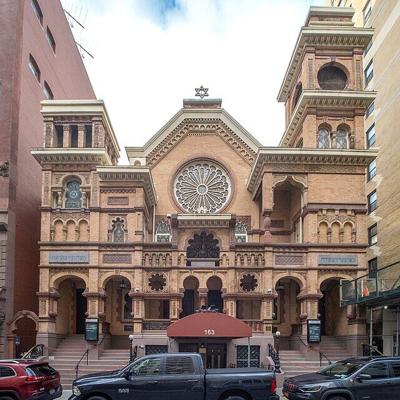
America’s commitment to free speech is one of its greatest strengths. But free speech was never meant to be a license to intimidate, terrorize or target vulnerable communities. When protests are deliberately staged at Jewish institutions and synagogues—places of worship, community life and identity, not political power, the line between expression and coercion has already been crossed.
Recent pro-Palestinian demonstrations outside Jewish institutions and synagogues in New York have exposed a dangerous misconception: that as long as no physical violence occurs, intimidation is acceptable. It is not. And calling it “protest” does not make it so.
In response, New York Gov. Kathy Hochul has proposed legislation creating a 25-foot buffer zone around houses of worship and health-care facilities. While well-intentioned, this proposal is inadequate, and from the perspective of anyone who has actually commanded public-order policing, it borders on the ridiculous.
I say this as a former senior law-enforcement official responsible for managing large-scale demonstrations, civil unrest and public-safety threats. Distance does not neutralize intimidation. If fear is the objective, then 25 feet—or even 50—changes nothing. The message remains unmistakable: You are being watched, targeted and made unsafe because of who you are.
These demonstrations are not about persuading the public or influencing policy. If they were, then they would be directed at lawmakers, embassies or government institutions. Instead, they are aimed at Jewish institutions and synagogues, places where families pray, children learn and communities gather. That choice is not incidental. It is strategic.
This is why the debate is being framed incorrectly. This is not a First Amendment issue. The First Amendment protects speech, not harassment. It does not shield conduct intended to coerce civilians, disrupt religious life or instill fear in a targeted population. When demonstrations are designed to make people afraid to enter their own synagogues or community institutions, they cease to be expressive acts and become acts of intimidation.
Some are uncomfortable using the word terrorism. They shouldn’t be. Terrorism is defined by intent, not scale—the deliberate use of fear and intimidation against civilians to advance an ideological cause. When demonstrators target Jewish institutions rather than political actors, chant slogans linked to violent movements and exploit historical trauma to magnify fear, the intent is clear.
Context matters. Jewish communities are not reacting in a vacuum. They are responding in the aftermath of the Hamas-led terrorist attacks on Oct. 7, 2023, when 1,200 people were slaughtered and another 251 kidnapped; amid rising global antisemitism and synagogue attacks; and open calls for violence against Jews worldwide. Ignoring that context does not make us neutral; it makes us negligent.
It must also be said plainly that law enforcement is not the problem. Police officers on the ground have acted professionally and responsibly, often under intense pressure, to prevent escalation and maintain order. They are doing their jobs within the limits of the law. What they lack is not commitment but legal authority. When statutes are vague and consequences are minimal, officers are forced to manage intimidation rather than stop it.
What is most troubling— and least discussed—is that many of these demonstrations bear none of the hallmarks of spontaneous grassroots activism. They are well organized, well-funded, coordinated across jurisdictions and professionally orchestrated. Messaging is uniform. Tactics are repeated. Targets are consistent. That alone warrants serious scrutiny.
Law-enforcement and national-security agencies must investigate these demonstrations for what they may represent. Some organizing entities may be receiving foreign funding or direction from adversarial actors who benefit from social division, religious intimidation and internal destabilization in the United States. This would not be unprecedented, and it would not be accidental.
The U.S. Department of Justice, as well as its federal and state partners, should assess whether the organizations coordinating and financing these actions meet the threshold for criminal conspiracy, material-support violations or racketeering activity. Where evidence supports it, accountability must follow. Political rhetoric does not confer immunity.
There is also a tangible and often overlooked consequence: financial harm. Jewish institutions targeted by these demonstrations are being forced to divert limited resources to private security, barriers and facility hardening costs incurred solely because they are being deliberately targeted. Organizations that orchestrate and fund such actions should be held civilly accountable for the foreseeable security costs that they impose. Forcing religious communities to absorb the financial burden of intimidation is not protected expression; it is economic coercion. Protest groups cannot externalize the cost of fear onto their targets and then claim moral exemption.
Supporters of buffer-zone legislation argue that it strikes a balance between free speech and religious freedom. It does not. Balance is not achieved by tolerating intimidation at a slightly greater distance. Law-enforcement professionals are trained to recognize pre-incident indicators—behaviors that signal escalation before violence occurs. Targeted harassment of Jewish institutions and synagogues is one of them. Waiting for violence before acting is not restraint; it is failure.
This debate is not unique to New York. Similar challenges are unfolding across the United States and in Canada, where Jewish institutions have increasingly become protest targets. The question everywhere is the same: Do Americans still have the right to worship and gather without fear?
Today, it is Jewish institutions and synagogues. Tomorrow, it may be churches, mosques or other vulnerable American religious institutions. Once intimidation is normalized, so long as it occurs just beyond an arbitrary perimeter, we erode not only religious freedom but the democratic values that depend on it.
Free speech is a cornerstone of democracy. But fear is its enemy. And when intimidation is disguised as protest, failing to name it is not neutrality; it is surrender.
America must draw a clear line: Protest policy all you want, but do not terrorize communities. Not at their doors. Not ever.


No comments:
Post a Comment