Quantifying Ukraine’s Strikes on Russian Energy Infrastructure
By Gabriel Collins
Rice University’s Baker Institute for Public Policy
Mar 2, 2026
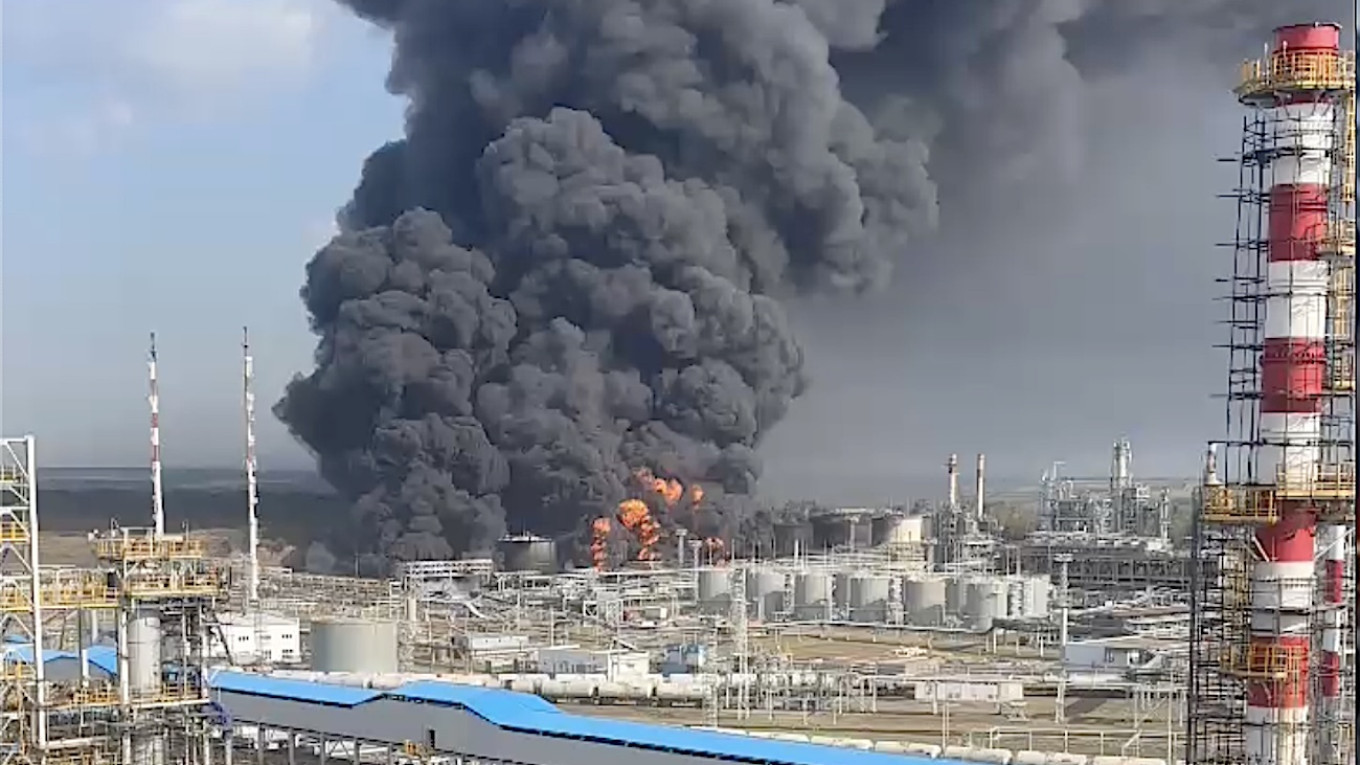
A Russian oil refinery struck by a Ukrainian drone
Paper Sanctions Versus Kinetic Sanctions
What options are available to a country facing attacks from a larger, more powerful neighboring state whose economy heavily relies on natural resource exports?
This question is currently being tested in Ukraine. After years of paper sanctions that saw major volumes of Russian oil and refined products still enter the market and subsequently provide Russia with revenue, Ukraine undertook a different approach in 2025: physical or “kinetic” sanctions. This approach demonstrates how dynamic actions can slice through the maneuvers that Russia utilizes to continue its oil shipments.
From 2022 through 2025, Russia’s so-called “shadow fleet” — comprised of opaquely owned and marked ships that trade and transport the country’s oil — could generally circumvent sanction lists and enforcement actions. However, when the response moves from European and American courts and compliance bureaucracies to Ukrainian drone and missile teams, decision speed and effects invert. While creating new shell companies and reflagging oil tankers is fast and relatively cheap, replacing energy assets struck by steel and explosives is much slower and far more expensive.
Numerical Tally of Ukraine’s Strikes
Figure 1 offers a holistic view of the number of confirmed and suspected Ukrainian strikes on Russian energy infrastructure, since near the beginning of the war to the present. This data set currently counts 272 discrete strike events.
Figure 1 — Confirmed and Suspected Ukrainian Strikes on Russian Energy Infrastructure by Asset Type, April 2022–February 2026

Source: Reuters; Bloomberg; NPR; Al Jazeera; Politico Europe; Euronews; France 24; ABC News; The Guardian; The Kyiv Independent; Ukrainska Pravda; RBC (Russia and Ukraine); Kommersant; TASS; The Moscow Times; RFE/RL (Radio Svoboda); Meduza; Novaya Gazeta Europe; ISW; Defence Express; Militarnyi; United24; regional Russian outlets; official regional governor Telegram channels; company releases (e.g., Rosneft, NOVATEK); Wikipedia; and Google Earth (specifically for facility background and coordinates). Note: To create this dataset, the author reviewed a range of English, Russian, and Ukrainian media outlets and other sources using both manual inspections and AI-enabled deep searching that drew upon the deep-research functionalities of ChatGPT 5.2, Gemini 3 Pro, and Claude Opus 4.6. Searches focused on drone and missile strikes and sabotage operations against oil, gas, and electricity infrastructure within Russia’s internationally recognized borders. This dataset is available upon request.
How Ukraine’s Campaign on Russia’s Energy Has Evolved
In the earlier parts of the Russia-Ukraine war, at least three key factors restrained Ukrainian targeting of Russian energy assets.
- Ukrainian
leaders prioritized immediate survival and battlefield action, as many
likely believed the current war would be relatively short in duration
rather than longer than the span of the Germany and the Soviet Union
conflict during World War II. This initial expectation matters because
targeting the adversary’s economic center of gravity typically yields
effects in a prolonged war. The war’s extended length did not become
clear until 2024.
- Until 2024 and 2025, Ukraine lacked the drone and missile capabilities for sustained, long-range strikes deep into Russia.
- Over concerns regarding the potential oil price spikes and their political impacts, the Biden administration discouraged Ukrainian strike campaigns against the Russian oil industry. Subsequently, U.S. political constraints on Ukrainian targeting of energy assets in Russia eased as Ukraine’s indigenous strike capabilities matured. Increased disruptions and operational challenges soon followed for Russian energy infrastructure.
Ukrainian Strikes on Russian Energy Infrastructure
The Ukrainian military are applying an effects-based approach to an entire energy value chain by targeting Russia’s upstream production assets, including oil platforms in the Caspian Sea; key pipeline pumping stations on export systems, such as the Druzhba Pipeline; power plants and substations; oil storage sites; oil loading ports, such as Novorossiysk; and most of all, oil refineries.
Multiple strategic factors underpin Ukraine’s specific attention to Russia’s oil supply chain. First, crude oil and refined products sales are Russia’s main source of externally generated income and largely fund its war efforts. Second, interdicting oil storage and refining capacity can also impede Russian battlefield logistics. This is reflected in the large number of strikes on oil storage assets located in western Russia as well as the fuel facilities supporting the Engels Bomber Base.
Third, Ukraine appears to be prioritizing economic and military effects over direct impacts on civilians in Russia. Put differently, Russian consumers may experience higher gasoline prices or increased reliance on public transportation, but electrical services have typically remained interrupted. Ukraine’s demonstrated energy strike capabilities at this point — including successful but limited strikes in late 2025 on key high-voltage power substations in central Russia — suggest that leaving Russia’s electricity infrastructure intact is thus far a conscious choice by Kyiv.
Impact of Ukraine’s Strike Campaign
A strike campaign on oil systems as large, complex, and resilient as Russia’s requires a long, sustained effort to have substantial impacts. Toward the end of 2025, Russia’s crude oil export volumes remained steady, but oil product exports began to decline at levels not previously observed during the war, notwithstanding the sanctions environment (Figures 2–3).
Figure 2 — Russian Oil Product Exports by Port, April 2022–October 2025 Source: Kyiv School of Economics and author’s analysis.
Figure 3 — Russian Crude Oil Exports By Port, April 2022–October 2025 Source: Kyiv School of Economics and author’s analysis.
Since 2024, Russian crude oil exports were steady, but refined product exports fell. That divergence indicates a significant shift.
Among other responses, the Russian government temporarily restricted oil product exports. The steadiness of crude oil exports and the decline in products exports are likely related, due to Ukraine’s campaign against Russia energy infrastructure. More specifically, Ukrainian strikes have clearly damaged a meaningful portion of Russia’s refining capacity, which both reduces plants’ abilities to process crude oil and produce refined products.
The result is that more crude oil is shifted from domestic refineries to export markets; this maintains the appearance of operational continuity, while product exports decline. If Ukraine intensifies its strike campaign against crude oil pipelines and ports, it is likely that the volumetric data of Russia’s crude oil and exports, expected to be released in the coming months, will both show noticeable declines.
This is where material disruptions — or kinetic sanctions — markedly diverge from legal paper sanctions. Legal risk tends to create price discounts. Then, profit opportunities can attract bad actors willing to sidestep laws. In Russia’s case, this scenario has reportedly culminated into an arbitrage ecosystem of shell companies run by Russia-linked middlemen and its “shadow fleet” that move oil to market.
Additionally, enforcement tends to be limited. If one refinery’s compliance department rejects an oil cargo, another will likely accept it at a discount. Likewise, a ship can avoid ports where it might be detained and then transfer oil to another vessel offshore or blend it to obscure its origins. Under these circumstances, risk is tightly bounded and relatively easy to avoid. Ultimately, once the oil enters the refinery and becomes diesel, gasoline, or jet fuel, the product can be sold anywhere in the world. Since the war’s start, the pricing of Russia’s Urals oil relative to Brent — a global pricing benchmark — reflects this adaptation cycle (Figure 4).
Figure 4 — Average Export Price of Urals Crude Oil Versus Brent Crude Oil, 2012–25
Source: Argus Media, Cbonds, Energy Information Agency, International Energy Agency, Interfax, Rigzone, Russian Ministry of Finance, and author’s analysis.
Kinetic risk is very different. It removes physical volumes of the product. If barrels cannot enter the market, the arbitrage window for practical purposes expires, at least from Russia’s perspective. Another seller of heavy, higher-sulfur crude would likely gain access to a new market opportunity — such as Iraq, Saudi Arabia, Venezuela, etc. — but those countries’ exchequers, rather than Russia, would receive the new revenues.
Kinetic sanctions through Ukrainian strikes at large scale can effectively disconnect Russia from the market and therein lies the key strategic impact. Strike impacts are not currently at this level, but if Ukrainian forces were to significantly damage the Primorsk and Novorossiysk oil ports and reattack on a weekly basis, physical disconnection would become a real possibility. Even if Russia lost 50% of its export capacity and global oil prices rose by 25% in response, Russia’s financial position — and ability to fund and fight a war — would decline rapidly.
Strategic Lessons From Ukraine’s Approach
Throughout late 2025 and onward, Ukraine has demonstrated the importance of low-cost, scalable indigenous strike capabilities. Strikes on targets 1,000 or more kilometers into the territory of an adversary with capable air defense was considered, prior to Russia’s invasion, a domain in which perhaps only the U.S., Israel, China, and Russia possessed the requisite capabilities.
The barriers to entry into long-range precision strike capabilities are considerably lower now. Ukraine’s national GDP before the war amounted to approximately one-fourth that of the Greater Houston area. Yet its combination of survival motivation, a talented and educated population, industrial base, and access to key imported components is culminating into a drone and missile complex — one that is highly capable and can credibly threaten key infrastructure assets up to 2,000 km from its borders.
Indeed, as recently as Feb. 21, Ukrainian forces significantly damaged a key missile factory located more than 1,300 km into Russia — roughly the distance from Houston to Jacksonville, Florida. That strike used the Flamingo, a Ukrainian-made cruise missile that can carry a 2,500 lb. warhead. In other words, it is a considerable weapon that would substantially impair refineries, oil ports, power plants, or any other energy infrastructure that Ukraine may choose to target.
In a world where middle-ranking powers may increasingly aim for independent deterrence capabilities, Ukraine offers an example of how a smaller country without nuclear weapon capacities can strike strategic level targets in a powerful adversary’s territory. Taiwan, Poland, Pakistan, and many other countries are likely paying close attention to Ukraine. Japan plans to upgrade its indigenous strike capabilities, and South Korea possesses a formidable domestic strike arsenal.
Many analysts’ attention has focused on the rising risks of nuclear proliferation. Yet long-range conventional strikes also deserve close examination, particularly since for every country with the technical base for pursuing a nuclear weapons program, there are likely five or more with the wherewithal to build indigenous long-range domestic strike weapons, as demonstrated by South Korea, Iran, and Ukraine. Nuclear weapons are designed to intimidate whereas conventional long-range strike systems are largely made with the potential of use. This distinction is increasingly significant in a world where prior restraints on striking another country’s soil have eroded in recent cases, such as Israel-Iran, India-Pakistan, Thailand-Cambodia, U.S.-Iran, and Russia-Ukraine.
In addition to the military strike dimensions, the Ukrainian energy campaign also highlights the importance of maximizing infrastructure connectivity. Kazakhstan, and to a lesser extent, Hungary and Slovakia have each experienced collateral impacts because of Ukraine’s strikes on Russian oil and gas processing and transportation assets.
For Kazakhstan in particular, diversification of oil export routes now holds a new strategic urgency. Ukraine’s fall 2025 sea drone strikes shut down the Caspian Pipeline Consortium Terminal at Novorossiysk, Russia, causing significant reductions in Kazakh oil output. Around this same time, Ukrainian air drone strikes on Russia’s Orenburg gas processing facility also negatively impacted Kazakh gas production at the Karachaganak Field just across the border.
Building alternative oil and gas export routes that are not directly tied to geopolitical risks associated with Russia and China is an expensive and complex challenge that Astana had previously been able to overlook. Now, however, export diversification is likely back on the table with an intensity, perhaps not seen since the 1990s. U.S. and partner company investments could look to address this issue, a topic the center aims to examine in coming months.
Future Considerations for Ukraine’s Energy Campaign
As Ukraine significantly reduced its strikes on Russian energy infrastructure in January 2026 and the first half of February, a few questions remain:
- What happens to
Russian refineries, product supplies, and export potential if Ukraine’s
long-range strikes resume a sustained attack pace similar to that of
late 2025? Russia has been able to lean on a combination of
redundancy conferred by infrastructure built for higher Soviet-era
demand levels, along with patchwork repairs. If Ukraine increases
strikes again and begins to incorporate heavier weapons — a likely
evolution in 2026 — Russia’s reconstitution potential will likely erode.
Export volumes would fall accordingly.
- What
happens as Ukraine becomes more able to integrate heavy missiles, such
as the FP-5 Flamingo, Long Neptune, and indigenous ballistic missiles,
into its energy strike campaigns? These munitions appear to be currently prioritized toward targets of immediate military relevance, such as the Votkinsk Missile Plant recently struck with Flamingo missiles.
If Ukraine continues to increase production and heavy strike missiles
become more numerous, these missiles could be used more frequently in
energy strikes given that their 500 lb. to 2,500 lb. warheads are
exponentially more damaging than the 100 lb.-range warheads currently
used on Ukraine’s longest-ranged drones.
- If oil and product exports are significantly impeded, how would Russia and its war effort evolve? Ukrainian and Russian soldiers are largely motivated by different factors shaped by their respective national circumstances: national defense considerations in Ukraine’s case and economic incentives in Russia’s case. Russia’s ability to recruit men — particularly from rural, impoverished areas — heavily depends on financial incentives, which is revenue derived from its crude oil and product exports. This system is primarily driven by a stark but rational set of calculations: a soldier receives regular compensation, and in the event of death, the soldier’s family collects a substantial payment, likely worth more than an income earned for decades of work.
As noted in this commentary, Ukraine has considerable incentives to diminish Russia’s income by reducing and destroying its oil and gas production and export systems. Simultaneously, Ukrainian arms manufacturers continue incrementally advancing indigenous heavy long-range strike capabilities. This intersection of Ukrainian survival imperatives plus Kyiv’s increasing strike capabilities suggests potential challenges ahead for Russian oil, refined product, and gas exports.
Ukrainian President Volodymyr Zelensky recently expressed frustration at what appeared to be Russia’s attempt to stall the latest peace talks; noting that time is of the essence, he stated, “So we have to decide, and have to finish the war.” If sanctions are economic pressure and battlefield operations are tactical pressure, Ukraine’s energy strike campaign is strategic pressure, representing an initial step in a potentially broader effort.


No comments:
Post a Comment