Published by an old curmudgeon who came to America in 1936 as a refugee from Nazi Germany and proudly served in the U.S. Army during World War II. He is a former law enforcement officer and a retired professor of criminal justice who, in 1970, founded the Texas Narcotic Officers Association. BarkGrowlBite refuses to be politically correct.
(Copyrighted articles are reproduced in accordance with the copyright laws of the U.S. Code, Title 17, Section 107.)
There are, IMHO, only three good things that ever came out of Oakland.
Me, United Parcel Service and the Raiders. One of those, UPS, took a
large hit on the stock market yesterday. It seems that Big Brown
decided that their large volume - low profit per package business with
Amazon just wasn't worth the effort and they are backing away from their
agreement with Amazon. I guess the market believes more in gross than
does the management at UPS. That's what they pay managers for. Were I a
betting man I would be with UPS on this one.
Revealed: What life on Earth will look like in 2100 - with entire
cities plunged underwater and millions of people perishing in the heat
By William Hunter
Daily Mail
Feb 1, 2025
The Statue of
Liberty underwater
From Snowpiercer to The Day After Tomorrow, countless movies and series have put forward their vision of how climate change might reshape the world.
Worryingly, scientists predict that the reality might be far more shocking than anything imagined by a Hollywood studio.
Now, artificial intelligence (AI) reveals what this might look like.
With Google's ImageFX AI image generator, MailOnline has used the latest scientific research to predict how the world will be in 2100.
As greenhouse gas levels continue to increase, scientists predict that entire cities will be plunged under water.
Meanwhile, climbing temperatures and punishing heatwaves could kill millions of people around the globe.
Professor Julienne Stroeve, a climate scientist from University College London, told MailOnline: 'The largest impacts that affect all of us are sea level rise and changes in weather extremes.
'All of these will increase through the century if we do not do anything to reduce greenhouse gas emissions.'
Scientists
say that the real impacts of climate change could be far more shocking
than anything imagined in a Hollywood studio. Now AI has revealed what
that might look like
Rising temperatures
Scientists have known for years that human-caused climate change is leading to a warmer climate.
As
greenhouse gases like carbon dioxide and methane build up in the
atmosphere, they act like a blanket covering the planet, trapping heat
from the sun and leading to rising temperatures.
Scientists
predict that global temperatures could rise by as much as 4.4°C
(7.92°F) above the pre-industrial average in the worst-case scenario.
This would lead to widespread drought in water-shortage-prone countries
like France
In the middle scenario, CO2 emissions stay
around current levels until the mid-century before declining towards
net-zero by 2100.
Meanwhile, in the
very high emissions scenario, the world does not take measures to curb
greenhouse gas emissions and CO2 levels actually increase by 2100.
Since
1990, arid regions have expanded by an area a third larger than India
and now cover 40 per cent of the Earth's land excluding Antarctica.
If
nothing is done to reduce greenhouse gas emissions, the number of
people living in drylands will more than double from 2.3 billion to 5
billion in 2100.
Likewise, one 2023
paper predicted that the risk of 'flash droughts', in which drought
conditions occur abnormally fast, will increase from 32 per cent to 53
per cent in Europe by 2100.
<p>Your browser does not support iframes.</p>
That means that countries like France
which already struggle with systematic water shortages are more likely
to face devastating droughts.
Melting Ice and higher sea levels
As the atmosphere gets warmer over the next 75 years, the seas will also begin to warm.
In the 1980s, scientists recorded that ocean temperatures were rising at a rate of about 0.06°C per decade.
Looking
ahead, the researchers say is 'plausible' that the ocean temperature
increase seen over the past 40 years will be exceeded in just the next
20 years.
In turn, that will lead to potentially devastating impacts for all life on Earth.
Professor
Stroeve says: ‘Summer sea ice for sure will be gone well before 2100
but there will be several months of ice-free conditions, not just one
month.
By
2100, scientists say the Arctic will be 'unrecognisable' with sea ice
totally vanishing in the summer, leaving months of ice-free waters (AI
impression)
Antarctic
sea ice also hit near-record lows during 2024. Reduced sea ice means
that less energy from the sun is reflected back out of the atmosphere,
triggering even faster rates of warming
'This will warm up the Arctic even faster,
leading to more melting from Greenland and faster sea level rise,
destabilization of the permafrost areas, and disruption of the
thermohaline [deep ocean currents] circulation.'
For
any people or animals that rely on snow and ice, Professor Stroeve says
this rate of change will simply be too fast to adapt to.
'The Arctic will be unrecognizable from its contemporary state,' says Professor Stroeve.
'Further,
the ice-free conditions exposes the coastlines to waves from storms,
and that combined with permafrost thaw results in entire communities to
be moved.'
As the oceans warm, they will also expand, combining with fresh water from the melting ice caps to drive up sea levels.
Researchers
from Nanyang Technological University (NTU) in Singapore have predicted
that global sea levels could rise by a staggering 6.2ft (1.9 metres) by
2100 if carbon dioxide (CO2) emissions continue to increase.
In
the European Alps, glaciers will be reduced by 75 per cent by volume
and snow will be absent for much of the year (AI impression)
Global
heating will melt the icecaps and cause the oceans to expand, leading
to rising sea levels. UK cities like Hull (pictured in AI impression)
could be completely submerged as the sea level rises by a staggering
6.2ft (1.9 metres) by 2100
Meanwhile,
in the US, people living on the East Coast would be hit the hardest -
with large portions of New York City, Boston, Atlantic City and Miami
submerged.
By
2100, one of the biggest ways we will feel the impact of climate change
will be in the massive increase in extreme weather events.
Dr
Suzanne Bartington, associate professor of environmental health at the
University of Birmingham, told MailOnline: 'Climate change is
significantly increasing the frequency and intensity of extreme weather
events, including heatwaves, heavy rainfall, droughts, wildfires which
affect physical and mental health.'
As
the atmosphere gets warmer, it is able to hold onto more water vapour
before releasing it as precipitation leading to much heavier rainfall.
A
Met Office study predicts that weather rivalling the wettest day ever
recorded could become ten times more likely by 2100 thanks to climate
change in a medium emissions scenario.
Even
as sea levels rise, plunging cities like London underwater, scientists
predict that there will be a significant increase in flooding. The UK
will receive up to 35 per cent more precipitation in winter and
record-breaking days of rain will be 10 times more likely
The
increased temperature led to record-breaking amounts of water vapour in
the atmosphere which created more severe storms and flooding around the
world
At the same time, changing weather patterns mean that some places will experience very little rain at other times of the year.
By 2070, the Met Office predicts that average summer rainfall in the UK could decrease by up to 47 per cent.
Meanwhile, the same study found that there could be up to 35 per cent more precipitation in winter.
When
these sudden bursts of rain hit areas where drought has already
hardened the ground, the risk of flash flooding becomes extremely high.
Unfortunately, we do not need AI to help us imagine such a scenario.
Last
year, Spain was hit by the worst ecological disaster in the country's
history as flash floods tore through Valencia and the surrounding
regions.
In the future, the situation is likely to become even more dire.
In
Valencia, Spain a combination of high temperatures and a long time
without rain led to devastating flash floods which killed at least 213
people. This photo shows residents and volunteers carry out clearing
duties in the flood-hit municipality of Paiporta, Valencia province,
Spain, November 4, 2024
Studies
have shown that the Mediterranean region - which is home to more than
510 million people - is warming 20 per cent faster than the global
average.
The UN predicts that, outside of summer, the Mediterranean will see up to 20 per cent more rainfall events by 2080.
Typhoons,
hurricanes, and tropical storms, which are all essentially the same
weather phenomena, are caused when warm moist air rises from the ocean.
As
human-caused climate change warms the oceans where these form, there is
more energy to drive the storm - leading to ever more powerful events.
Last
year, a group of researchers called for the standard scale used to
measure hurricanes, the Saffir-Simpson Windscale, to be extended to
include these abnormally-strong storms.
For
places like Japan, Indonesia, the Philippines, and the southern states
of the US, these devastating storms may become much more common by 2100.
Warmer
waters also mean more intense tropical storms in Asia and above the
Gulf of Mexico. This puts cities like Toyko (depicted here by AI), which
already experiences typhoons, at serious risk
During
2023 and 2024 a natural weather phenomenon called the El Niño Southern
Oscillation created exceptionally high sea surface temperatures. This
event occurs once every 14 years, leading to warmer temperatures.
However, the end of El Niño does not mean that temperatures will begin
to decline
Raging wildfires
While some parts of the world will be battered by intense storms, others will be baked by stifling droughts and heatwaves.
Scientists
predict that this combination of intense heat and low rainfall will
turn some regions into 'tinderboxes' - regions susceptible to wildfires.
Worryingly, there are clear signs that this process has already begun.
The
devastating Los Angeles wildfires started on January 7 and spread
quickly, killing at least 28 people and destroying more than 10,000
homes, racking up billions in costs and leaving thousands of people
homeless.
At the time the fires started, LA was experiencing its driest start to the year since records began in 1944.
As
of January, Los Angeles Airport had recorded just 0.03-inch (0.08cm) of
rain since October 1, creating 'severe drought' conditions across Los
Angeles County.
Extreme
wildfires are predicted to become 50 per cent more frequent by 2100 as
drier, hotter conditions create highly flammable conditions. In cities
like LA, these fires could cause huge destruction. This is an
ultra-realistic AI depiction of Los Angeles affected by climate change
The
devastating Los Angeles wildfires (pictured in this photo) started on
January 7 and spread quickly, killing at least 28 people and destroying
more than 10,000 homes, racking up billions in costs and leaving
thousands of people homeless
By
2100, the UN Environment Programme predicts that climate change and
changing land usage will make wildfires more intense and more frequent.
Studies
suggest that cities like Delhi (pictured) which already has deadly
levels of air pollution could face even worse conditions. Warmer air and
less rain mean pollution stays in the air longer
Due
to mass urbanisation, industrialisation, and population growth cities
like Delhi, India (pictured) now have worse pollution than ever before
Studies
have predicted that air pollution will lead to 260,000 deaths by 2100
as a result of the changes caused by climate change
In countries experiencing rapid industrial growth, poor environmental regulation has allowed pollution to reach unsafe levels.
Over
the last few years, Delhi's air pollution levels have exceeded 100
micrograms per cubic meter - 20 times higher than the WHO
recommendations.
By 2100, many researchers expect these conditions to get worse for many people around the globe.
Less rain and warmer temperatures mean that pollution tends to stay in the air for longer.
This
means that climate change will increase the amount of ground-level
ozone and fine particle pollution we breathe - leading to lung disease,
heart conditions, and strokes.
Research
published in Nature Climate Change found that if climate change
continues, air pollution will cause an extra 60,000 deaths worldwide by
2030 and 260,000 deaths by 2100 as a result.
Millions dead
Through
a combination of these factors, scientists believe that the world will
see millions of extra deaths by 2100 thanks to human-caused climate
change.
Excess
heat alone is predicted to cause 5.8 million extra deaths in Europe by
2100. The worst affected city will be Barcelona (depicted in this AI
impression) where 246,000 net extra deaths are forecast
As the climate warms, more and more people will be exposed to the effects of deadly heatwaves.
This will be particularly harmful in areas which have never had to adapt to extreme heat conditions in the past.
Even
under the most optimistic scenario, an additional 8,000 people will be
killed by the heat every year while an extra 80,00 could die in the
worst-case scenario.
Dr Bartington
says: 'Under current climate policies it is expected that heat-related
deaths will increase, particularly among older people in the context of an ageing population.'
Between 2015 and 2099, heat alone will
lead to 5.8 million extra deaths with the worst affected city in Europe
being Barcelona - with 246,082 net deaths.
That
is even after accounting for the number of people that climate change
would save from death in the cold European winters - challenging the
popular theory that global heating could be a net positive for cold
countries.
Combined with rising air pollution, the effects on life around the globe could be even worse.
Even
in the most likely scenario, an additional 10.8 million people could
die each year due to heat while 19.5 million might be killed by air
pollution.
Given that these figures do
not even consider the increased risk of extreme weather, wildfires, and
famine caused by disruption to agriculture, the true toll of climate
change could be higher still.
EXCLUSIVE Explosive twist in claims about who took iconic Vietnam War 'Napalm Girl' picture
By James Reinl
Daily Mail
Feb 1, 2025
After 50 years of silence, a freelance photographer from Vietnam has
claimed he took the iconic 'Napalm Girl' image (above) showing a naked
child fleeing from a bomb in 1972
A photographer credited with taking an
iconic image of the Vietnam War claims he will sue the filmmakers who
say he basked in the glory of another man's work for decades,
DailyMail.com can reveal.
But a new documentary called 'The Stringer,' which premiered on Saturday, claims that Ut has lived a lie all these years as the 'napalm girl' photo was really taken by Nguyen Thanh Nghe, an NBC News driver.
Now, Ut's lawyer, Jim Hornstein, says
these dueling claims will be tested in court, as he will in the coming
weeks file a defamation lawsuit against The VII Foundation and others
involved in the movie.
Hornstein says
the film's claims are 'absolute bunk' and based on a '50-year vendetta'
of an AP photo editor in Saigon who was jealous of Ut, and the
glittering career he has had once the war ended.
The
lawyer shared with DailyMail.com documents from the case file,
including a letter from Kim Phuc, the girl in the photo, now a
61-year-old living in Canada, who says she has 'no doubt' that Ut took the photo.
He also shared a letter from a 1989 edition of the Los Angeles
Times, in which an NBC News director who witnessed the horrors at the
town of Trang Bang praised Ut for his work, but made no reference to
Nghe.
'A defamation action will soon be
filed against the filmmakers to correct this outrageous decision by VII
Foundation' to release the movie, Hornstein told DailyMail.com.
Titled
The Terror of War, it became one of the most haunting images of the
20th century. Nick Ut (pictured), now 73, was 21 when he took the photo,
which won a Pulitzer Prize
The 'napalm girl' photo was taken on 8
June 1972. It shows Kim Phuc as a naked nine-year-old girl and several
other burned and crying children fleeing a napalm attack on their
village of Trang Bang.
Officially titled The Terror of War, it became one of the most haunting images of the 20th century.
A billion people are estimated to have seen the photo within 24 hours of its publication, with billions more viewing it since.
It
was so influential in hammering home the horrors of the Vietnam War
that President Richard Nixon even questioned if it had been doctored.
The
AP and Ut have long maintained that Ut, then aged 21, took the photo,
which won him a Pulitzer Prize, photojournalist fame and a distinguished
career until his retirement from the AP in 2017.
More than half a century later, The
Stringer flips the script on this, claiming that the image was actually
taken by Nghe, who was in Trang Bang that day as a driver for an NBC
News crew.
Nghe says he captured the
image of Phuc running down the street with arms outstretched and sold it
to the AP for $20, and that they gave him a print of the photo that his
wife later destroyed.
Investigations
into his claim by teams for The Stringer were led by husband-and-wife
team Gary Knight and founder of the VII Foundation, and producer Fiona
Turner.
It was directed by Vietnamese-American filmmaker Bao Nguyen.
The movie sent shockwaves through the Sundance Film Festival in Park City, Utah, where it premiered on Saturday.
A
key source in the film is Carl Robinson, a former AP photo editor in
Saigon, who was overruled in his judgment not to use the picture by
Horst Faas, AP's Saigon chief of photos, it is claimed.
Pictured: Vietnam war survivor Kim Phuc, left, and AP photographer Nick Ut, greet each other before a talk in 2007
Nguyen
Thanh Nghe has said the monochrome photograph, which has long been
credited to AP staffer photographer Nick Ut, was actually taken by him.
(Pictured: Director Bao Nguyen and Nguyen Than Nghe)
AP
bosses have said there is 'no reason to conclude that anyone other than
the long-credited photographer, Ut, made the picture'. (Pictured: Ut
(center) flanked by the girl pictured, Kim Phuc, on his left)
The letters page from a 1989 edition of the LA Times is set to feature in the upcoming lawsuit
Robinson says in the film that Faas instructed him to 'make it staff' and credit Ut for the photo.
Both Faas and Yuichi 'Jackson' Ishizaki, who developed the film, are dead.
Robinson was dismissed by the AP in 1978. The 81-year-old says he 'didn't want to die before this story came out.'
The Stringer gives several theories about why Nghe did not get credit for what was allegedly his photograph.
One is that it was common practice at the time to credit staff over local stringers.
Another is that Fass felt loyalty to Ut, whose brother, also a photographer, died on a job in a war zone.
Faas
also wrote a memo hinting that it was commonplace not to credit the
local Vietnamese stringers because of their 'weird' names.
Researchers
enlisted a French forensics team, INDEX, to help determine the
likelihood of whether Ut had been in a position to take the photo.
They concluded that it was highly unlikely that Ut could have been at the scene, given the other shots he captured that day.
The
AP conducted its own investigation into the controversy and concluded
it had 'no reason to believe anyone other than Ut took the photo.'
Pictured: Phan Thi Kim Phuc, left, is visited by AP photographer Nick Ut in 1973
Pictured: Phan Thi Kim Phuc stands with photographer Nick Ut, at an exhibition in New York in 2001
Gary Knight attends the 'The Stringer' premiere during the 2025 Sundance Film Festival
The
agency urged the documentary makers to release their contributors from
non-disclosure agreements for the film, including Nghe.
Hornstein shared with DailyMail.com documents that support Ut's assertion that he took the photo.
They include a statement from Kim Phuc, the girl from the photo.
She
has 'only flitting' memories of the fateful day, but family members
have since told her that Ut took the photo and then helped her to
hospital.
'I have no doubt in my mind
and heart that it was Nick who ran towards me to capture the famous
photo,' she writes, calling the film an 'outrageous and false attack' on
the photographer.
Ut's case also
features a letter written by NBC News director Arthur Lord to the LA
Times in October 1989, 13 years before his death.
Lord describes being an eyewitness to the children streaming out of the bombed-out village.
He wrote that only Ut and NBC News cameraman Le Phuc Dinh captured the harrowing scene.
AP
was the only outlet to publish an image of the children, amid concerns
over the nudity and graphic content, and 'Nick Ut won a well-deserved
Pulitzer Prize' for his work, wrote Lord.
According
to Hornstein, this letter discredits Nghe's account, as Lord would have
known if his own driver had also taken photos of the screaming kids.
Eyewitnesses
to the event 'uniformly credit Nick Ut, not just for his skill in
capturing the photo, but also for his bravery and his humanity that day
in putting down his camera and taking the injured children to the
closest hospital,' says the lawyer.
He slammed the filmmakers for amplifying Robinson's claims, who he says harbors a '50-year-vendetta' against AP and Ut.
DailyMail.com reached out to Knight and his VII Foundation for comment.
The Stringer does not yet have distribution plans.
Tucker Carlson and Piers Morgan in tense standoff over gun control and Gaza: 'That's disgusting'
By Will Potter
Daily Mail
Feb 1, 2025
Tucker Carlson with Piers Morgan in Saudi Arabia
Tucker Carlson and Piers Morgan got into a tense standoff over an array of hot-button issues as they shouted each other down on a rooftop in Saudi Arabia.
The two journalists and former TV broadcasters met in the Middle East nation this week to discuss topics including the war in Gaza and whether the US should be funding it, gun control and the legacy of Winston Churchill.
On the Israel-Hamas war, Carlson condemned the Israeli government's bombardment of civilians for over a year, which Morgan questioned as he said such bombing 'wasn't evil.'
Carlson said: 'If you're intentionally killing civilians,
you probably shouldn't beat your chest and brag about it... maybe you
can make the case that you had to do it, but you should weep.'
'Is it evil though?' Morgan responded, to which Carlson argued: 'To kill civilians on purpose? I think it is. Kids and children? Yeah.'
Morgan
said he could see there being a 'moral right' to civilian deaths in
wartime, saying: 'If there is a world war that threatens the entire
world, yes.'
When Carlson called his
view 'disgusting', he walked back and said it could be justified 'in a
pure defensive action' as the two journalists sparred over the
conflict.
'To intentionally kill noncombatants, women and children, I think we can say that's wrong,' he concluded.
Tucker
Carlson and Piers Morgan got into a tense standoff over an array of
hot-button issues as they shouted each other down on a rooftop in Saudi
Arabia this week
One
of the issues the two men sparred over was Israel's war in Gaza, as
Carlson branded Morgan's argument that killing civilians can be morally
justified as 'disgusting'
The two journalists moved onto the issue
of whether the US should continue funding Israel's efforts against
Hamas, after former President Joe Biden sent at least $17.9 billion in
military aid since the October 7, 2023, terrorist attacks.
After
Carlson repeated his calls for the US to stop supplying aid to Ukraine
in its conflict with Russia, Morgan questioned: 'Why do you support
Israel against Hamas? Why do you support giving them billions of
dollars?'
'I don't,' Carlson snapped back.
'I
support Israel in the sense that I really like Israel, I brought my
family on vacation there... but (I support Israel) only to the extent
that it helps the United States.'
Morgan
claimed this was a hypocritical stance given his criticism of aid to
Ukraine, saying his support merely 'depends on which country'.
'I don't see a difference between (Israel's bombing of Gaza) and what is happening in Ukraine,' Morgan continued.
'This
is a long way away from America, there is no direct involvement with
America or no mainland involvement, and yet you think it's right that
America support Israel, but you don't think it's right that America
supports Ukraine.'
Morgan and Carlson argued over whether the US was justified in sending billions of dollars to fund Israel's onslaught on Gaza
Later in their conversation, which ran for
more than an hour and a half and was posted to X, the two men got into a
heated exchange on the issue of gun violence in the US.
Morgan,
who has argued against the ownership of guns and has condemned
America's school shooting epidemic numerous times, acknowledged that
their argument was based in 'cultural differences.'
'In
my country, everybody used to have a gun in the old days, now very few
people have guns, there are incredibly tight restrictions, and the
consequence of that is that we have almost zero gun crime,' he said.
'But the problem we have is with knives.
'So,
I'm not saying for a moment the moment you get rid of guns nobody gets
killed, we have a knife crime problem epidemic in our country.'
Carlson
said London was suffering from a 'people problem' and said knife crimes
had surged in the city compared to the 1970s, saying 'the actions of
the people are totally different, you have different people.'
Their
wide-ranging conversation also turned to the legacy of Winston
Churchill, with Morgan taking offense to Carlson's argument that
Churchill didn't do enough in World War Two.
Their
wide-ranging conversation also turned to the legacy of Winston
Churchill, with Morgan taking offense to Carlson's argument that
Churchill didn't do enough in World War Two
Morgan
argued that Churchill was a significant figure because he 'defeated the
Nazis', while Carlson question what his achievements 'preserved'
'People want to tell me Churchill’s an incredible guy. Really? Well, why didn’t he save Western civilization?' Carlson said.
Morgan responded: 'He did save Western civilization! He defeated the Nazis.'
'Well,
I know he helped defeat the Nazis with his friend Stalin,' Carlson
said. 'I’m not defending the Nazis. I’m just saying, where is Western
civilization? What did he preserve? Where is it? I don’t know where it
is.'
Morgan countered that Churchill
died in 1963, the year he was born, as he said the impact of Churchill's
defeat of the Nazis was significant at the time.
However, Carlson argued mass immigration had reshaped Western civilization beyond what Churchill saved decades ago.
'But
the question was like, Where’s the victory? I don’t understand. Like,
everyone wants to yell at you for not loving Churchill. Okay, well, show
me the victory — no it’s a theoretical victory.
'He beat Hitler. Great. I’m totally for beating Hitler.'
Eyal Zamir during a ceremony in Tel Aviv, July 11, 2021.
Maj. Gen. (res.) Eyal Zamir, the Defense Ministry director-general,
has been nominated by Prime Minister Benjamin Netanyahu and Defense
Minister Israel Katz to become the next Israel Defense Forces chief of
staff.
Zamir, 59, had been considered the frontrunner candidate to replace
IDF Chief of Staff Lt. Gen. Herzi Halevi, who is resigning over his
responsibility for the failures that led to the Hamas terror group’s
October 7, 2023, onslaught.
By law, candidates for IDF chief of staff, as well as other senior
positions such as police commissioner and Bank of Israel governor, must
be vetted by the Senior Appointments Advisory Committee. After that, a
nominee is confirmed in a cabinet vote.
Zamir will become the IDF’s 24th chief of staff when he replaces Halevi, who is resigning on March 6.
Politicians across the political spectrum welcome the nomination of
Maj. Gen. (res.) Eyal Zamir to become the next Israel Defense Forces
chief of staff.
Opposition Leader Yair Lapid calls the current Defense Ministry
director-general the “the right person for the job” while The Democrats’
chairman Yair Golan lauds him as “a talented officer and leader [who]
will have to deal with the task of rebuilding the army, and with the
burden of protecting the IDF from a dangerous and corrupt political
echelon.”
MK Yuli Edelstein (Likud), the chairman of the Knesset Foreign
Affairs and Defense Committee, says that Zamir is entering his position
“at an intense and fateful time” and will have the “historic task of
shaping the face of the IDF for future generations.”
Finance Minister Bezalel Smotrich and Otzma Yehudit chairman Itamar
Ben Gvir both call on Zamir to reshape the IDF to be more aggressive and
to shed alleged defeatist ideas about national security that are
allegedly prevalent among its leadership.
“The Israeli people expect him to lead the IDF very quickly to a
drastic change in the concept of security and complete victory on all
fronts,” Smotrich declares, adding that Zamir will have to replace many
people on the IDF general staff with “combative and determined
commanders of the generation of victory.”
“This is the time to break free from the conceptions of the past,
restore deterrence, and act with a strong hand against terrorism,” says
Ben Gvir.
In a video message, National Unity chairman and former IDF chief of
staff Benny Gantz calls Zamir “an experienced commander, with values
and a broad strategic vision [who] is certain to promote the
mobilization of the Haredim and all populations, and to preserve the IDF
as the people’s army.”
Responding to Trump, Arab nations reject transferring Gazans ‘under any circumstances’
Egypt, Jordan, Saudi Arabia, Qatar,
Palestinian Authority and Arab League say such plans would pose a threat
to regional stability, risk expanding conflict
The Times of Israel
Feb 1, 2025
Demonstrators
gather outside the Egyptian side of the Rafah border crossing with the
Gaza Strip on January 31, 2025 to protest against a plan floated by US
President Donald Trump to move Palestinians from the Gaza Strip to Egypt
and Jordan.
Arab foreign ministers on Saturday rejected the transfer of
Palestinians from Gaza “under any circumstances or justifications,”
presenting a unified stance against US President Donald Trump’s call for
Egypt and Jordan to take in residents of the Strip.
In a joint statement following a meeting in Cairo, the foreign
ministers and officials from Egypt, Jordan, Saudi Arabia, Qatar, the
Palestinian Authority and the Arab League said they were looking forward
to working with Trump’s administration to achieve a just and
comprehensive peace in the Middle East, based on a two-state solution.
The foreign ministers rejected any “infringement of the inalienable
rights” of Palestinians, whether by “settlement, expulsion, home
demolitions, annexation, depopulation of the land of its people through
displacement, encouraged transfer or the uprooting of Palestinians from
their land.”
The statement warned that such plans “threaten the region’s
stability, risk expanding the conflict, and undermine prospects for
peace and coexistence among its peoples.”
Trump insisted
on Thursday that Jordan and Egypt will support a proposal to resettle
Palestinians in their countries rather than in a rebuilt Gaza Strip,
despite flat refusals from both countries to consider the move.
“They will do it. They will do it. They’re gonna do it, okay? We do a
lot for them, and they’re gonna do it,” Trump said when asked about the proposal during a photo op in the Oval Office
US President Donald Trump looks on after
delivering remarks at the House Republican Members Conference Dinner at
Trump National Doral Miami, in Miami, Florida on January 27, 2025.
King Abdullah II of Jordan (L) and Egypt’s President Abdel-Fatah El-Sisi explicitly rejected Trump's proposal on Wednesday.
Both Egyptian President Abdel Fatah el-Sissi and Jordan’s King Abdullah explicitly rejected the proposal on Wednesday.
“Regarding what is being said about the displacement of Palestinians,
it can never be tolerated or allowed because of its impact on Egyptian
national security,” Sissi said.
Trump said earlier this week that the issue would be discussed with
Prime Minister Benjamin Netanyahu when he travels to Washington next
week.
Trump’s Middle East envoy Steve Witkoff,
who has spent the past week on a diplomatic trip around the region,
including a visit to Gaza during his larger trip to Israel, told Axios
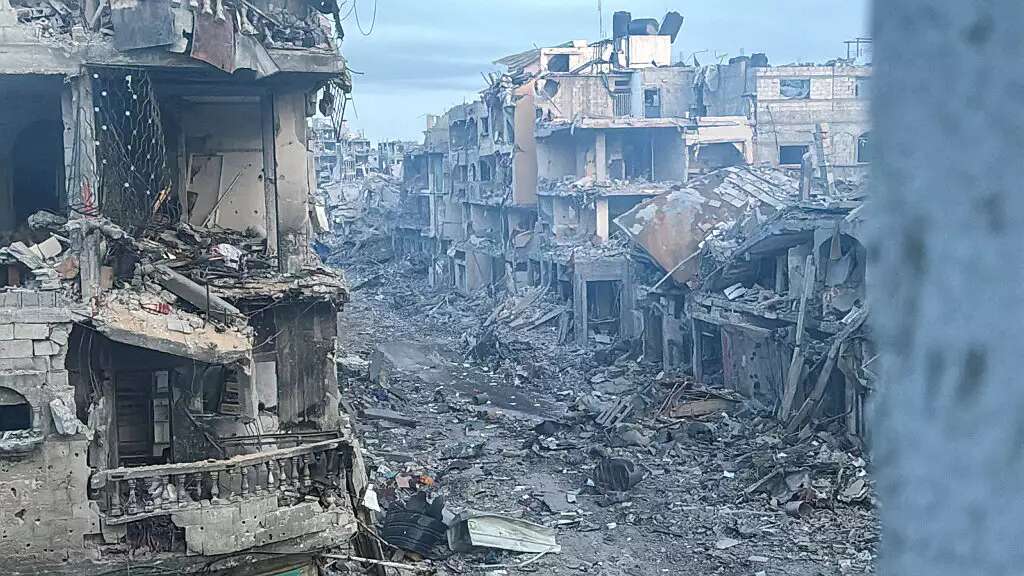
Thursday that there is “almost nothing left” of the Strip and rebuilding
the war-ravaged enclave could take 10 to 15 years.
“People are moving north to get back to their homes and see what
happened and turn around and leave… There is no water and no
electricity. It is stunning just how much damage occurred there,”
Witkoff told the US news website after visiting Gaza.
Witkoff also told Axios he has not discussed with Trump the idea of moving Palestinians from Gaza.
Displaced Palestinians return to Rafah, Gaza Strip, Jan. 20, 2025
A UN damage assessment released this month showed that clearing over
50 million tons of rubble left in the aftermath of Israel’s campaign
could take 21 years and cost up to $1.2 billion.
The debris is believed to be contaminated with asbestos, with some
refugee camps struck during the war known to have been built with the
material.
The rubble also likely contains human remains. The Hamas-run Gaza
health ministry estimates that 10,000 bodies are missing under the
debris.
The images emerging from the
devastated Gaza Strip do not depict Hamas as a collapsed, crushed, or
dismantled organization, let alone a destroyed one. The victory images
we had hoped to see will have to be found elsewhere.
Hamas
and Islamic Jihad gunmen in Khan Yunis, where released Israeli hostages
were ushered through a mob of howling and hostile Gazans.
The initial phase of the hostage release framework is underway after fifteen months of war, relentless IDF firepower, and a sustained military campaign in the Gaza Strip.
For months, senior IDF officials and government leaders have assured
the public that Hamas had been dismantled as a military force, that it
had lost most of its capabilities, and that its grip on local public
opinion was waning.
Over the past few months, Israel applied significant pressure on Gaza
by closing the Rafah border crossing, asserting control over the
Philadelphi Corridor, and slicing the Strip in half along the Netzarim
Axis while preventing residents from returning to northern Gaza.
However, two of these pressure levers were removed this week.
IDF forces operating in Beit Lahia, Gaza Strip.
The hostage release deal is necessary. If anything, it should have
been implemented earlier. Yet, in the past two weeks, as Israel refrains
from making decisions regarding "the day after" Hamas in Gaza, the
reality on the ground shows a terrorist organization that remains the
Strip's sole ruler. Hamas is exploiting each hostage release phase to
stage a theatrical display of governance and reinforce its control. Its
ability to organize and maintain outward symbols - uniforms, equipped
vehicles, staged photography, flags, police presence, and more -
alongside military displays of armed fighters and vehicles, is far from
what one would expect from a group that has been crushed and stripped of
its capabilities.
How, after all the IDF's bombardments and military pressure, when
Gaza is completely isolated from the outside world, is Hamas still able
to mobilize forces and equipment in such an organized manner, both in
scale and in condition, within days? This is difficult to comprehend,
and it demands an explanation from IDF commanders, something we have yet
to hear. This is an organization that was supposedly stripped of its
command structure and assets, yet it still manages to project strength.
The victory image we sought in this war against Hamas in Gaza appears
elusive. Hamas remains standing, and as time passes and the hostage
release process continues, its grip and control over the Strip only
tighten.
Hamas has not been defeated despite the destruction of Gaza.
Hamas, which has proven to be a tough negotiator in the hostage
release talks, has adeptly leveraged the situation to its advantage. Its
insistence on a phased release plan spread over 42 days, combined with
the removal of Israeli pressure levers, such as reopening the Rafah
crossing and lifting the territorial division at the Netzarim Axis, was
likely a strategic move aimed at reasserting its control. By
facilitating the return of hundreds of thousands of Gazans to northern
Gaza without basic living conditions, Hamas is effectively using them as
human shields, making it far more difficult for the IDF to resume
military operations in the north, or anywhere else in the Strip.
Tens of thousands of Gazans head to northern Gaza.
Israel's attempt to impose conditions on future hostage release
phases is, in essence, an effort to "cut losses." While it is being
framed as a necessary step to remove the physical threat to hostages
from an uncontrolled, frenzied crowd - a justified move - it is also an
attempt to deny Hamas the "victory displays" that serve its internal
propaganda goals, and one day, could be used against Israel as well.
Even when the second phase of the hostage release is completed, and
all captives return home, it will not be a victory image. The release is
a moral obligation and a national necessity, one that stems from one of
the greatest failures in Israel's history. We must not delude
ourselves. It is crucial to remember the cost, the time that has passed,
and those who could have returned alive but never will.
As a nation and a society, we seek moments of optimism, joy,
excitement, and the affirmation of life. But let us not be mistaken,
these emotions will not erase the horrors of October 7, 2023. And to
those who assured us that "we have defeated Hamas" (as Defense Minister
Katz claimed upon taking office) or that "Hamas has been dismantled,
along with its battalions and capabilities" (as the IDF Chief of Staff
declared), I hope the images from Gaza are prompting a reassessment.
They should be asking themselves: Where did we go wrong? More
importantly, where do we go from here? What reality will remain in Gaza
on the day we bring the last hostage home? Hamas' PR displays and
military parades leave much to ponder.
Drones used by Mexican drug cartels often carry explosives such as these seized by the Attorney General of the Republic of Mexico
Cartels have authorized the use of weaponized drone explosives
against border agents and other U.S. law enforcement at the southern
border as violent threats are escalating on social media, with some
promising the use of deadly force against Immigration and Customs Enforcement officers.
U.S. Customs and Border Protection is taking the threats seriously enough to circulate two memos among agents and officers within the agency. Copies of the memos were obtained by NewsNation.
One of the communications references three different social media posts that included threats.
One post encourages people to assassinate ICE police, while a TikTok
video tells immigrants illegally in the U.S. to spit and urinate on ICE
agents’ food and defecate in their vehicles. Another post calls for the
murder of local ICE agents.
A second memo warns that cartels have authorized the use of drone
explosives against CBP personnel and U.S. law enforcement officers.
Border czar Tom Homan told NewsNation this week that leaked information about targeted operations has forced authorities to pivot to keep officers and agents safe.
“We’ve got many target cities, but I’m not going to share them with you because we got to keep our officers safe,” Homan said.
“Matter of fact, Chicago, that operation was leaked, so we had to
reschedule that one. But we need an element of surprise because of
officer safety issues. We don’t want the bad guy to know we’re coming,”
he added.
Agents are reminded to be cognizant of their surroundings and should
be wearing their ballistic armor and utilizing their long firearms.
Maryland Rep. Glenn Ivey, a member of the House Homeland Security
Committee, told NewsNation that weaponized drones have become more
common in warfare, so it’s not surprising cartels may be poised to use
them at the U.S. border.
The answer is two stupid bastards in Chicago. At about 0500 near a
school in the Homan Square neighborhood this garbage collector was out
doing his garbage collector thing when two guys tried to rob him. He
didn't want to be robbed so he pulled out his legally owned and legally
carried gat and started shooting. The encounter left the 28-year old
garbage man unharmed. One of his two assailants is deader than dog
shit, the other is in critical condition with a non-factory hole in his
neck.