Blighted San Francisco Diagnoses Its 'Perilous Trifecta' -- and Bungles the Cure
By Christopher F. Rufo
Real Clear Investigations
April 28, 2021
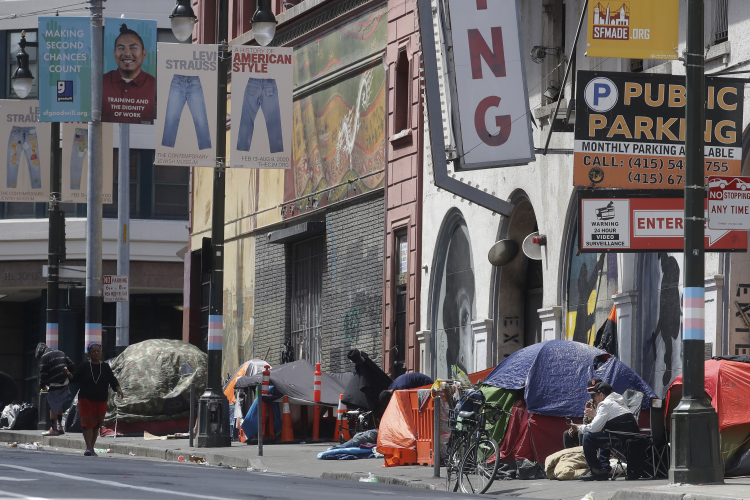
San Francisco is coming undone. In recent years, the city has
manifested a series of visible and persistent inequalities, with a
spoils-to-the-victor world for its technological elite, and a chaotic,
brutalized world for its dispossessed. In the city’s Tenderloin
district, men openly hawk drugs on the street corners, desperate addicts
are crumpled across the sidewalks, and first responders dart through
the chaos to revive overdose victims.
The city has become a web of contradictions. There are thousands of new millionaires, and, by the latest estimates,
18,000 people in and out of homelessness. The headquarters of Uber,
Twitter, and Square are blocks away from the open-air drug markets of
the Tenderloin, Mid-Market, and SoMa. Wealthy families attending an art
opening at the Civic Center have to cross through the tent encampments
that line the sidewalks.
Residents, property owners, and small businesses—who pay an enormous
premium to live and work in San Francisco—have begun to erupt in
frustration. Citizens tell pollsters that homelessness is the city’s most pressing issue and business owners tell pollsters that "conditions on [the] streets have progressively deteriorated.”
City Hall has begun coming to terms with the crisis. Mayor London
Breed recently hired a director of mental health reform, Dr. Anton
Nigusse Bland, who compiled a statistical summary of the problem. People
have long known that San Francisco has a homelessness problem, but
Nigusse Bland discovered a population-within-a-population—the so-called
“perilous trifecta”: 4,000 men and women
who are simultaneously homeless, psychotic, and addicted to alcohol,
meth, or heroin. About 70 % of them have been on the streets for more
than five years; 40% have been on the streets for more than 13 years.
This is the city’s fundamental predicament. How do you help people in
the grips of the perilous trifecta? What interventions could make
progress? Where do social workers even start? It’s almost impossible to
understate the depths of this challenge.
San Francisco’s current policy toward the perilous trifecta can be
best described as compassionate neglect. Every year, the chronically
homeless cycle through the institutions of the socialized state, from
hospitals, jails, and shelters, to sobering centers, case management
appointments, and 72-hour psychiatric holds. Local government provides
enough to meet an outward standard of compassion, but not enough to
alter the trajectories of the homeless. The result is a disaster, which
has drawn criticism across the political spectrum. Progressives are
demanding more funding for existing programs, while moderates are
bewildered by the eternal recurrence of tents, needles, and feces in
their neighborhoods.
The current policy regime can be divided into three domains -- the
hospital, the jail, and the subsidized apartment. Together, these
institutions represent the new orthodoxy of the modern urban approach:
Homelessness is reduced to a set of social-scientific variables, to be
manipulated through the intensive application of the medical and social
sciences.
As part of its medical system, San Francisco currently spends more
than $255 million per year on mental health and substance abuse
programs, many of which cater to the city’s homeless. In a recent audit
of the behavioral health system, the city’s budget and legislative
analyst found that 70% of all psychiatric emergency visits involved a
homeless individual and that 66% of all visitors had co-occurring mental
health and substance abuse disorders. In total, the top 5% of
“super-users,” totaling 2,239 adults, the majority of whom fall into the
perilous trifecta, accounted for 52% of total systemwide service use.
Doctors at San Francisco General see the same set of patients so
frequently that they have developed an entire vocabulary to describe the population that circles in and out of their doors.
The jail system is next. According to the San Francisco County Jail, the homeless account for 40%
of all inmates -- despite being less than 1% of the city’s overall
population, and even after San Francisco decriminalized many
quality-of-life crimes associated with homelessness. Again, the perilous
trifecta looms large. Inmates with co-occurring mental health and
substance abuse disorders are more likely
to be homeless and more likely to be charged with a violent crime
compared to the general jail population. The pithy observation about
deinstitutionalization is largely true: The people who might have once
lived in the state mental hospital have simply been transferred to the
county jail.
Finally, the public-housing complex is the new great hope, and
fastest-growing public expenditure, for the homeless. Like many
major West Coast cities, San Francisco has
gone all in on “Housing First,” the theory that the municipal government
must provide free housing for the homeless in perpetuity, with no
expectations of sobriety, work, or participation in rehabilitation
programs. For a city with a recurring homeless population of 18,000, this is an enormous expense. In 2019, San Francisco spent $285 million on shelters and “permanent supportive housing,” plus $65
million on traditional public housing, vouchers, and SRO units. At the
same time, voters passed an additional $600 million bond to build
“affordable housing.” But still, 67% of the Bay Area’s homeless are unsheltered.
Even as they tout “evidence-based interventions,” “data-driven
solutions,” and “best practices,” leaders in San Francisco have
recognized the failure of the current system and proposed an ambitious
reform agenda. However, in broad terms, this agenda only deepens its
dependency on the social-scientific model and doubles-down on its worst
assumptions. It can be summarized this way: deinstitutionalization,
destigmatization, and decriminalization.
In 2019, Mayor Breed and Supervisors Matt Haney and Hillary Ronen
championed legislation for sweeping “mental health reform.” The plan
would increase total spending on mental health and substance abuse to
$500 million per year, and prioritize the homeless, create a central
service center, and pressure private insurers to cover more costs. When
it passed unanimously through the Board of Supervisors, Ronen
celebrated it as a progressive milestone: “We just created the first universal mental health and substance use system in the country.”
But this universality is only a theoretical formulation. The
legislation does not include a funding source and, more important,
simply expands the existing behavioral health system rather than
reforming it. For the perilous trifecta, the problem is often not access
to services, but participation in services. According to the latest
one-night count,
only 17% of the homeless reported using mental health services and only
11% reported using substance abuse services. For the unsheltered
population, these figures are almost certainly lower.
The problem is that members of the perilous trifecta are the least
likely to seek services. According to the Treatment Advocacy Center,
approximately half the patients with
schizophrenia and bipolar disorder suffer from anosognosia, which is
the inability to understand their own disorder, often leading to a
refusal to enter treatment and take medication. Adding a serious
addiction to methamphetamine, which can cause paranoia, psychosis,
hallucinations, and violent behavior, only compounds the problem.
In the past, the solution to this paradox was compulsion. The state
took custody of the “gravely disabled” and treated them in long-term
residential institutions. However, with the exposure of civil rights
abuses and the release of Ken Kesey’s 1962 novel, “One Flew Over the
Cuckoo’s Nest,” the United States gradually dismantled its mental health
system, reducing the number of mental health beds per capita by an astonishing 95% between 1955 and 2016. Today, California has fewer beds per capita than the national average, with San Francisco having only 219 adult psychiatric beds available at a given time -- drastically insufficient for the number of people in need.
Although Mayor Breed has tentatively moved towards a return to
short-term “conservatorships,” a form of involuntary commitment for
individuals who present a grave danger to themselves or others, the plan
has neither the scope nor the force to significantly reduce the numbers
of the perilous trifecta. Because of pressure from disability activists
and the ACLU, which have called conservatorships
“the greatest deprivation of civil liberties aside from the death
penalty,” the plan is limited to individuals who have had eight or more
involuntary psychiatric holds in the past year, which, in practice,
would mean less than 100 people citywide.
Mayor Breed did not return a request for comment.
 San Francisco's uber-liberal DA
Many progressive socialists argue that there is too much force in the
system, not too little. San Francisco’s district attorney, Chesa
Boudin, took office in January 2020 pledging to substantially reduce the county jail population, end cash bail, and decriminalize quality-of-life
crimes associated with homelessness, including public camping, drug
consumption, prostitution, and public urination. Boudin contends that
the criminal justice system in San Francisco is a domain of persistent
inequalities – locking up a disproportionate number of poor and minority
residents – and has become the dumping ground for the addicted and
mentally ill. Rather than continue this system, Boudin argues, the city must “implement
a comprehensive transformation of the criminal justice system to
decriminalize and treat mental illness, housing instability, and
substance use as public health issues rather than criminal justice
issues.”
Boudin’s formulation does align with a single-day snapshot of
the San Francisco County Jail population from 2016, which found that
48% of inmates were African American, 70% self-reported substance abuse,
and 10% were deemed to have a serious mental illness. However, the
narrative that the city is somehow targeting non-violent drug offenders
and “criminalizing homeless” is specious. The snapshot also shows that
68% of inmates were arrested for violence, weapons possession, and
serious felonies. Contrary to progressive rhetoric, only 4% were
arrested for drug crimes -- a vanishingly small number of people for a
city in the midst of a heroin and methamphetamine epidemic.
 Authorities have enabled massive open-air drug markets in neighborhoods like the Tenderloin
The hard reality is that the perilous trifecta has fueled a boom in
property crime and public disorder. In 2019, at least 1,120 individuals
in the trifecta spent time in the county jail. Although the homicide
rate remained static during Boudin’s first year office, burglaries have soared in a city that already had one of the highest property crime rates in the nation, while authorities enabled massive open-air drug markets in neighborhoods like the Tenderloin, which is a central hub for the homeless population.
The nexus between homelessness, addiction, and crime is clear: According to city and federal data, virtually all of
the unsheltered homeless are unemployed, while at the same time, those
with serious addictions spend an average of $1,256 to $1,834 a month on
methamphetamine and heroin. With no legitimate source of income, many
addicts support their habit through a “hustle,” which can include fraud,
prostitution, car break-ins, burglaries of residences and business, and
other forms of theft.
Boudin’s plan to decriminalize such property offenses – the mirror
opposite of the low-tolerance “broken windows” approach adopted in the
late 1980s as crime rates began historic declines – has contributed to
the sense that he is not holding criminals accountable. In 2019, the
city had an
incredible 25,667 “smash-and-grabs,” as thieves sought valuables and
other property from cars to sell on the black market. The following
year, rather than attempt to prevent or even disincentivize this crime,
Boudin has proposed a $1.5 million fund to pay for auto glass repair, arguing
that it “will help put money into San Francisco jobs and San Francisco
businesses.” In literal terms, Boudin is subsidizing broken windows,
under the notion that it can be transformed into a job-creation program.
Boudin did not return a request for comment.
Some San Franciscans are pushing back. Earlier this year, a group of residents and business owners launched a recall effort targeting Boudin, arguing that his policies have enabled crime and not done enough to protect victims.
The final plank of San Francisco’s policy platform is “destigmatization.” Public health experts in the city have gradually abandoned recovery
and sobriety as the ideal outcome, preferring the limited goal of “harm
reduction.” In a recent task force report on methamphetamine, the San
Francisco Public Health Department noted that meth users “are likely to
experience high levels of stigma and rejection in their personal and
social lives,” which are “often reinforced by language and media
portrayals depicting individuals who use alongside images of immorality,
having chaotic lives, and perpetual use.”
On the surface, this is a strange contention. If San Francisco’s
perilous trifecta is any guide, methamphetamine use is heavily
correlated with chaotic lives, perpetual drug abuse, crimes against
others, and various transgressions against traditional morality. The
harm reductionists’ argument, however, rests on the belief that
addiction is an involuntary brain disease, akin to Alzheimer’s or
dementia. In this view, addiction is better seen as a disability, and
any stigma associated with it is therefore an act of ignorance and
cruelty. According to the Department of Public Health, the goal of harm
reduction policy is to reduce this unjustified stigma and focus public
policy on “non-abstinence-based residential treatment programs,”
“supervised injection services,” “trauma-informed sobering site[s],” and
“training for staff on how to engage marginalized or vulnerable
communities in ways that do not perpetuate trauma or stigma.”
In practice, the task force recommendations would create an entire
infrastructure to service addiction, rather than to reduce it. Although
proponents of harm reduction claim the mantle of compassion, it’s a
fatalistic theory. It assumes that most people cannot recover from
serious addiction and, therefore, the social obligation is to provide
the space and resources for addicts to pursue their own ends, which, for 40% of the perilous trifecta population, means 13 or more years in and out of homelessness. Activists have suggested that addicts
can “reduce harms” by “[using] indoors instead of on the street,”
“reducing how much [they are] using,” “transitioning from injecting to
smoking,” and “continuing to use one type of drug but quitting another
drug.” But in the face of the pathological overload of the perilous
trifecta, these recommendations are negligently naïve, relegating a
large portion of the homeless to a lifetime of chaos, sickness, and
despair.
In the long term, the real danger of destigmatization is that it
would lead to the normalization of serious addiction and its
consequences. In San Francisco, progressives have attempted to normalize
the worst aspects of street homelessness, minimizing the drug use,
toxic waste, psychotic episodes, and related crimes; they have blurred
the lines between sickness and health, madness and sanity. Moreover,
without a trace of irony, they have weaponized destigmatization itself,
stigmatizing anyone who opposes the breakdown of public order as
“fascists” and “homeless haters.”
The implicit wager of San Francisco’s policy is that the
social-scientific apparatus can rescue people faster than the perilous
trifecta expands its ranks. But the evidence suggests the opposite: that
San Francisco has become a magnet for the troubled homeless.
Methamphetamine deaths are up nearly 400% over the past five years; fentanyl overdoses doubled between 2019 and 2020. Meanwhile,
the socialized state has reached a point of near exhaustion. First
responders, police officers, and emergency room nurses are burning out.
Psychiatrists at San Francisco General Hospital despair about the
mass migration of out-of-state residents in search of the “San
Francisco Special”: “housing, a psychiatrist, case manager, primary care
provider, and transfer of Medicaid or general assistance.”
The political class has insisted on greater control over the
corporations, developers, and landlords, while deregulating life at the
bottom. The result has been a deepening inequality, and an even more
anarchic world for the poor. There is an entire
social media community of mostly anonymous accounts who document the
squalor of the encampments and psychotic episodes in the streets; they
are the last resistance to the normalization of the perilous trifecta,
and maintain their anonymity, it seems, out of fear of retribution. It’s
a dark reality, but perhaps a warning of what’s to come.
In the end, San Francisco finds itself fighting a monster. “Homelessness isn’t just a problem; it’s a symptom,” says its
mayor. “The symptom of unaffordable housing, of income inequality, of
institutional racism, of addiction, untreated illness, and decades of
disinvestment. These are the problems. And if we’re going to fight
homelessness, we’ve got to fight them all.” But this is part of the
reason homelessness has become so intractable -- —the political class
has haunted its own world with abstractions; it has projected its own
ideological premises onto the brutal reality of the streets.









 Cop-hating professor and Braden Ellis