Follow the blood money trail: How billions of dollars for Hamas paved way for Oct 7 massacre
Sixteen years have elapsed since
Hamas took control by force of all the government branches and
institutions in the Gaza Strip, and either expelled the Fatah operatives
or literally threw them off the rooftops. With the support of
international aid organizations, and also to a large extent with the
indirect support of Israel, Hamas developed into a governmental
terrorist organization.
Israel Hayom
Nov 1, 2023
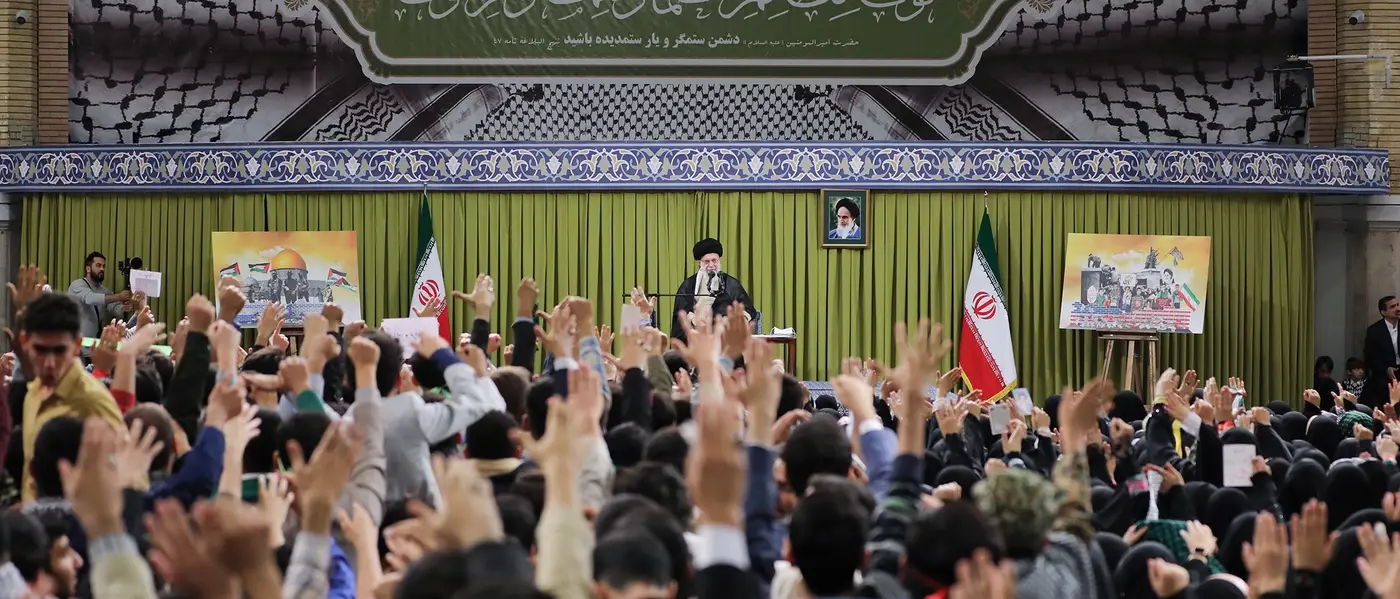
Students attend a meeting with Iranian Supreme Leader Ali Khamenei in Tehran on November 1, 2023
Various governments in Israel, the Coordinator of Government Activities
in the Territories, the IDF, and Israel's Security Agency, better known
as Shin Bet, saw the blood money trail but were blinded by the
conception that Hamas is now an established governmental entity, and as
such it has much to lose, and so despite the accumulation of its
military capabilities and power – it will avoid the use of them for any
murderous purposes. Economic analysts of terrorist organizations with
whom we have spoken in recent days have all expressed their deep
frustration and anger at this. For years they have been looking at the
numbers, and the funding channels, and providing warnings regarding the
capital being used to fund Hamas' militarization. The figures are here
for you all to see. In this case, seeing is not believing, but rather
"disbelieving".
The overall annual budget available to the Hamas regime in the Gaza
Strip amounts to $2-2.5 billion per annum. This is the figure estimated
by Yitzhak Gal, an established expert in Middle East economic issues as a
whole and the Palestinian economy in particular, who has engaged in
comprehensive consulting work regarding the funding of the Hamas regime.
This is an enormous amount compared with the size of the economy in the
Gaza Strip. It constitutes 65-70 percent of the Gaza Strip's GDP (Gross
Domestic Product = the overall size of the economy). For the sake of
comparison, Gal states, the PA's (Palestinian Authority) budget for
Judea and Samaria is slightly over $3 billion, constituting a mere 20
percent of the GDP of that area. And for the sake of further comparison –
in Israel, the budget currently accounts for about 25% of the GDP.
Following the massacre in the Gaza border communities, in a document
published only a week ago by the US Department of the Treasury, the
current estimated value of Hamas' assets is put at hundreds of millions
of dollars.
Dr. Udi Levi, a senior analyst at the Jerusalem Institute for Strategy
and Security (JISS), an expert in economic warfare and the person who
headed the Counter Terrorism and Proliferation Finance Bureau (which was
closed down in 2016), explains: "In the Gaza Strip a portion of falafel
costs NIS 5-7, the unemployment rate is at 50% – and so it was clear
that the colossal budget run by Hamas was diverted for the purpose of
paying workers who built the tunnels, for the procurement of weapons,
for training and employing its fighters – and certainly not for the
benefit of the civilians there. We saw all the trucks bringing in metals
to the Gaza Strip over the years, and all this just to buy a little
peace and quiet. I was the one who screamed out against this conception
of allowing the money to flow into the Gaza Strip, I claimed that Hamas
should have been undermined by facilitating its economic collapse – but
none of this worked. But it is still not too late. Even now, by adopting
a series of measures that will not harm even one soldier, the Israeli
government can economically choke Hamas and Hezbollah, but it needs to
take immediate action."
In 2007, Hamas rose to power in the Gaza Strip, and since then it has
gained permanent support from the majority of the residents there. Over
the course of time, it established the bank, recruited officials, and
became a Palestinian government, second to that of the PA in Judea &
Samaria. "Hamas succeeded in building an enormous budget for itself, by
maneuvering both the PA and Israel into enabling the constant flow of
large budgets from legitimate external sources, covering all the
government's civilian expenditure in the Gaza Strip, while considerable
amounts were diverted from these funds to finance the Hamas military
systems (mainly military personnel and dual-use products).
"In parallel, they developed indigenous sources of revenue, under their
exclusive control, available to fully serve the needs of military
buildup and to maintain Hamas' overall governmental apparatus in the
Gaza Strip, which amounts to several thousand senior managers."
According to Dr. Levi, this basic structure of a "double budget" has
existed in the Gaza Strip for 15 years now.
Gal, Levi, and a former senior governmental official describe the key
money channels through which funds were pumped into the Gaza Strip for a
decade and a half. The first one – the Palestinian Authority budget:
The second one – external economic aid, which in the past came from the
international community and in recent years has mainly relied on Qatar.
The third one – the Hamas Charity Coalition, an entire setup of
donations that generates millions and which is mainly based in Turkey.
The fourth one – the local collection of taxes by Hamas, and the fifth
one – the Iranian funding provided to counter Israel, which covers the
entire areas of Judea and Samaria as well as the Gaza Strip.
And in greater detail: this is how the financial
setup of a murderous terrorist organization was established, one with a
turnover of hundreds of millions of dollars a year right in front of
Israel and the entire world.
1. The Palestinian Authority budget:
NIS 6.6 billion per annum for Hamas
The Palestinian Authority budget amounts to NIS 20 billion per annum,
65% of which comes from Israel – tax and customs payments. The PA is
supposed to transfer one third of its total budget for use by the Hamas
government in the Gaza Strip, to pay for the governmental institutions,
the hospitals, and the municipal authorities there. The transfer of
funds from the PA budget to Gaza is carried out in an orderly manner via
the Palestinian banking system, which is controlled by the Bank of
Israel. Furthermore, the Palestinian banks are subject to constant
concern that they might be transgressing the international regulations
on counter-terrorism financing and may then be blacklisted by the US and
other authorities, so that the transfer of funds to Gaza is carried out
under special arrangements and with the special "seal of approval"
issued by Israel.
In addition to the direct transfer of funds to Gaza, several hundred
million dollars a year from the Palestinian budget are transferred
directly by the PA to Israel, as payment for electricity, water, medical
services, etc., that are provided by the state to Gaza. Since Hamas
threw out the Fatah from governmental positions in Gaza, the PA has for
years been offsetting the budget for the Hamas officials – as they,
inter alia, are members of the Hamas Military Wing.
"The PA is caught up in a trap here," says Gal. "On the one hand, the
residents of Gaza are part of the Palestinian people, so it is difficult
for the PA not to fund their educational and health needs. On the other
hand, the PA has a huge budget deficit from the payments it makes to
Gaza. 100% of the deficit originates from the Gaza Strip, which is a
veritable 'black hole'. The PA pours money into Gaza, but it does not
receive the taxes paid there, as Hamas takes them."
The Government of Israel, which saw this crisis blow up in its face in
2018, then willingly organized what came to be popularly known as the
Qatari "money suitcases" (more of that later on), which were intended to
cover the funds that the PA had offset on its own initiative. "At a
certain point in time, Mahmoud Abbas decided to cut some of the
budgetary funds he used to give to the public sector in the Gaza Strip –
teachers, policemen, and doctors," testifies an individual who was an
important figure involved in real-time decision making on this issue in
Israel. "He wanted Israel to clash with Hamas, so that they would have
no money, and then they would begin violent protests along the border
fence, leading to a confrontation.
"When the demonstrations began along the Gaza
border fence, proposals were made, and one of the options was that the
money that Mahmoud Abbas had cut off, would be paid by Qatar. In order
to prevent these funds being put to use by the Hamas Military Wing, it
was decided that the money would be entered via the purchase of fuel
used for generating electricity, money for the public sector officials
that Mahmoud Abbas had financed, and via direct aid support for people
on the lists checked by Hamas."
2. The Qatari money:
$30 million per month for Hamas; tens of millions of dollars per year in donations
The monthly payment to Hamas in the Gaza Strip,
which began in 2018 during the fourth government of Prime Minister
Benjamin Netanyahu, was intended to compensate for the funds that ceased
to be paid by the Palestinian Authority. The overall sum amounts to $30
million per month, but while this is the most talked about channel of
funds transfers between Qatar and Hamas, which was also granted a
"kosher certificate" or seal of approval by Israel – according to Levi,
there are two additional channels via which the smallest yet richest
Arab emirate funds terror around the world, including in Israel too,
completely unhindered.
On the second track, according to Levi, Qatar transfers financial
support directly to the Hamas leadership that resides there. These funds
involve a tremendous amount of money, which buys status and power and
also funds the Hamas terrorism in Turkey, Lebanon, and of course Israel.
And the third channel – the Qataris, those who currently purport to be
honest brokers in the ongoing deals to release the Israeli hostages,
transfer money directly to fund terrorism via the Hamas charity
associations (the Daʿwah).
Dr. Levi's research study provides a detailed presentation of the Qatari
funding routes, among others, as emerged in the lawsuit of Israeli
victims of terrorism that was filed between 2014-2016 against Qatar
Charity, the Qatar National Bank (QNB) and the Masraf Al Rayan Bank, for
their involvement in providing support and funding the terrorist
attacks, and eventually exploited their banking ties within the US to
supply US dollars to Hamas and the PIJ (Palestinian Islamic Jihad).
Qatar used its charity associations to route illegal funding to
terrorist organizations via the US banking system.
After it was transferred via banks located in New York, the money was
apparently sent to the Qatari charity accounts at the Bank of Palestine
and the Islamic Bank in Ramallah, and from there it was distributed to
Hamas and the PIJ. According to the lawsuit, between March and September
2015 at least $28 million were sent by the Qatari charity organization
to the two banks in Ramallah.
An additional channel for Qatari "investment" in Hamas is the funding of
the terrorist organization's senior figures. During the deal for the
release of Gilad Shalit, the IDF soldier abducted by Hamas in 2006, 40
terrorists defined as a key threat to Israel's security were released
from prison and exiled. The Qatar government assumed responsibility for
15 of them, promising them housing and a monthly income. Needless to
say, that from their release to this very day, they have not made any
effort to look for a "new line of work" and remain deeply engaged in
terrorist activity. Qatar even opened bank accounts for these terrorists
in the Qatari QNB bank. Among those for whom bank accounts were opened
were Musa Dudin and Hussam Badran, Hamas terrorists with blood on their
hands, as well as Ahlam A'aref Ahmed Tamimi, who appeared on the FBI's
most wanted list.
"The
March of Folly is here," says Gal, referring to the two main channels
of Hamas funding – the PA and Qatar. "Both Israel and the PA gave the
organization, most generously, all the requisite tools to maintain its
government. So, yes, it does build the odd school here and there, it
does everybody a favor and allows the international community to build a
wastewater treatment plant, these are the sort of things that it does
between the wars. And, after all is said and done, it has genuinely
succeeded in maneuvering everybody into working for it: The PA maintains
the main systems, and Europe and the international community provided
money for the ongoing maintenance of Gaza – until they were replaced by
the Qataris.
"The main contribution of these sources for Hamas' military buildup lies
in the fact that they free Hamas from the need to worry about funding
the civilian system and the basic services for the local population.
This enables Hamas to divert all its independent funding, from its own
tax collection, Iranian support, and so on, to finance its military
establishment and to arm its units. We can estimate the overall scope of
these 'free' budgets, used for Hamas military needs, as amounting to a
sum of almost one billion dollars per year."
3. The Hamas Charity Coalition (Daʿwah) and investment network
500 million dollars per annum
"The Hamas investment network is deployed across the entire Arab
world, a large portion originates in Turkey, and it generates a turnover
of half a billion dollars per annum," says Levi. Turkey essentially
serves as a key focal point for fundraising to finance Hamas terrorist
activity via the "Charity Coalition" on the one hand, and via
investments in various companies such as real estate, investment funds,
etc. While the Abraham Accords in practice led to a relatively rapid
reduction of the Hamas economic activity in those countries, it was
Turkey – a country that hosts a considerable number of the Hamas
leadership – that realized the potential of such investments.
From US Department of the Treasury data, which is currently imposing
sanctions on the funding channels of this murderous terrorist
organization, it emerges that one of the ways of transferring the aid
money to the Gaza Strip is via virtual currency wallets. One of the
wallet addresses seized in 2021 by Israel belongs to the Buy Cash Money
and Money Transfer company, which supplies money transfer services along
with virtual currency exchange, including that of Bitcoin. In 2017, a
Buy Cash account was registered by somebody involved in procurement
activity for ISIS. A similar domain also serves the financial activity
in the Gaza Strip, using virtual currencies and the transfer of goods.
Uzi Shaya, the former Shin Bet and Mossad senior official who was
heavily involved in financial operations describes how Hamas in Saudi
Arabia established a highly diversified and complex network of dozens of
commercial companies owned by its own people. "The network dealt with
investments while everything was managed by a company in Saudi Arabia
called Anda. In the last two-three years, in parallel to the growing
proximity between Israel and Saudi Arabia, the Saudis threw them out of
the kingdom and so the Hamas financial nerve center moved to Turkey,
managed by Saleh al-Arouri's deputy." The companies, according to
Shaya's data, rake in between half a billion and 700 million dollars,
which have succeeded in building the organization's economic might
outside the Gaza Strip too. In addition, most of the Hamas senior
figures' accounts are also located in banks in Qatar, the UAE, and
Turkey, and Israel is aware of some 90 such bank accounts. According to
Shaya, "The world regards Gaza as being wretched and beaten, while Hamas
makes millions without any interference."
In 2009 Hamas established an accepted financial organization for its own
purposes – the Palestine Islamic Bank. The Americans wasted no time in
including it in their sanctions lists but did not really do anything of
substance to curtail its abilities. According to the bank's financial
statements, some 100 million dollars pass through it a year. The bank is
currently among the rubble in the Gaza Strip following IAF activity
there, but its accounts are still active. The main method of funneling
the financial support for Hamas into the Gaza Strip is via a global
network of money changers. A similar system exists also in Judea and
Samaria, providing financial support for the terrorist networks there
too.
According to Levi, Israel is aware of and monitors those money changers,
but does not actually take any practical steps against them. And he
should know. Until 2016, he headed the Counter Terrorism and
Proliferation Finance Bureau, which was established by the former Mossad
chief, Meir Dagan, back in 2001. Surprisingly, the unit was closed down
in 2016, and the strategic efforts to contend with terror funding
shifted to pinpoint activities on the tactical level alone.
"In practice, there is only a limited number of people dealing with
terror financing, and this is an issue that is currently defined as one
of the lowest priorities. At the time, then prime ministers, Ariel
Sharon and Ehud Olmert defined this activity as an extremely high
priority, and after them, the efforts to deal with terror financing were
simply abandoned." He mentions the NBCTF (National Bureau for Counter
Terror Financing) that was set up in the Ministry of Defense, but one
that was generally regardless as being ineffectual – over recent years
only a handful of actions pertaining to specific cases have been
reported, alongside Israel's Security Agency, the Shin Bet. At this very
moment, and as an immediate lesson learned from the October 7 massacre,
a new body is being established in the IDF's elite 8200 intelligence
unit, to deal exclusively with monitoring the funding of the Hamas
murderous terrorist organization.
4. Tax collection:
300 million dollars per annum
Under the guise of a legitimate government, Hamas
has oppressed the residents of the Gaza Strip who vote for it en masse
year after year. Thus, in practice, all goods entering the Gaza Strip
pay a double tax to Hamas. Workers, who recently have been entering
Israel in their thousands, alongside the active role they played in the
October 7 massacre, simply set the Hamas economy in motion, as from each
pay packet entering the Gaza Strip and paid by the Israelis, a
considerable sum was deducted that was then transferred to the terrorist
organization's diverse setup. "Hamas collects more than 300 million
years a year in taxes – from money changers, workers, and from the
trucks bringing in the goods," says Levi.
Over the last two years, the number of workers entering Israel from the
Gaza Strip has grown at an alarming pace, at the recommendation of the
professionals both in the IDF and COGAT (the Coordinator of Government
Activities in the Territories). This trend became extremely prominent
during the government under Prime Minister Naftali Bennett, who even
took credit for this at the time. A former diplomatic official
estimates: "The sizable revenues from tax come from Israel. A
Palestinian worker might earn NIS 7,000 a month, which on occasion is
the equivalent of seven local pay packets in the Gaza Strip, and an
extortionately high rate of taxes is deducted from this, and we have no
way of controlling this or seeing where the funds are diverted."
According to him, even if that worker would return with sugar and flour,
Hamas would deduct something from that too. The entry of workers, which
was supposed to contribute to the rehabilitation of the Gaza Strip by
Israel, in practice led to Hamas being able to maintain its military
force, as when the Gaza Strip is working in its entirety – all the money
entering into it becomes poisonous.
Gal assesses: "Taxation contributes 20 percent of the Hamas budget and
fully finances the military units and the organization's efforts to arm
itself." He adds: "The Hamas independent and illegitimate tax collection
and customs system on the imports into Gaza from Israel and Egypt, is
carried out with Israel turning a blind eye. Israel was well aware of
this tax collection system and allowed it to take place. Had Israel
wanted to, it could easily have inflicted serious damage on these
systems too. Hamas levy taxes from goods entering the Gaza Strip from
Israel using methods akin to those of highwaymen. Even though the VAT
has already been paid to the PA, once a truck crosses the border into
Gaza, the Hamas customs officer stops it and charges an additional fee.
The same is true in Rafah. Fuel that is brought into Gaza from Egypt and
which is subject to high taxation from the Egyptians is taxed once
again by Hamas."
5. The Iranian funding:
250 million dollars per annum
If you have succeeded in reading this far without
holding your head in your hands in pure desperation, then here is
another fact to add to the downpour of funds used to finance the October
7 massacre in the Gaza belt communities, the preparations for it and
the current ground war in the Gaza Strip. Iran is not just engaged in
the development of its nuclear capabilities over there. For many months
now, the heads of the defense establishment in Israel have been warning
that Iran is sending to Judea and Samaria, as well as to Gaza, funds and
arms to launch a war against Israel via our local enemies. Until now,
the military-security leadership was totally focused on what was going
on in Judea & Samaria, based on their assessment that it was there
that the Iranian money would set in motion terrorist attacks against the
Israeli population more rapidly and with greater lethality.
According to Levi, based on research he conducted,
the Iranian money used to finance terrorism in our region generates a
sum of 250 million dollars per year around the world. In plain sight of
the Americans and the Europeans. According to him, "There are no
sanctions and no effort at all" against the money used to finance
terrorism, and so Iran, Hezbollah, and the Syrians have taken over the
market for counterfeit medicines and fake drugs, which rakes in 30
billion dollars per year. And the world? "Is turning a blind eye." Levi
mentions the drugs found on the bodies of the Hamas terrorists found in
the Gaza belt communities and says: "These are precisely the drugs with
which they are poisoning the world."
According to Shaya, "In recent years, the Iranians have become Hamas'
key bankroller. The money has succeeded in reaching its destination via
the extensive network of money changers: some of whom are located in the
Gaza Strip (about ten individuals known to the IDF), working with a
money changer network in Turkey and in Lebanon." So, how does it all
work? The Iranian money arrives in Lebanon – the money changers operate
using the traditional hawala method (money changes hands via a
third party: if I owe you money and am unable to transfer it, they then
take it from another individual, and the money is paid back to him from
the money changer - SAC), it is transferred to Turkey and from there to
Gaza. This is how millions of Iranian dollars were transferred.
Shaya found unequivocal proof of Iran's involvement in financing Hamas'
military activity in cyber activity during 2018. He explains that in a
cyber operation to penetrate the Al-Qard Al-Hassan financial association
in Lebanon, 400 thousand accounts of Hezbollah terrorists were exposed.
"This is a financial association that has been banned by the Americans
but it still continues to work unhindered," says Shaya cynically. Here
too, financial transfers of millions of dollars were uncovered destined
to provide aid to the intifada and the Palestinians.
According to Gal, "There is considerable difficulty in estimating the
scope of the Iranian aid, some of which is military equipment that is
smuggled into Gaza, and the larger part of which is funds transferred
via money changers. There are clearly numerous breaches in these
systems, but the international supervision of them is constantly being
tightened. It is difficult to believe that they succeed in transferring
more than several hundred million dollars per year via these roundabout
ways, but we should still not underestimate the importance of this, as
all of this money is directly invested in terrorism, though the overall
share of this element in the grand scheme of financing the Hamas regime
is only secondary." According to a serving political source, Israel
estimates that 93% of Hamas' military funding comes from Iran alone.
What can we do now?
As we have outlined, the funding routes are known to Shin Bet, the
Mossad, and the IDF, and all the experts with whom we spoke recommend
taking immediate action to undermine the organization's economic
infrastructure and ensure its collapse. They stress, and this is a
crucially important point, that while military activity will be able to
do away with Hamas' power, the organization's financial reserves and its
senior figures who reside abroad will in the future be able to
rehabilitate this ISIS-like terrorist organization within a relatively
short time frame. Only a strategic war on Hamas' economy will prevent it
from being rebuilt and posing a threat to Israel's citizens again. In
the hope that some of our senior officials have a peek at this article –
here are a number of recommended courses of action.
According to Levi, it is imperative to wage "All-out war on the money
changers. To carry out extensive arrests of the money changers operating
in the service of Hamas in Judea & Samaria, and to treat them as
terrorists for all intents and purposes. And in the Gaza Strip – even
during the process of rebuilding the damage – not to allow the growth of
a new bank."
Gal
also recommends stopping the PA funds from pouring into the Gaza Strip,
and as far as Qatar is concerned – both Levi and Gal strongly recommend
sidelining this small, terror-financing emirate, and showing it the
'red card'. If a foreign financier is required in the Gaza Strip once
hostilities have died down, Levi recommends bringing in the Saudis to
assume this role, while Gal recommends restoring the Palestinian
Authority to the Gaza Strip. "As long as the administration in Gaza is
not subordinated to the PA in Ramallah, then Israel should ensure that
no budgets are transferred and should also prevent the entry of imports
apart from essential products," says Gal. As far as the effort to deal
with the digital currencies is concerned, Levi recommends "Working with
the Americans, and adopting significant sanctions against those digital
exchanges, which to date have completely ignored Israel's declarations
against terrorism."
To put all of this in a nutshell Shaya says emphatically: "In order to
eliminate Hamas and its ideology, it is imperative to eradicate the Da'wah
and their civilian institutions. So far, this has not been achieved and
it is here that we have failed as a state. The eradication of Hamas as
an organization absolutely must include targeting its economic
infrastructure."