Erdogan emerges as Israel's next strategic threat
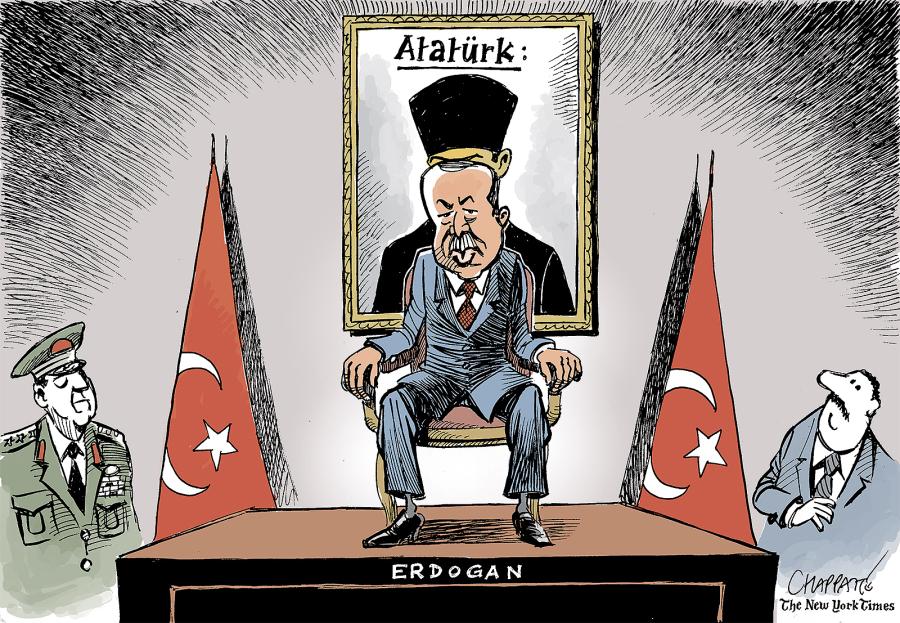
Whether it falls or not, the Iranian threat as Israel knews it is no more, but that certainly does not mean we can beat our swords into plowshares. There is growing assessment that Erdogan will seek to take Khamenei's place and build a Muslim Brotherhood proxy army around Israel.
Amit Segal
Israel Hayom
Jan 22, 2026
The Sunni threat
Should we start with the good news or the bad? As clouds of war once again gather over Tehran, senior officials in the region assessed this week the Iranian regime's chances of survival as "very high." If there is no genuine military intervention, said the officials, crossing their legs and leaning back, Khamenei could make it to January 20, 2029, the inauguration date of the 48th president of the United States, still ruling the Islamic Republic. It is extremely difficult to topple a regime that is prepared to kill even three hundred thousand of its own people if necessary, they explained.
Even if the regime were to fall, there is no reason to hope for a secular, liberal Iran. In their assessment, the regime that would arise would be a Persian version of Pakistan: a centralized, Muslim, hostile, and far-from-democratic system; the product of a "palace coup" within the Revolutionary Guards rather than a popular uprising from below, whose activists were mown down en masse in the streets. That is why there is not much enthusiasm in the region for an American attack—if, in their view, nothing good is going to come of it anyway.
And now for the good news: even if the regime does not fall, they believe the Iranian threat as we knew it no longer exists. The era in which Iran could calmly and without interference cultivate a formidable proxy army across the Middle East while inching step by step toward a nuclear bomb is over. They are "who they were," and it is preferable to focus on eliminating the Houthis and the remnants of Hezbollah, the last remaining arms. The Middle East has already internalized the "day after" Iran; entirely different things now preoccupy it.
At the top of the list: Turkey. Within ten years, perhaps even less, the Sunni, terror-supporting regime in Ankara will try to take control of the Middle East. It too will have proxies, and it too will try to encircle Israel and make its life miserable. Senior officials in the region are not particularly troubled by Turkey's and Qatar's integration into Gaza's "executive council," which they see as largely symbolic. Qatar as well, in their view, is undergoing a slow process of turning in the right direction after years of a stormy romance with terror and incitement. But what will happen if Jordan—already a state with a Palestinian majority—falls into Turkey's sphere of influence? What if Egypt falls? Or Lebanon? Attention must also be paid to the worrying processes underway in Syria and its effective transformation into Erdogan's murderous client state. It is not yet too late to act, before the Muslim Brotherhood and their patron wash over the region.
Saudi Arabia's reversal
Speaking of changes, here is the updated assessment now being heard in important capitals in the region: normalization with Saudi Arabia is dead, at least for the foreseeable future. The strategic decision to pursue reconciliation with Israel has been replaced by a wild incitement campaign, whose depth and damage are questionable in terms of awareness. When Qatar's "plastic empire" attacks Israel via Al Jazeera, it is very harmful—but when the preacher in Mecca poisons the entire Sunni world against Israelis, that is something else entirely.
Over the past month, Al Arabiya has been worse than Al Jazeera in the texts broadcast against any normalization with Israel. Saudi podcasters who specialize in luxury cars or sports are suddenly cursing Zionism and the Abraham Accords. The broader context is the Saudi-Emirati military confrontation in Yemen—an attack that should greatly worry Israel and the United States, and that delights the Houthis, who watch their enemies fight one another.
Why is this happening? Strangely, Israel has fallen victim to its historic success in severely damaging Iran's nuclear project and its proxy network. In 2015, the Saudi king sent Netanyahu a note congratulating him on his speech to Congress against the nuclear deal. That is where the seeds of cooperation with the moderate Sunni states were sown, culminating in the Abraham Accords. When concern over Iran reached its peak and interest in the Palestinian issue reached a low point, the de facto ruler, Mohammed bin Salman, embarked on a campaign to prepare hearts for peace with Israel. The date was late September 2023.
October 7 changed everything: it both reignited Arab interest in the Palestinian issue and led to an Israel–Iran war on seven fronts. Saudi Arabia received, for free, the goods it wanted in Tehran, and the price it demanded on the Palestinian issue rose sharply. Contrary to the impression created, Netanyahu and Dermer were not particularly eager to pay any price to the Saudis either. "If not, then not—no force," Netanyahu said in one cabinet meeting.
Now, with the Saudis no longer celebrating the Abraham Accords, they are trying to undermine their foundations of support, from Morocco to the Emirates. Someone I spoke with this week used an Arab proverb to explain it: "He who cannot reach the grapes says they are sour." I suggested an Israeli version, straight from air-defense battle lore: "If I don't fly, nobody flies."
Donald Trump has a move or two available in Riyadh. Israel and its friends in the region should ask him to use his influence to halt the toxic campaign against his main international legacy and make clear that an attack on the accords is an attack on him.
The betting site Polymarket is not particularly impressed by most of the polls published in Israel. When the line opened on the identity of the prime minister after the 2026 elections, Bennett led—but within days the trend reversed. For two months now Netanyahu has been confidently in front. This week he widened the gap: a 54% chance of being prime minister. Bennett stands at 19% (a significant drop from last week), followed, in order, by Eisenkot, Lapid, and Golan, all in single digits. Of course, it should be remembered that the Netanyahu option also includes the possibility that he remains in office, but as head of a caretaker government. Still, this is completely different from the impression created by the polls over the past two years.
What is going on here? Is it the bitter experience of Hapoel fans, accustomed to losses and unable to accept a lead in any league? Or is it the dynamic that should worry the opposition: Netanyahu versus the opposition, and the opposition versus itself?
Gadi Eisenkot's move this week—to propose a united list with Bennett and Lapid—was intended to end the destructive descent into internal battles. In the right-wing bloc it is clear who leads and what the structure is. A giant list, with Lieberman on its right and Golan on its left, would end the leadership brawls in one stroke and neutralize the "prisoner's dilemma," in which each player acts rationally for himself and the shared goal is gravely harmed.
Bennett has long warned that an alliance with Lapid would severely damage his chances of drawing votes from the right, but Eisenkot's camp believes that in any case the almost only person capable of doing that is Lieberman. They think a party with two prime ministers and a chief of staff should allay the fears of undecided voters.
One more thing can be learned from the episode: Gadi Eisenkot has not abandoned his intention to lead the bloc. If Bennett refuses the proposal to choose the prime ministerial candidate only close to the elections, will that pave Eisenkot's way to say, "I tried, they didn't want to, I'm running alone"? Or perhaps to run with Yair Lapid, who is willing to discuss vacating the top spot under certain conditions? The chances of the unification Bennett wants so badly, with Eisenkot, declined this week. Bennett wanted straight and right; Eisenkot wants to meet in the center.
Can more than a hundred percent of blame be measured for a disaster? If not, any effort to explain complexity will look like an attempt to extract the responsible party. You talked about the failures of the army and the Shin Bet before October 7? You are trying to absolve Netanyahu of responsibility, and vice versa. As in Gaza, so on the roads. You talked about ultra-Orthodox roadblockers? You absolved the driver who ran people over. You blamed the driver? You ignored the violence of the blockage.
There is enough blame to go around, and it is worth starting at the beginning. Blocking roads is a thuggish and violent act, not an effective protest without disruption to public order (and if it is, then it's time to block the road leading to the Attorney General's home every morning; we'll see how long it takes for the directive to change). The State Attorney's guidelines from August 2020 state that inciting those present to block roads can be considered an aggravating circumstance justifying prosecution; so can organizing such a demonstration. Gali Baharav-Miara and her predecessor Amit Isman made a conscious decision in 2023 to exempt the organizers of mass road blockages from any responsibility, in order to protect themselves and their counterparts in the legal system. It was a "green light" to normalize violence and a prelude to making Israelis' lives miserable.
To the credit of the Kaplan protesters, both on the enforcing and the non-enforcing side, a similar disgrace also characterized the disabled protests. And to the discredit of the extreme ultra-Orthodox who blocked roads en masse, it should be said that they did so even before the paralysis of Ayalon became fashionable. But once the illegal disregard by law enforcement for its own guidelines was normalized, the train left the station (and was then blocked by protesters).
If there is no price at all for blocking a road, how is this phenomenon supposed to end? What is a driver supposed to do when a protester stops in front of his car? The answer is certainly not to run him over. But the protester and the blocker also bear responsibility and blame for the tragic outcomes. Not all the responsibility and not all the blame, of course, but a decisive contribution: without a blockage, there would have been no running over. It is worth remembering this, not only on Romema Street, but also the next time Kaplan protesters are shocked by a driver who struck them on the road. There is a price for lawlessness. If the justice system does not collect it, it may, tragically, be collected by passersby.


No comments:
Post a Comment