Why replacing the United Nations is not a scandal, but a necessity
Since the 1960s, it has functioned first as an instrument of Soviet domination, then as a factory of anti-Americanism, and ultimately as a systematic de-legitimizer of Israel.
JNS
Jan 23, 2026
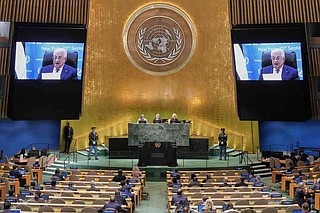
Is it really so shocking that the new organization for Gaza appears to be an attempt—however imperfect—to replace the United Nations? Are we so emotionally attached to the U.N.’s greenish corridors that we forget what they have represented for decades?
Since the 1960s, those corridors have served as the backstage of Third-Worldist ideology, later repackaged as “woke,” a comfortable home for overt and covert supporters of the world’s worst dictatorships. Dozens upon dozens of commissions were created to legitimize a moral inversion in which Iran could sit for 24 years on the Human Rights Commission—chairing it in 2001—and preside over the U.N. Human Rights Council’s Social Forum as recently as 2023, while a U.N.-appointed rapporteur decides whether the Palestinians are “right” and Israel perpetually wrong.
Is it truly a tragedy that Donald Trump is trying to retire a billion-dollar organization funded largely by American taxpayers, after realizing that, since the 1960s, it has functioned first as an instrument of Soviet domination, then as a factory of anti-Americanism, and ultimately as a systematic de-legitimizer of Israel?
It is far from clear whether the so-called Board of Peace assembled in Davos—some 60 countries, an executive council and a technocratic commission—will succeed in anything meaningful under Trump’s heavy hand. Its task is Herculean: to rebuild Gaza while mediating constant quarrels, holding together democracies and autocracies, resolute Christians and militant Islamists. One cannot even be sure that the Palestinian technocratic committee will remain technocratic, rather than sliding—as history suggests—toward a jihadist derailment.
Turkey and Qatar seated alongside Israel; Pakistan and Hungary at the same table. Strange? Perhaps. But still less surreal than the United Nations. At least here the rules are explicit: attacking the United States and Israel is not permitted, nor is demonizing Europe—at least not the Europe that has not fully surrendered to Macron-style anti-Americanism.
The real test, however, is linguistic and moral. Will anti-imperialism finally lose its status as the U.N.’s universally authorized vocabulary? Will we stop passing resolutions like the infamous 1975 declaration that “Zionism is racism,” the poisonous seed from which much of contemporary antisemitism has grown?
Since Nikita Khrushchev’s arrival in New York in 1960, the U.N. steadily abandoned the democratic values for which it was founded. They were replaced by an ideology of anti-colonial hatred disguised as pacifism. During the Vietnam War, the U.N. became a motor of global anti-American movements. The Non-Aligned Movement consolidated into a bloc that still flirts with Russia and China, while the Arab narrative became institutional orthodoxy. Terrorism was rebranded as “national liberation.”
Israel, meanwhile, became the U.N.’s permanent defendant. The post–Six-Day War resolution on “disputed territories” was transformed into an accusation of systematic violations of international law. UNRWA became the only refugee agency in the world whose mission is to perpetuate refugee status indefinitely—while its employees participate directly in terrorism.
After Oct. 7, the U.N. could not bring itself to issue a clear and immediate condemnation of Hamas. Instead, it unleashed investigative mechanisms against Israel—the victim—rather than against the terrorists. This moral collapse explains why the United States has withdrawn from 31 U.N.-affiliated bodies, why Trump walked away from the Human Rights Council, UNRWA, UNHCR, UNESCO—which absurdly declared Jerusalem an exclusively Islamic heritage site—and other agencies devoted less to peace than to defamation.
Is this radical? Yes. Is it easy? No. Is it necessary? Absolutely.
If the international system is to have any credibility, it must turn the page. What Trump has begun may be messy, incomplete and controversial, but after decades of institutionalized hypocrisy, it is a beginning worth making.


1 comment:
MOVE IT TO GREENLAND
Post a Comment