Slouching Towards Fort Sumter?
By Victor Davis Hanson
American Greatness
Jan 29, 2026
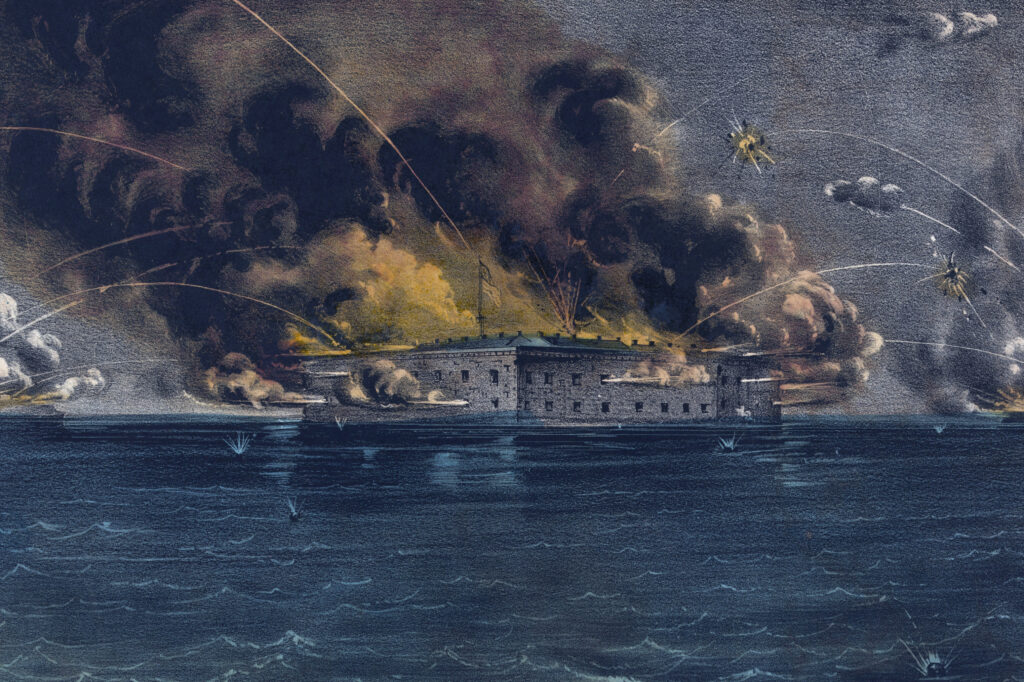
In the months before the April 12, 1861, firing on Fort Sumter, there
were lots of sharp divisions in the North about the proper reaction to
the first seven Confederate states that had already left the Union.
Not all Unionists believed that war was inevitable. Some, in fact,
were happy to be done with the departing South and thus see their stain
of slavery gone from the Union. Similarly, others agreed that the
emerging Confederacy was not worth the trouble and costs of war, and the
secessionists could just form their own nation and stew in their own
backward, servile juice.
But after Fort Sumter, Lincoln—who was hated as much by the
Confederates as Trump is by the woke and socialist left—gained a
consensus that the Constitution had no clauses about any lawful
departure from the union. But it did operate under a clear supremacy
clause that made state obstruction of federal law and occupation of
federal property veritable sedition.
Lincoln and the preservationists felt that they easily had the moral
high ground of abolition versus the continuance of slavery. Nor did they
want a North America of fragmenting, warring nations in the manner of
Europe.
Something similar is emerging over Minnesota, the South Carolina of our age.
Once sanctuary states, cities, and counties had established the
precedent that, with impunity, they could nullify federal immigration
law, then what followed was a logical and mounting descent into the
current open defiance of the federal government. How odd that
self-described progressives are now acting out the visions of prior
kindred nullificationists and neo-Confederates from John C. Calhoun to
George Wallace.
The reaction of the rest of the nation, especially its conservative
half, to Minnesota resembles the 1861 disconnect in the North over the
insurrectionary states.
Some believe that if Minnesota wants to protect its approximately
1,300 jailed illegal alien murderers, rapists, and assorted felons, so
be it, and ICE should leave such a dysfunctional and dystopian state to
its own self-destructive path.
In this way of “See ya, wouldn’t wanna be ya” thinking, Trump should
stick to the red and purple states, clear them of criminal aliens with
the help of local enforcement, but without the organized performance-art
leftist resistance. Then he could contrast the nation with the
difference between low crime, noncontroversial deportations, versus the
blue-state model of protecting illegal alien criminals and their
indifference to the mayhem they inflict on the innocent.
If Minnesota further wants to be a state like 1861 South Carolina
that openly defies the federal government, then also so be it. But it
should accordingly not expect federal funding for its pick-and-choose
approach to federal law and property.
Has Minnesota forgotten that, like blue-state America, it cheered on
Barack Obama’s DOJ when it successfully sued Arizona in 2010, insisting
that it was Obama’s right as a federal custodian not to enforce federal
immigration law at the border—and thus not legal for Governor Jan Brewer
to use her state resources to enforce a federal law that derelict
federal officers would not?
But on the other hand, contemporary Unionists objected that such live
and let suffer is defeatist. Moreover, there are millions of Americans
inside insurrectionary Minnesota who do not support their
neo-Confederate leaders. Millions in Minnesota properly see themselves
as Americans first and Minnesotans second.
In this line of argument, just as Lincoln refused to give up federal
armories, property, and offices inside the South—most notably Fort
Sumter in Charleston Harbor—to insurrectionists, so too the Trump
administration has an obligation to protect federal property and offices
in Minnesota and to enforce federal law throughout the nation, at least
if it is to continue as a nation.
Very soon, Trump will have to decide which strategy is preferable and politically viable before the midterms.
Meanwhile, Minnesota’s highest elected officials have ordered local
and state police not to protect federal immigration officers from the
very street violence that they fuel. Indeed. Governor Walz, Mayor Frey,
and Attorney General Ellison are actively encouraging Minnesotans to
obstruct federal officers from enforcing federal laws—despite the
mounting violence that follows their collective prompts.
The three know that organized and well-funded groups organize the
protests and incite the violence. And perhaps the trio even welcomes
would-be martyrs to use their vehicles to ram ICE officers or to arrive
at protests armed with military-grade, semi-automatic pistols with
plenty of magazines and ammunition to spare.
Walz and company further quietly accept that they could easily
mitigate the violence by simply turning over roughly 1,300 criminal
illegal aliens in various Minnesota jails to federal authorities. To do
so would lessen the chances of violence, make Minnesota a safer place,
and expedite the rotation of ICE out of Minnesota.
But, of course, Walz, Frey, and Ellison have no such intentions, given their schemes are elsewhere.
Given the failure of an increasingly socialist Democratic Party in
2024 to offer a more popular and convincing agenda than Trump’s, they
believe their future lies in an increasingly redistributionist America,
fueled by unlimited, unaudited immigration from the former Third World.
They view as a political asset millions of arriving poor in dire need of
massive federal health, food, housing, and education subsidies and
entitlements, imbued with DEI victimhood, and nursed on America as toxic
at its birth and ever more pathological ever since.
So for the Minnesota state officials, screaming for ICE “to get the
f**k out of Minnesota” is more than mere braggadocio. It is a reminder
that the Democratic Party wants a safe place for illegal immigration,
the fuel of a future dependent constituency—as the architecture of the
recent massive Somali frauds attests.
They also believe that the more turmoil, the more violence, the more
resistance, and the more a general sense of chaos and unrest swirl
around the Trump administration, the more they can drive down its
popularity before the midterms.
They still cherish the months of riot, violence, and arson in the
George Floyd “summer of love” in 2020 as critical in defeating Donald
Trump.
Now as then, the left believes they can create a lose/lose dilemma
for Trump: send in the National Guard to restore order, and he confirms
that he is a “Nazi” and using the “Gestapo” to quell “peaceful”
protests. Stand down, and the left owns the street, exasperating the
MAGA base that mysteriously Trump has allowed the criminal left to
nullify the enforcement of federal law in near-secessionist fashion.
There are other Democratic agendas, both short- and long-term.
The Minnesota Democrat apparatus either knowingly turned a blind eye
to, protected, or silently partnered with the architects of likely the
largest theft of federal welfare and entitlement monies in U.S.
history—largely by the Somali community, both immigrants and their
second-generation apparatchiks. The Democratic elite counted on the
prophylactic cry of “racist!” to exempt the Somali community from any
legal accountability. And so far, they seem right in that assumption.
And the public?
Polls reveal its trademark ambiguity. A majority voted for Trump to
enforce immigration law, close the border, end illegal immigration, and
deport those who broke federal law. But that hope and the reality of
implementing it are two different things—especially when a state like
Minnesota has not just institutionalized illegal immigration but nearly
canonized foreign nationals illegally residing in the U.S.
To sum up public opinion, the proverbial people want all criminal
illegal aliens deported as soon as possible, and they may even support
the deportations of all 10-12 million illegal aliens who came en masse,
unaudited, and with the de facto blessing of the Biden administration.
But that said, they want the act of deportation of the non-criminal
to be out of sight, out of mind—as if magically they can simply
disappear and thus either self-deport or assemble at ICE stations eager
to be sent at no cost home.
For now, Walz, Frey, and Ellison are upping the rhetoric, fanning the
violence, and talking openly about how best to nullify federal law and
impede federal enforcement. They are convinced that they have galvanized
national opposition to the hated Trump, smothered the Somali fraud
scandal, and stopped ICE deportations of their constituents.
In all of those assumptions, they have little idea they are following
the Confederate script to the letter. And like their spiritual
forefathers of 1861, they grow ever more cocky, boastful, and defiant as
they create martyrs, spread narratives of victimhood, and daily slouch
toward another Fort Sumter.