‘Palestine 36’ is propaganda by subtraction
Absent is a decade-plus of anti-Jewish violence that led up to the Arab Revolt. That is only one of many omissions in this supposedly “historical” story.
By Micha Danzig
JNS
Dec 26, 2025
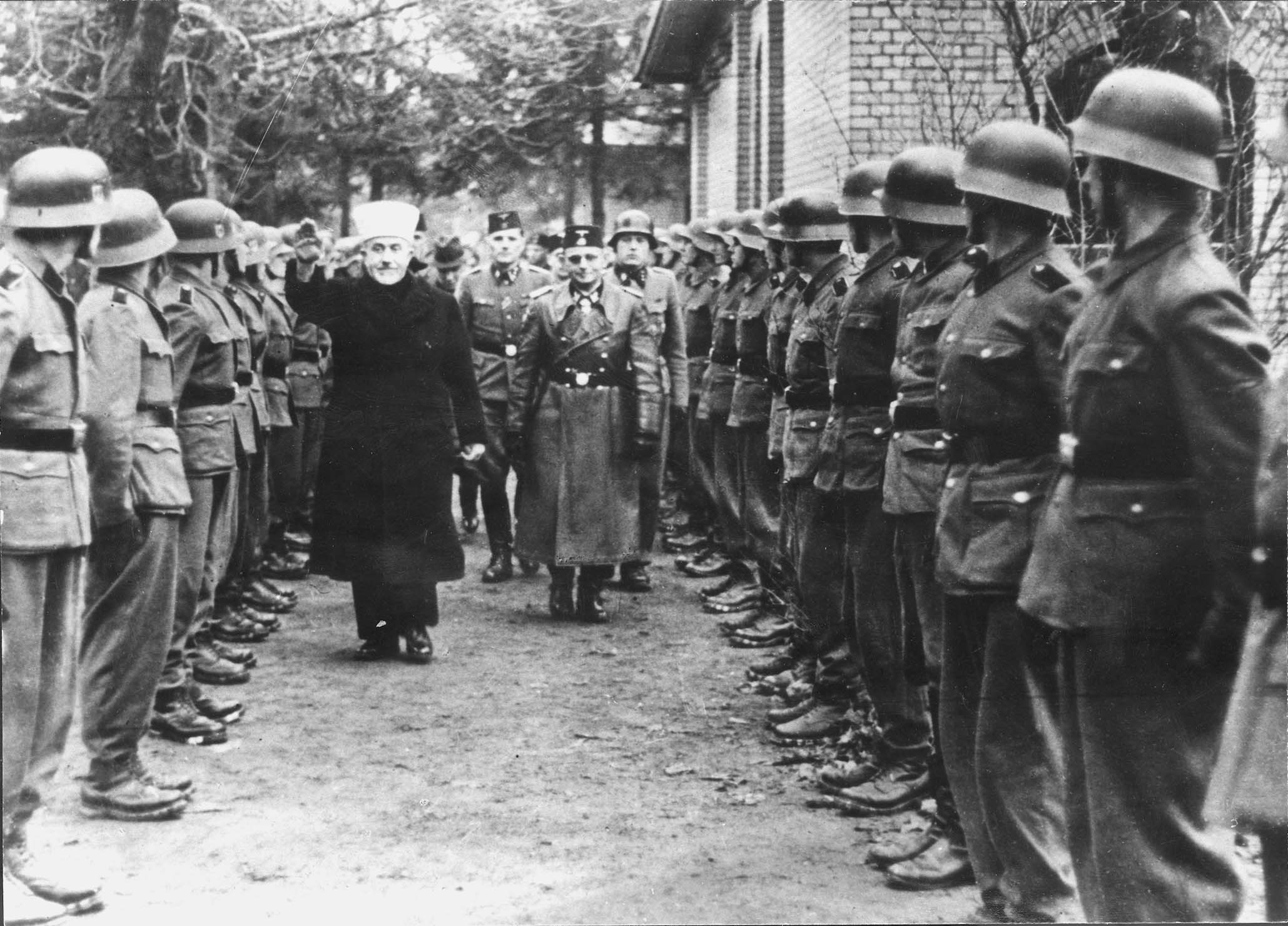
Haj Amin al-Husseini, the Grand Mufti of Jerusalem, reviewing a unit of Muslim Bosnian Waffen SS in November 1943.
The new film “Palestine 36” has been widely promoted as a sweeping cinematic portrayal of the 1936-39 Arab revolt against British rule, an ambitious historical drama that purports to illuminate a formative era in Palestinian Arab history.
Directed and written by acclaimed filmmaker Annemarie Jacir, and backed by producers from Europe and the Middle East, the film enjoys serious cultural momentum. It features renowned actors such as Hiam Abbass, a Palestinian actor and film director, and Palestinian actor Saleh Bakri. It premiered to a standing ovation at the Toronto International Film Festival, and has already been selected as Palestine’s official entry for the Academy Awards.
Palestine has submitted films for Oscar contention since 2003.
As far as “Palestine 36” goes, beneath its prestige veneer lies an omission so central it transforms what might have been compelling historical cinema into a politically sanitized fable. It tells the story of a revolt that had a clear leader, explicit ideological drivers and a long record of pre-revolt violence, yet it erases the single most important Arab figure of the period: Haj Amin al-Husseini, the Grand Mufti of Jerusalem. His absence is not artistic license. It is historical fraud.
The Arab Revolt did not emerge spontaneously. It was fomented, directed, and enforced by al-Husseini, the undisputed political and religious leader of the Palestinian Arabs from the early 1920s through the 1940s. He chaired the Arab Higher Committee, dominated the Supreme Muslim Council, controlled mosques, courts, schools and charitable endowments, crushed Arab rivals, suppressed dissent and dictated Arab political life. He was the Palestinian Arab national movement’s first paramount leader—the unelected David Ben-Gurion of his people.

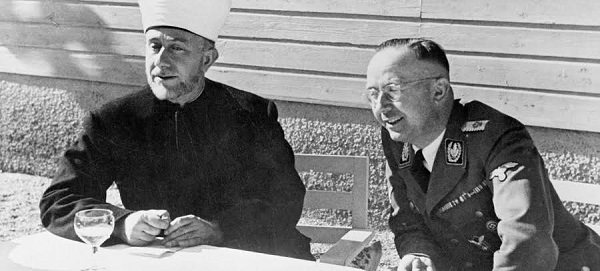
The Grand Mufti of Jerusalem Haj Mohammed Amin al-Hussein was a guest of
SS Chief Heinrich Himmler in 1943.
To omit him from a film about the revolt is like making a movie about the Russian Revolution, which started in 1917, without Vladimir Lenin or about the 1979 Iranian Revolution without Ayatollah Ruhollah Khomeini. It turns history into mythology.
Also absent from this film is the decade-plus of anti-Jewish violence leading up to 1936. From the Jerusalem riots of 1920 to the Hebron and Safed massacres of 1929, hundreds of Jews were murdered or maimed in pogroms across British Mandatory Palestine, long before the founding of Israel. These attacks were not “anti-colonial resistance.” They were targeted assaults on Jewish civilians—many whose families had lived in the Holy Land for centuries—stoked by the Mufti’s rhetoric portraying Jews as villainous religious enemies.
Instead, the film recasts the revolt as a clean anti-colonial uprising in which Jews were mere instruments of British policy and Palestinian Arabs its passive victims. This narrative collapses the moment the full historical record is acknowledged.
And there is another historical truth the film conceals: al-Husseini’s forces did not only target Jews. During the 1936-39 revolt, Arab militias loyal to the Mufti killed more Arabs than Jews—thousands of them. They executed village leaders, moderates, political rivals and anyone who was suspected of cooperating with the British or favoring compromise with the Jews.
The “revolt” became, in large part, a violent purge designed to enforce ideological conformity.
The Mufti’s willingness to execute fellow Arabs for insufficient extremism has a modern echo: Hamas continues to murder Arabs accused of “collaboration,” often on fabricated evidence, to maintain its control. The lineage is ideological and behavioral. It is no coincidence.
There’s a reason why “Palestine 36” avoids al-Husseini: His real record contradicts the film’s narrative. His worldview, which was defined by eliminationist antisemitism fused with religious absolutism, existed long before 1936 and did not end with the Arab Revolt.
During World War II, al-Husseini was a committed Nazi Party collaborator. He lived in a mansion provided by the Third Reich; met repeatedly with Nazi hierarchy; broadcast Arabic-language propaganda for Nazi radio, urging listeners to “kill the Jews wherever you find them”; blocked efforts to rescue Jewish children; and helped recruit Muslim SS divisions responsible for atrocities in the Balkans. Prosecutors at the Nuremberg trials after the end of World War II described him as a collaborator “of the highest order.”
This is not a figure who fits comfortably into a romantic narrative of anti-colonial resistance.
And that erasure is not accidental; it is political. Acknowledging al-Husseini forces recognition of the conflict’s true roots: an Arab nationalism in Mandatory Palestine shaped primarily by Islamist and European bigotry, and ideological rejection of any Jewish sovereignty, not by anti-colonial grievance. The Mufti didn’t oppose the partition of the land because of borders; he opposed granting Jews any civil or national rights whatsoever.
A film that acknowledged these truths would undercut the preferred narrative that the conflict began in 1948 or 1967, or that it is purely an anti-colonial dispute. It would reveal what has always been the case: Jews in Mandatory Palestine were not colonizers. Rather, they were a vulnerable minority facing organized campaigns to eliminate them or keep them permanently powerless and stateless.
Modern Palestinian leadership has never disavowed al-Husseini. His portrait hangs in official offices. Schoolbooks echo his rhetoric. Hamas praises him outright. The hatred ideology that he championed animated the pogroms of the 1920s and 1930s, just as surely as it animated the Hamas-led atrocities in southern Israel on Oct. 7, 2023.
This is why films like “Palestine 36” must erase him. Because restoring him to the story restores the truth—and the truth shatters too many cherished political narratives.
And here lies the film’s deeper deception: “Palestine 36” is not history. It is propaganda by subtraction—a film that invites viewers to mourn the colonized while concealing the internal purges, the anti-Jewish violence, the ideological extremism and the Nazi collaboration that shaped the entire conflict.
The war against Jewish self-determination did not begin with Israel’s declaration in 1948 or with the Arab Revolt of 1936. It began when leaders like al-Husseini chose hatred over coexistence, rejection over compromise and alliance with genocidal tyrants over peace with their Jewish neighbors.


No comments:
Post a Comment