But the speech wasn’t the focus of most of
the commentary. Instead, the headlines were about the airplane for
future use as Air Force One, given to him by the rulers of Qatar. And if
that blatant instance of trying to buy influence wasn’t enough, Doha
also sealed a deal with the Trump real estate company to build a golf resort in the desert emirate.
This understandably raised the hackles of
conservative pro-Israel Trump backers and the usual chorus of Trump
haters in the mainstream corporate media and political opponents.
Whether coming from the right or the left, critiques of his judgment in
accepting this “gift,” coupled with the atrocious timing and dubious
judgment of the real estate deal, were entirely well-founded.
A frenemy in Doha
Qatar’s status as a frenemy of the United
States is well-established. While it hosts an American military base and
often speaks as if it is an American ally, it is also closely aligned
with Iran. More than that, it is a primary funder of Hamas, hosts the
ideological leader of the Muslim Brotherhood, and spends heavily to
spread Islamist and antisemitic ideas in the United States on college
campuses and in mosques. Its influence is exactly what the Trump
administration is seeking to combat in its essential efforts
to force institutions of higher education to stop tolerating and
enabling Jew-hatred and anti-American indoctrination. On top of that, it
also hosts/runs Al Jazeera, the international outlet that is a
primary source of anti-American and anti-Israel propaganda that
operates under the guise of a news channel.
That several administrations of both
parties have continued this toxic relationship with Doha when they
should have all cut off relations with it is bad enough. But for Trump
to be championing it personally—and largely because, knowing his vanity,
the Qataris are flattering and showering him with presents—is
indefensible.
And we didn’t have to wait long to see the fruits of Qatar’s charm offensive.

U.S.
President Donald Trump is greeted by Emir Sheikh Tamim bin Hamad Al Thani at Hamad International Airport in Doha,
Qatar, May 14, 2025.
Reasons for concern
During the course of the week, not only
did the Qataris help broker a deal to gain the release of 21-year-old
Edan Alexander, the last hostage being held by Hamas with American
citizenship. Rumors were also flying around the region and in Washington
that Doha was successfully nudging the United States and its witless
Middle East envoy Steve Witkoff, who is already compromised
by a financial bailout given him by the Qataris, toward both a broader
ceasefire agreement with Hamas and a new nuclear deal with Iran.
A new pact with Hamas—notwithstanding
Trump’s demands that the terror group be eradicated and replaced with
some sort of American-run Gaza—could allow Qatar’s ally to survive and
retain control of the Strip. Negotiations with Iran also seem to be
oriented toward allowing it to retain its nuclear program under the
dubious notion that the oil-rich nation required it for civilian
purposes to produce more energy.
Either prospective agreement would be a disaster for American interests and a deadly threat to Israel’s security.
Even more surprising was the
Qatar-Saudi-supported Trump decision to lift sanctions on the new regime
running Syria, headed by former ISIS terrorist Ahmed al-Sharaa, whom
the president met. The Islamists in Damascus are reportedly also dangling
the possibility of their own real estate bribe to Trump. Given that
there is no reason to trust that al-Sharaa and his jihadist government
will be a stabilizing force or have given up their extremist stands, the
U.S. decision to normalize relations with it was, at best, premature.
Add to that list of troubling decisions
was Trump’s declaration of a ceasefire between the United States and the
Houthis in Yemen, despite the fact that the Iranian-backed terrorists
have shown no other signs of giving up its efforts to interdict
international shipping in the Red Sea or stop firing missiles and drones
at Israel in an effective but harmful effort to aid Hamas.
To make supporters of Israel even more
nervous was the obvious absence of Israel on Trump’s itinerary or much
sign that he was coordinating or consulting with Jerusalem about any of
this.
Does this mean that Trump 2.0 will be as damaging to Israel as his first administration was supportive?
The only honest answer to that question is
that we don’t yet know, though given his priorities and basic approach
to relations with the nations of the region, there is reason to believe
that it could all turn out to the benefit of the interests of the United
States and Israel.
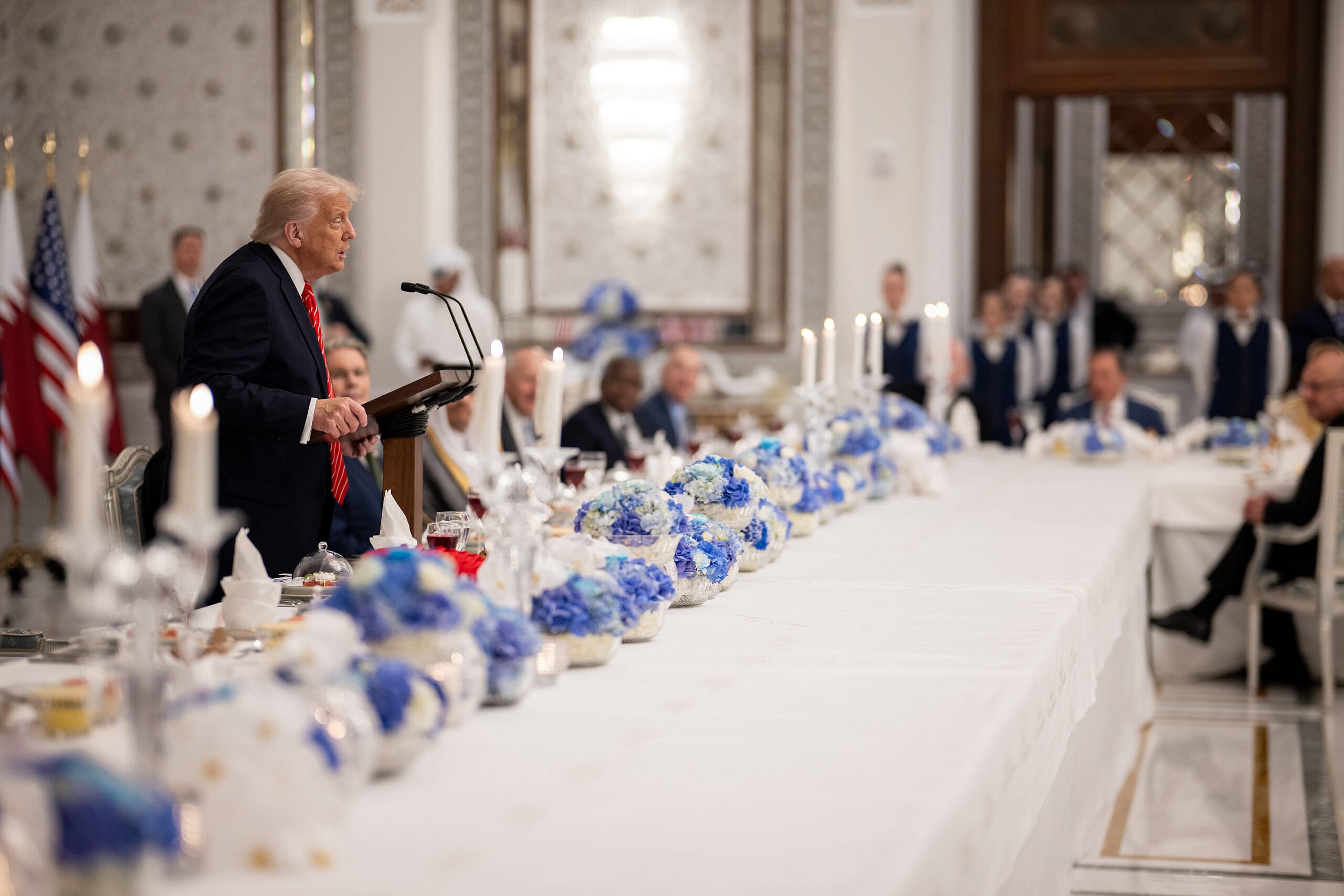
U.S.
President Donald Trump gives remarks during an official State Dinner at
Lusail Palace in Doha, Qatar, May 14, 2025.
A rational policy approach
And that is why Trump’s policy speech
deserves as much scrutiny as his unfortunate current dealings with
Qatar. It should be understood as a fundamental rejection of his
predecessors’ approach to the region, and that (worries about Qatar,
Hamas and Iran, nonetheless) is a good thing.
Trump railed against the “neocons” who ran
foreign policy under the last Bush administration for sinking the
United States in quagmires in Iraq and Afghanistan with the aim of,
among other things, converting those countries into something resembling
Western-style democracies. However well-intentioned that effort was, it
turned out to be a fool’s errand, and the president is right to say so.
Equally wrongheaded was the Obama and
Biden effort to appease Iran, which was not so much the result of bad
bargaining skills but an actual desire for a rapprochement with Tehran.
The goal was to embrace its leaders and essentially have the country
replace Israel and the Saudis as a key American ally. That was not so
much dumb as utter madness.
Obama’s 2015 nuclear deal with Iran
enriched and empowered the Islamist regime, allowing it to engage in
foreign adventures, spread its influence and foment terrorism aimed at
toppling American allies and undermining U.S. interests.
Just as damaging was the way that, despite
the outreach to the brutal Iranian tyranny, Obama and Biden both also
framed their approach to the region in terms that were echoed by
international human-rights groups that sought to undermine both Riyadh
and Jerusalem.
Trump is rightly disdainful of this
approach since it ignores the fact that moderate Arab regimes like the
one in Saudi Arabia are, for all of their faults, far less of a threat
to the interests of the West and their own people than that of the
Iranians and their terrorist proxies. It also wrongly accepted the false
Palestinian narrative about Israel being a brutal “occupier” and
human-rights abuser rather than the only democracy in the region. If
Israel is forced to use its military power against its enemies, it is
because the Palestinians, the Iranians and their allies are still
determined to pursue the destruction of the only Jewish state on the
planet.
In place of both sets of misguided
policies, Trump offers something that sounds less idealistic, but which
is much better-suited to help the people of the region and bolster
American interests.
Trump sees trade and the abandonment of
war as key to a better future. He is prepared to make peace with any
regime that is ready to give up the long Muslim-Arab war on Israel and
engage in commerce with it and the United States. “Peace to Prosperity”
was the title of the Mideast plan that Trump offered the Palestinians in
2020, which they rejected out of hand. The emphasis on economic ties
and putting aside squeamishness about the authoritarian nature of the
Saudi and other Gulf state regimes remains entirely rational and more
likely to accelerate the process by which these nations become less
oppressive. Not to mention the fact that doing so helped break down the
effort on the part of the Palestinians and Iranians to maintain the
isolation of Israel and to keep the destructive war against it going.
Trump’s decision to engage with the new
government in Syria may prove foolish, but if it follows his advice and
normalizes relations with Israel—and becomes another moderate government
seeking engagement with the West—then his move will prove to be wise.
The same is true of his commitment to keep growing closer with the
Saudis and their modernizing leader, Crown Prince Muhammad bin Salman.
The same principles seem to be behind the administration’s testing of the waters with Iran and even its plans for Gaza.
The catch to all of this is that there is
very little apparent reason to believe that Tehran or Damascus can or
will pursue such a rational policy. The same could be said for the
prospects that growing close to Qatar will advance peace or American
interests, even if making nice with Doha may be personally profitable
for the Trump family and Witkoff, a factor that renders anything the
administration does ethically questionable even if the rosiest of
scenarios about their goodwill to the West proved to be true rather than
wishful thinking.
So, how can it all turn out well?
The answer is that because Trump views
foreign policy as a purely transactional business, he isn’t handicapped
by the idealism of Bush or the feckless belief in appeasement and
diplomacy for its own sake of Obama and Biden. He is, whatever one
thinks of him, someone who knows the difference between a good deal and a
bad one. If he is prepared to let bygones be bygones with groups like
the Houthis or the Iranians, it is only if they conform to his ideas of
how they should behave.
It is because Trump believes that American
national interests must be the paramount concern of its government and
diplomats, rather than other agendas that are disconnected from them,
that it’s possible to believe that he will be able to judge his dealings
with Qatar, Iran, Syria and any other country on the results rather
than ideology.
Will that happen? We don’t know.
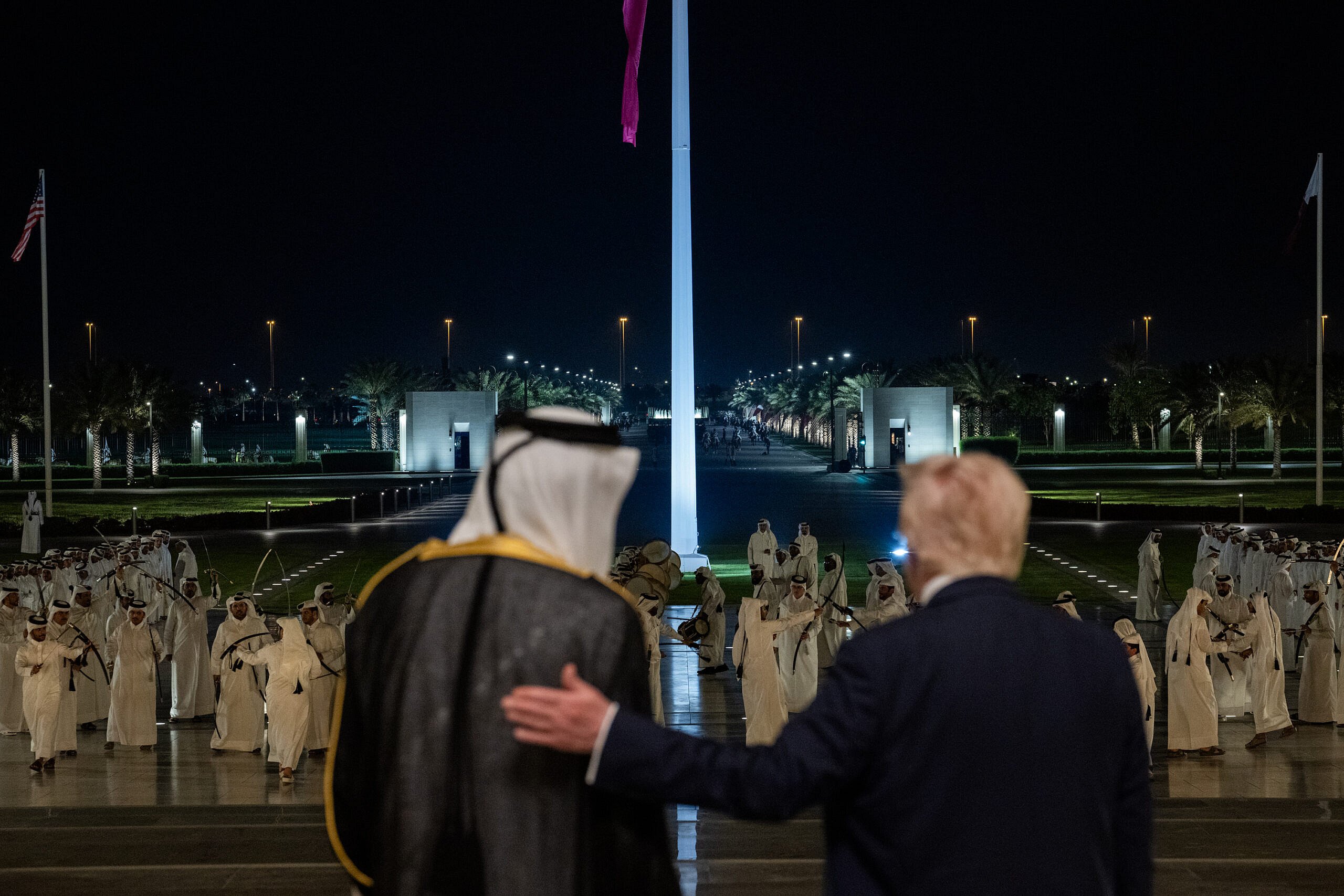
U.S.
President Donald Trump is greeted by Emir of Qatar Sheikh Tamim bin
Hamad Al Thani at Lusail Palace in Doha, Qatar, May 14, 2025.
No one’s sucker
Even if his characteristic embrace of any
leader or country that flatters him is a terrible look and undermines
confidence in his judgment as well as American national interests, this
is also a president who has earned some trust from both Americans and
Israelis.
Whether he coordinates with Jerusalem or
not at every turn, his goals are still laudable. His consistent advocacy
for normalization and the expansion of the Abraham Accords, as well as
his basic positions opposing Iran’s nuclear program or the survival of
Hamas, ought to inspire at least some confidence that he won’t accept a
warmed-over replica of Obama’s dangerous nuclear deal or an equally
catastrophic plan for Gaza that will empower the terrorists. Above all,
it’s hard to imagine him passively accepting a diplomatic outcome in
which Washington will be Tehran’s patsy. Trump is a lot of things, but
he is no one’s sucker.
Faith in his good sense is hard to
maintain while observing these recent escapades. Still, Trump’s decision
to try diplomacy before reverting to force against Iran, added to his
embrace of dubious partners, can be vindicated if he is able to
dispassionately analyze the outcome of these gambits. Those willing to
damn him as a betrayer of Israel or as hopeless a dupe of Iran as Obama
need to avoid jumping to such conclusions in the absence of proof that
the administration is actually abandoning a hard-headed pursuit of
realpolitik national advantage.
Until then, the rational answer to the
question of what the president is doing right now must rest on the
assumption that he will reverse course if his new friends prove
untrustworthy or treacherous, along with an acknowledgement that if he’s
proven right, it will be of inestimable benefit to all.


1 comment:
45-47 is a Peace Maker not a Warmonger.
Post a Comment