When journalism becomes the engine of antisemitism
An attack by a pro-Palestinian mob on an Italian newspaper highlights how Italy’s media have fueled hatred against Jews and Israel.
By Fiamma Nirenstein
JNS
Dec 1, 2025
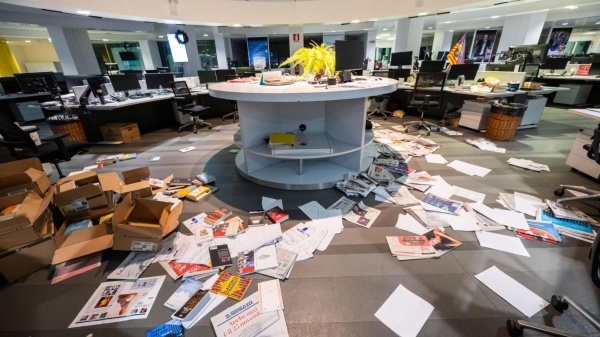
About 100 pro-Palestinian protesters stormed the Turin offices of La Stampa during a journalists’ strike on Nov. 28, vandalizing the newsroom.
The recent assault on the newsroom of La Stampa, the Italian newspaper where I worked for decades and to which I remain deeply attached, was not born in a vacuum. It was the bitter fruit of years of informational distortion that replaced reporting with propaganda on Israel’s war against Hamas.
About 100 pro-Palestinian protesters stormed the Turin offices of La Stampa during a journalists’ strike on Nov. 28, vandalizing the newsroom, spraypainting threats and hurling manure at the entrance.
Thirty-four suspects were later identified by police from surveillance cameras after the masked assailants overturned desks, wrote slogans against journalists, calling for a “free Palestine” and demanding the revocation of an expulsion order for an imam from Turin, Mohamed Shahin.

In response to the attack, United Nations Special Rapporteur Francesca Albanese condemned the violence but also denounced journalists who refuse to repeat her preferred narrative, saying, “This should also be a warning to the press to get back to doing their job.”
In effect, she encouraged intimidation against reporters who do not bow to the daily drumbeat of one-sided coverage that has dominated much of Italy’s media since Oct. 7.
Yet her remarks also offered, in reverse, a painful truth: We must finally confront what message has been chosen, for whom it has been crafted, and how much moral devastation it has produced.
A sick information system has revived antisemitism reminiscent of the 1930s. It has inverted the concept of human rights and manipulated public opinion so thoroughly that Italy has witnessed a wave of anti-Israel, anti-Jewish and openly anti-democratic violence. Italy, so admirable in many ways, now stands exposed on the global stage as a warning.
Italy is uniquely afflicted. It is the only Western country where a national labor union called a general strike for Palestine. It is the only one where leaders of the far-left Rifondazione Comunista accuse the media of supporting “genocide.” Public spaces are now saturated with Hamas flags and chants that recast Zionism as colonialism, erasing its true meaning as the national rebirth of the only indigenous people who never abandoned Jerusalem.
The attack on La Stampa rightly provokes outrage. But outrage alone is not enough.
According to research by demographer Sergio Della Pergola presented at a major antisemitism conference hosted by CNEL and the Unione delle Comunità Ebraiche Italiane, La Stampa emerged as the Italian newspaper most consistently engaged in anti-Israel propaganda between Oct. 7 and Sept. 19, 2025.
Prominent voices such as Vito Mancuso, Anna Foa, Ilan Pappé and Rula Jebreal shaped a steady narrative of demonization. Despite its historic reputation for moderation, La Stampa has portrayed Israel as violent, punitive and malevolent, while Hamas’s savagery faded into the background of a simplified story of victimhood framed as genocide, apartheid and war crimes.
Della Pergola documented how the historical and political context vanished almost entirely. The Oct. 7, 2023, massacre was swiftly detached from Hamas’s declared goal of destroying Israel and from its systematic use of human shields. Headlines such as “Israel blocks even births,” “Israel tightens the noose,” and repeated claims that massacring civilians is a “standard practice” of the Israeli army became routine.
Editor Andrea Malaguti defended his newsroom with fierce conviction, asserting professional integrity. But professionalism cannot survive when truth is sacrificed to ideology. What happened at La Stampa should serve as a warning to every journalist who believes that a single, morally flattened version of reality can sustain itself without consequences.
Even Mahatma Gandhi, whom the editor cited in self-defense, means nothing to vandals driven by hatred. What must concern us is the collapse of knowledge that has turned young people into instruments of violence, hollowed out their understanding of reality, and produced a moral degeneration fed by ignorance.
Journalism must return to its duty of truth. Not to plant Palestinian flags across Europe. Not to indulge fashionable guilt toward the “Third World,” revolutionary romanticism, jihadist apologetics or antisemitic reflexes. These forces now shape not only the attackers in the streets, but—tragically—the readers formed by years of informational distortion.
The lesson of La Stampa is not only about an attack on a newspaper. It is about the corrosion of conscience that made such an attack imaginable.


No comments:
Post a Comment