Top secret war document reveals China would crush the US and 'destroy' the world's largest aircraft carrier
By Nick Allen
Daily Mail
Dec 10, 2025
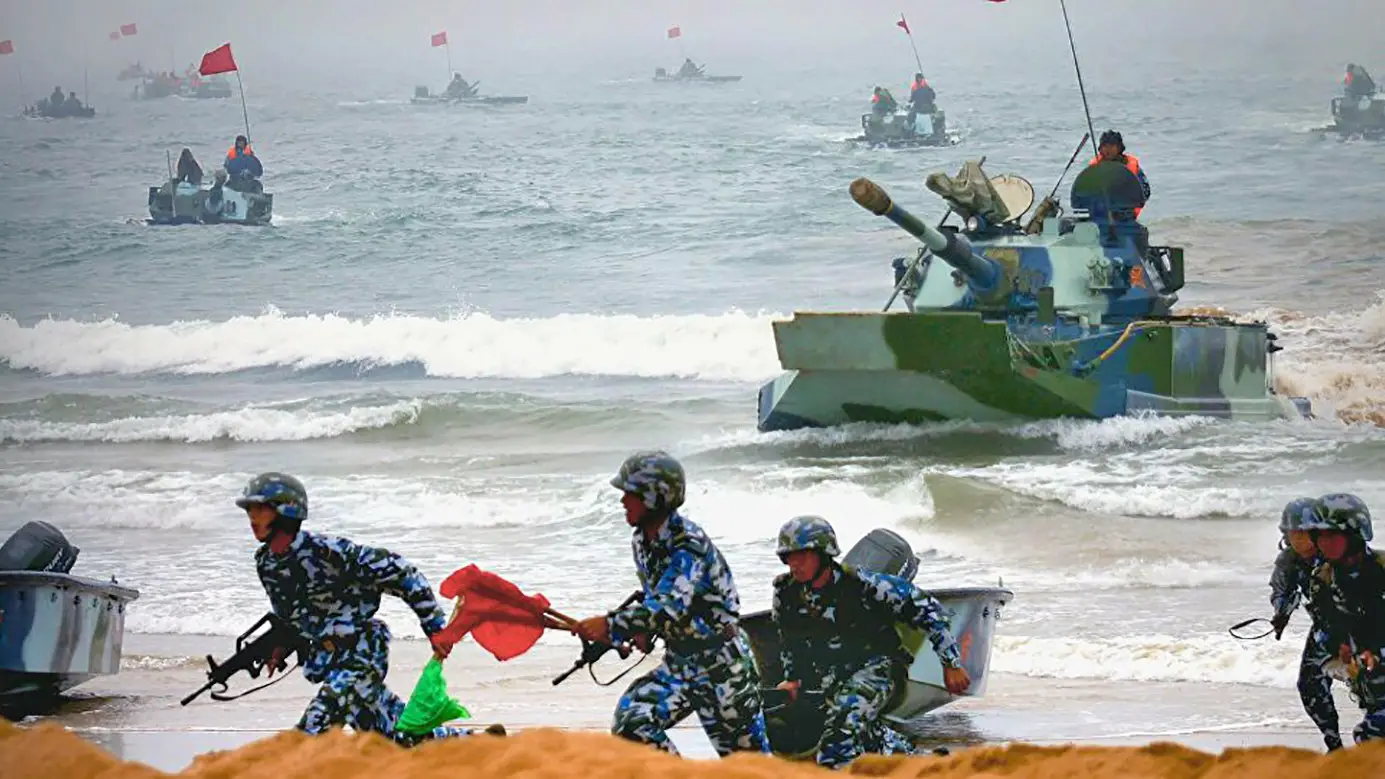
Chinese naval troops and amphibious armor advance ashore during an amphibious exercise designed to prepare its forces for a forthcoming invasion of Taiwan
The United States would suffer a devasting defeat and lose its biggest aircraft carrier if it tried to stop China invading Taiwan, according to a top secret Pentagon report.
War games showed the U.S. would be overwhelmed by China's arsenal of around 600 hypersonic weapons, along with missiles and nuclear submarines.
The grim assessment, revealed by the New York Times, confirmed the conclusions of previous war games, but it also highlighted wider concerns about the future direction of the U.S. military and its continued reliance on outdated methods.
It means Pentagon chiefs are set to face accusations that they are 'generals fighting the last war' and have failed to adapt to rapidly advancing, cheaper, more disposable forms of weapons technology including drones.
The domination of the U.S. military-industrial complex by a small group of behemoth contractors will also be called into question following the report, which was said to have made one White House official 'turn pale' when he saw it.
Ships like the $13 billion USS Gerald R. Ford - the largest aircraft carrier in the world - were often destroyed in scenarios gamed out for a U.S. defense of Taiwan.
Despite that, the Pentagon still has plans to build nine more similar ships.

President Donald Trump and China's President Xi Jinping meeting at the Gimhae Air Base, South Korea on October 30, 2025

The world's largest aircraft carrier USS Gerald R. Ford would be lost in many scenarios in a war over Taiwan, according to Pentagon war games

A map shows how China's People's Liberation Army (PLA) has been conducting drills in the waters around Taiwan
Advocates for a different route forward will argue that some of that funding should be spent on drone and cyber capabilities instead.
The war in Ukraine has shown the fading power of traditional weapons including tanks, they will suggest.
The latest bombshell for the Pentagon comes after President Xi Jinping ordered his generals to be prepared for a possible invasion of Taiwan as early as 2027.
Beijing claims the self-governing democracy is part of China and has not ruled out seizing the island by force.
With the U.S. set to defend Taiwan, China could launch cyber attacks against American power and water networks.

Xi Jinping says Taiwan is part of China and has told his military to be ready to take it in 2027

Taiwanese tanks and armored vehicles fire during a live-ammunition drill on a beach
The Pentagon's secret 'Overmatch' report was recently sent to the White House.
It reportedly gave disturbing details of how China would be able to take out U.S. ships, jets and satellites.
Secretary of War Pete Hegseth has previously said that 'we lose every time' in Pentagon simulations of a Taiwan conflict
Earlier this year, he said China is 'rehearsing for the real deal' and added: 'We are not going to sugarcoat it, the threat China poses is real and it could be imminent.'
China has accused Hegseth of making 'groundless accusations.'
During President Trump's second term so far U.S. military resources have been regularly pulled away from the Indo-Pacific to support military needs in the Middle East and Europe.
During the Biden administration, national security adviser Jake Sullivan, said the US would rapidly run out of artillery shells in a war over Taiwan.
Michael D Swaine, a senior research fellow in the East Asia Program at the Quincy Institute for Responsible Statecraft, said: 'I agree with this call for the United States military to drop many of its legacy weapons and transition to a force that more accurately reflects the kinds of threats and capabilities the country faces.'
But he added: 'The assumption is that the United States needs to maintain its global military dominance, which is entirely unrealistic and prohibitively costly. Does the United States really need hundreds of overseas bases housing tens of thousands of soldiers? And is it in the vital interest of the United States to wage a war with China over Taiwan?'

The USS Gerald R. Ford is the world's largest aircraft carrier

A missile is being launched to strike a low-altitude target during a live-fire tactical drill in Jiuquan, China

A Chinese fighter jet pilot from the Eastern Theater Command of the Chinese People's Liberation Army (PLA) takes part in exercises near Taiwan
Trump's National Security Strategy document, released last week, made clear the U.S. must attempt to deter a Chinese invasion by having a superior military.
It said: 'Given that one third of global shipping passes through the South China Sea there are major implications for the U.S. economy.
'Hence, deterring conflict over Taiwan, ideally by preserving military overmatch, is a priority.'
Any Chinese move to take Taiwan could start with a naval blockade.
Results from a previous set of war games, played out by the Center for Strategic and International Studies (CSIS) think tank, suggested that would have dire consequences.
It showed the U.S. could lose thousands of men, hundreds of aircraft, submarines, and dozens of ships including aircraft carriers .
A blockade, rather than an immediate full-scale invasion, would squeeze Taiwan into submission, and trigger a desperate race to evacuate one million foreign nationals from the besieged island.
President Trump would face the monumental and historic decision of whether to try to bust the blockade militarily with convoys, or leave Taiwan to its fate.

Taiwan's Patriot air defense system is deployed at a park

China's People's Liberation Army (PLA) conducts missile tests
He would also have to consider a dangerous ongoing airlift - like the allies did for Berlin in the aftermath of World War II.
A total of 26 war games scenarios were played out by CSIS.
In the worst-case scenario, busting the blockade cost the U.S. 21,000 casualties, 45 ships, an aircraft carrier, two submarines and over 1,000 aircraft.
China suffered 13,000 casualties and lost 42 submarines, nearly 100 ships and around 1,000 aircraft.


1 comment:
All speculation from a news source already proven to be unreliable. I doubt if the U.S. will ever see another large war. Our weaponry is so much more advanced than any other country on earth. Our Special Forces can be in for a specific threat and out before any enemy knows what happened. For F*ck sakes, even Israel killed and wounded large numbers of enemies with pagers. Yes, China isn't Venezuela but China isn't the U.S.A either. Ask Iran.
Post a Comment