The Saudis have mastered the art of manipulation
They have wanted the benefits of normalization without normalization itself.
By Mitchell Bard
JNS
Dec 17, 2025
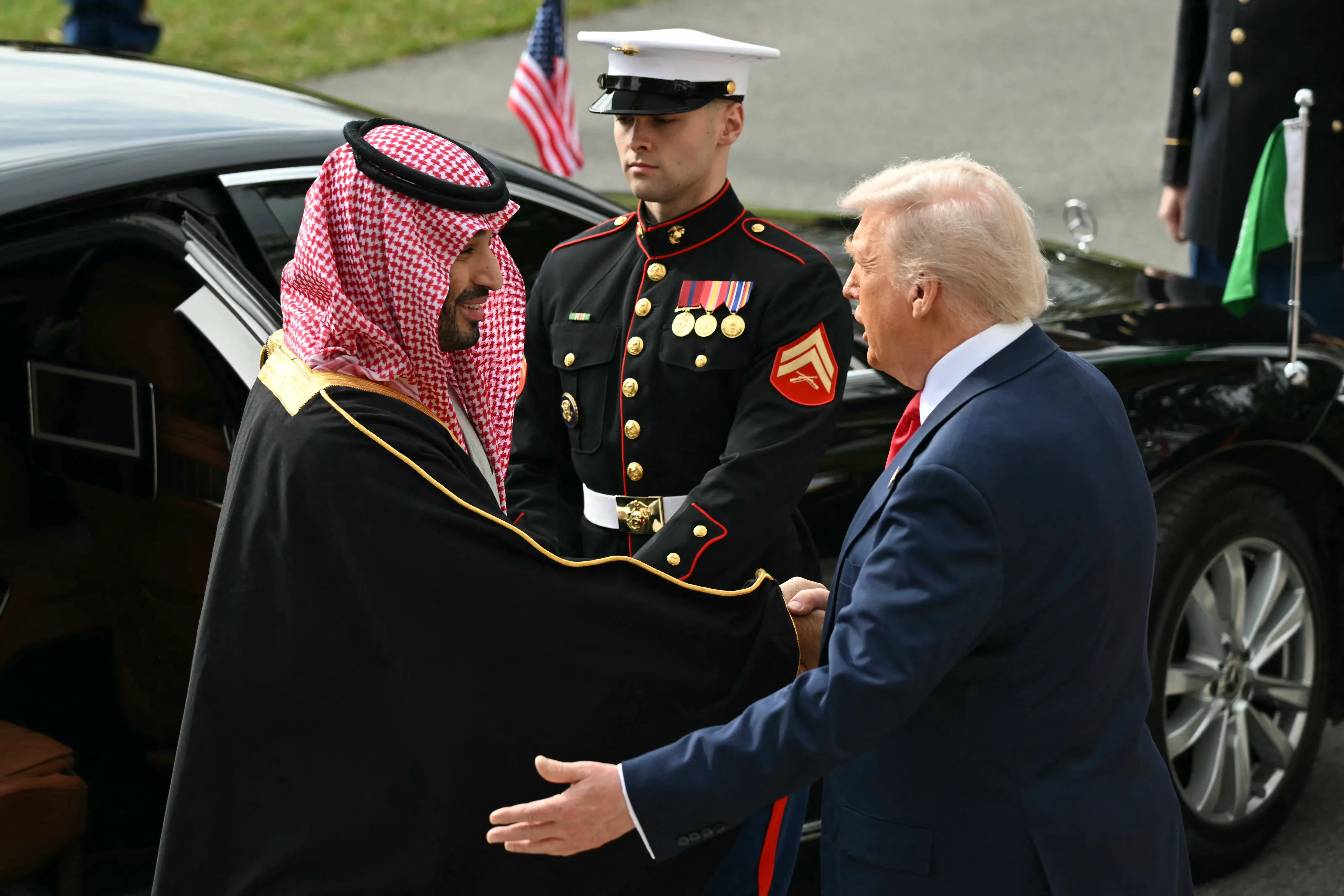
U.S. President Donald Trump welcomes Crown Prince and Prime Minister Mohammed bin Salman Al Saud of Saudi Arabia to the White House, Nov. 18, 2025.
What is the going rate for selling out Israel? Under U.S. President Donald Trump, we now have an answer: roughly $1 trillion.
Trump arrived in office boasting he would expand the 2020 Abraham Accords and leverage America’s unrivaled influence over Saudi Arabia. Instead, he squandered that leverage, pocketed a headline-grabbing investment pledge and walked away empty-handed on normalization—all while handing Riyadh sweeping strategic concessions that directly undermine Israel’s security.
This was not diplomacy. It was capitulation.
To understand the scale of the failure, one must grasp a basic truth about Saudi royals: They care about one thing and one thing only—keeping their heads connected to their shoulders. For decades, the ultimate guarantor of the House of Saud’s survival has been the United States. Even when America depended heavily on Middle Eastern oil, Riyadh needed Washington more than Washington needed Riyadh.
Yet the Saudis have mastered the art of manipulation. In every era, they have learned which threat to emphasize to extract American protection—the Hashemites one decade, Arab nationalists the next, communists during the Cold War and Iran after 1979. Israel has always been the convenient rhetorical foil, never the real concern.
The State Department Arabists, always fearing the loss of access to oil, coddled the Saudis even as they persisted in supporting terrorists, promoting radical Islam, discriminating against Jews and Christians, and compiling an abysmal human-rights record. Trump is less worried about oil, though Saudi control of the spigot can sink the U.S. economy, as former President Joe Biden learned when he decided the Saudis should be made pariahs.
Trump entered office unburdened by U.S. State Department orthodoxy and with unprecedented leverage. Saudi Arabia wanted the benefits of normalization without normalization itself. Trump could have said no. Instead, the master of the deal gave away the store to Crown Prince Mohammad bin Salman (MBS). Administration officials had taken the position that Trump had done what MBS wanted, and it was time for the prince to satisfy the president’s desire for normalization. MBS said, “No.”
Instead of kicking him out the door, Trump gave the Saudis a formal security guarantee like the one he gave the Qataris. In both cases, it was done by fiat, rather than going through the messy constitutional process of signing a treaty that requires Senate approval.
Without securing peace with Israel, Trump elevated Saudi Arabia to Major Non-NATO Ally status, placing it on par with Israel. He signaled openness to selling Riyadh F-35 fighter jets, directly eroding Israel’s congressionally mandated Qualitative Military Edge. He approved the sale of tens of thousands of advanced semiconductors made by the California-based company Nvidia—technology that could easily leak to adversaries. He revived civil nuclear cooperation, despite Saudi refusals to accept nonproliferation safeguards, even as Saudi leaders openly declare they would pursue nuclear weapons if Iran does.
Each concession weakened Israel. None extracted a price.
Oh, and who did Trump’s “very good friend” meet with shortly after the president? The Chinese foreign minister.
The message was clear: Saudi Arabia has successfully bought American support while keeping its options open with Washington’s greatest adversary.
Meanwhile, Trump has made clear through his negotiations on Gaza, Lebanon and Iran that he is much more concerned with satisfying Arab interests than Israel’s. In that regard, he, too, is an Arabist.
Israel has traditionally been allied with the United States due to shared values and interests. Trump, however, cares only about interests—financial interests. He is unbothered by the disparate values of dictatorships. The murder and dismemberment of an American journalist doesn’t interest him. The Saudis are also less troublesome than the pesky Zionists, whom he sees as ruining his chance for the Nobel Peace Prize. The Saudis also have more to contribute to both the American and the Trump family coffers than the Israelis.
Trump is not necessarily pro-Israel; he is transactional. Values do not factor into the transaction.
Moreover, the deals with the Saudis benefit America. The pledge of up to $1 trillion in Saudi investment would inject massive capital into the American economy. Nvidia will prosper, and the contractors and subcontractors that make the F-35s and the other weapons Trump is selling will reap the benefits and create jobs. The economic activity will provide Republicans with talking points to showcase economic growth and industrial strength.
Trump is like his predecessors in appeasing the Saudis. The distinction is that the others weren’t interested in Saudi-Israeli peace. Instead, they were more focused on appeasing the Saudis’ supposed fealty to the Palestinian cause. Trump realizes that the Saudis have no love for the Palestinians. Notice that they have not agreed to allow any Gazans refuge in the kingdom or volunteered to pay to reconstruct Gaza. They look down on the Palestinians and support them only to the extent that it serves their interests.
This is why MBS appeared willing to sell out the Palestinians and normalize ties with Israel during talks with the Biden administration. But that became untenable after Oct. 7.
The crown prince fears that if he acts while Israel is killing Palestinians, then he might suffer the same fate as former Egyptian President Anwar Sadat, who was assassinated by radical Muslims in 1981, several years after making peace with Israel in 1979. Moreover, as long as King Salman remains alive—a man steeped in antisemitism—normalization is unlikely.
Israel will survive Trump’s betrayal. Security compensation will eventually follow. Arms deliveries will be delayed and modified. Quiet intelligence cooperation with Saudi Arabia will continue against Iran. But the damage is real: The status of the Saudis has been elevated while Israel has been downgraded from strategic ally to negotiable asset.
A trillion dollars bought Saudi Arabia U.S. indulgence. Israel got nothing, except the lesson that loyalty, values and history carry less weight than a well-timed check.


No comments:
Post a Comment