Stopping Iran is not a violation of international law
The Iranian regime’s decades-long campaign of terror, nuclear ambition and proxy warfare posed a clear and present danger—one that critics of Israel and the United States often choose to ignore.
By Fiamma Nirenstein
JNS
Mar 10, 2026
The Iran of the ayatollahs has long been dangerous—and ready for war. If the world wished to prevent it from attacking its enemies with lethal weapons, including potentially nuclear ones, then action to stop it was not only justified but necessary.
International law does not forbid self-defense. Yet in practice, it often condemns the act of preventing an enemy’s aggression, even when the threat is clear and events are already in motion.
When actors such as the United States and Israel take steps to stop such a threat, the institutions that claim to safeguard international law—first and foremost the United Nations—frequently declare them outside the bounds of that very law.
This approach is not only dishonest. It is self-defeating.
The danger posed by Iran has been clear and present for decades. Ignoring it would have been an invitation to catastrophe—potentially even nuclear aggression. Tehran’s ambitions were not hidden. They were developed methodically over the years and accompanied by constant acts of war carried out directly and through proxies.
Yet in much of the international conversation, anti-Americanism, pacifist reflexes and hostility toward Israel dominate the narrative. Iran is no longer described as the world’s leading sponsor of terrorism, governed by a dictatorship that brutally violates human rights. Instead, it is often portrayed as the victim.
The result can be grotesque.
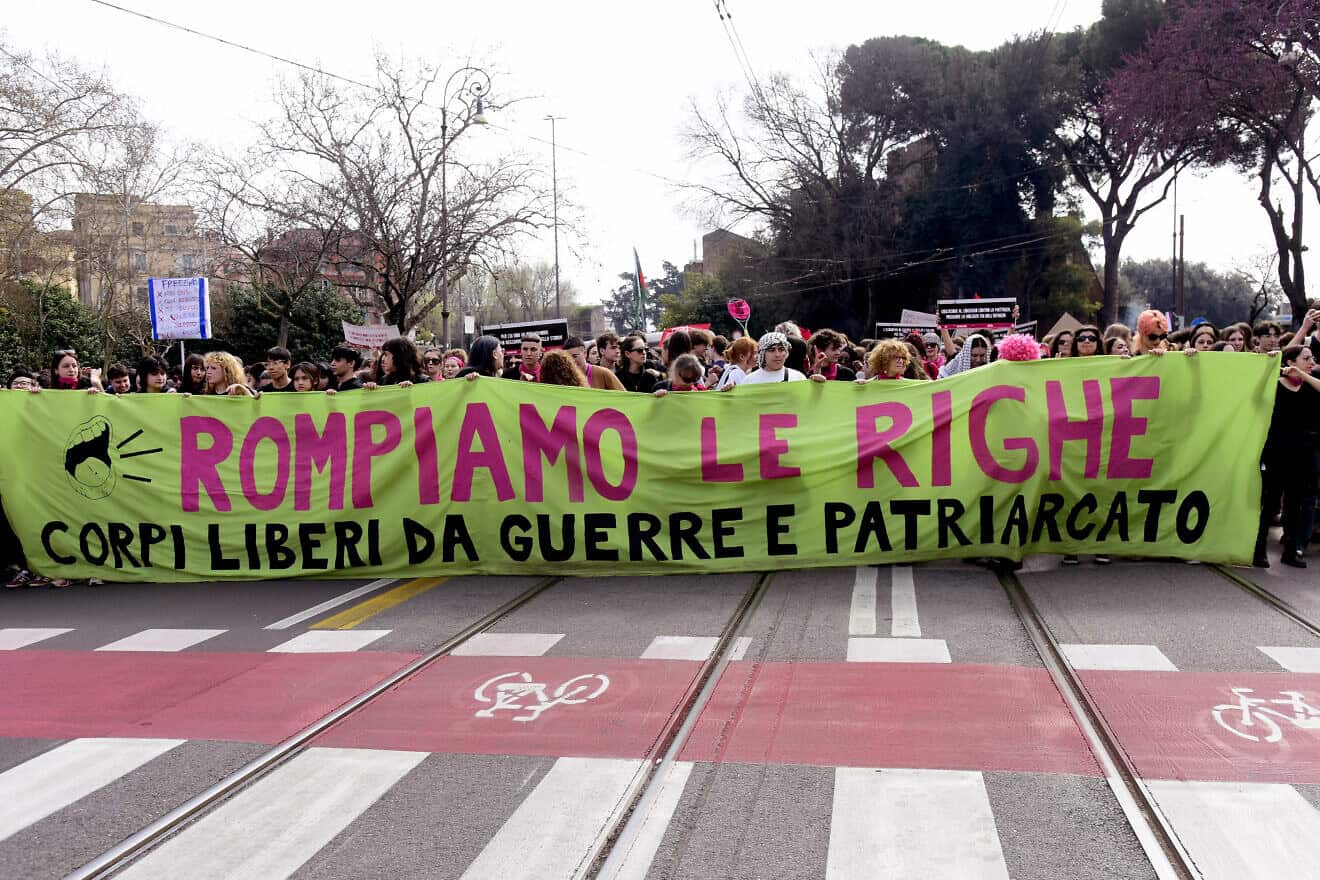
In recent demonstrations in Europe, activists from the feminist movement “Non Una Di Meno” expelled Iranian women from their marches because those women supported confronting the regime in Tehran. The reason offered was that war “violates international law.”
Apparently, the rights of Iranian women oppressed by that regime matter less than ideological slogans.
Critics of Israel and the United States insist that confronting Iran undermines the global code of justice and morality. But such arguments reveal how compromised that framework has become. If international law cannot recognize the need to defend oneself against a war already being waged against you, then it has lost its relevance.
The attempt to equate the campaign against Iran with Vladimir Putin’s invasion of Ukraine is one of the more absurd claims in this legalistic narrative. Iran has not been a peaceful country suddenly attacked without provocation.
Since the Islamic Revolution of 1979, Tehran’s hostility toward the United States and Israel has been explicit and constant. It began with the seizure of the American Embassy in Tehran and the 444-day hostage crisis involving 66 Americans. The slogans “Death to Israel” and “Death to America” soon became permanent features of the regime’s rhetoric.
The consequences are visible everywhere.
Iran has developed ballistic missiles and advanced its nuclear program while building a network of proxy forces across the Middle East. Hezbollah in Lebanon, Hamas in Gaza and the Houthis in Yemen have all received Iranian support, weapons and training.
Missiles built or supplied by Tehran have been aimed deliberately at civilians in Israel. Terrorist attacks supported by Iran have struck Jewish and Western targets around the world—from Buenos Aires to Burgas.
American soldiers were killed in the 1983 bombings in Beirut. Hijackings of international flights, suicide bombings and attacks on buses, cafes and shopping centers in Israel followed. Thousands have died in operations carried out by Iranian-backed groups.
Yet the institutions tasked with determining “international legitimacy” often focus only on the narrow rule that a state may respond only after suffering a direct attack.
The problem is that the modern world no longer fits that formula.
Today’s conflicts involve terrorism, proxy militias and covert cooperation among authoritarian powers—including Russia, China and North Korea. Billions of dollars flow through these networks to finance violence while maintaining a thin layer of deniability.
International law, designed for a different era, struggles to address these realities.
Meanwhile, a vast campaign of accusations against Israel has flourished. Even after the massacre of Oct. 7, 2023, Israel was dragged before the International Court of Justice and accused of violating international law.
Such claims reveal how urgently the international legal system needs reform.
The world is already confronting a war that ignores borders and targets civilians. Pretending otherwise does not protect justice—it weakens it.
And the victims of that blindness may include everyone—even the activists who believe they are defending moral purity while turning away the Iranian women who know the regime’s brutality best.


No comments:
Post a Comment