Whose ‘stolen’ land is it, anyway?
Throughout history, wars have had territorial consequences, especially when they were won but not started.
By Paul Driessen
JNS
Mar 16, 2026
Land acknowledgements have become de rigueur at academic commencements, award ceremonies and other programs. They might read: “We acknowledge that the land on which we gather was taken from Indigenous People who stewarded it for centuries before European colonialists seized it.”
In accepting her Grammy, singer-songwriter Billie Eilish used her opportunity to criticize immigration policies, saying, “No one is illegal on stolen land.”
But, of course, “rightful” land-ownership questions are hugely complicated by history and reality. Consider Europe, the Americas, Asia and the Middle East in the past, and Ukraine and Tibet today.
These lands were not stolen the way a burglar grabs jewelry. Most were purchased or taken through war and conquest across the globe and throughout human history.
They raise fascinating questions. At what points do conquests, and thus land titles, begin and end? Who holds a “legitimate” title, and who decides that is legitimate? Should all claims be treated the same, or do some have more “legitimacy” than others?
Europe has been a battleground for millennia—over fiefdoms, states, countries and empires. Pax Romana once governed the continent and Britain before the Visigoths, Celts and other tribes vandalized the Roman Empire. Religious, ideological and political forces fragmented Christian Europe for centuries. Two world wars and the collapse of the Soviet Union created modern-day maps.
Muslim armies occupied Spain and Portugal from 700 to 1492. Mongols invaded Eastern Europe in 1237. Ottomans ruled southeastern Europe for two centuries.
The Americas inherited Europe’s history and philosophy of discovery, conquest, religious conversion and resource extraction. Hernán Cortés and Francisco Pizarro took advantage of superior weapons, smallpox epidemics, and alliances with subjugated tribes to dismantle the Aztec and Inca empires.
The United States secured lands and resources from France through the Louisiana Purchase; California and the Southwest through wars with Mexico; and the rest of North America from Britain and Spain, and from Native American tribes.
Nowhere, however, is the “stolen land” trope more vocal and vicious than toward Israel.
The Middle East has been a bridge and a battlefield for trade, culture, and invading armies since time immemorial. After the Israelites arrived in the Promised Land, they defeated the Amorites, Canaanites and Philistines, who had conquered previous occupants. The Kingdoms of Israel and Judah were seized by the Assyrians and then the Babylonians, who exiled most of the Jewish people until Cyrus the Great of Persia defeated Babylon and permitted their return.
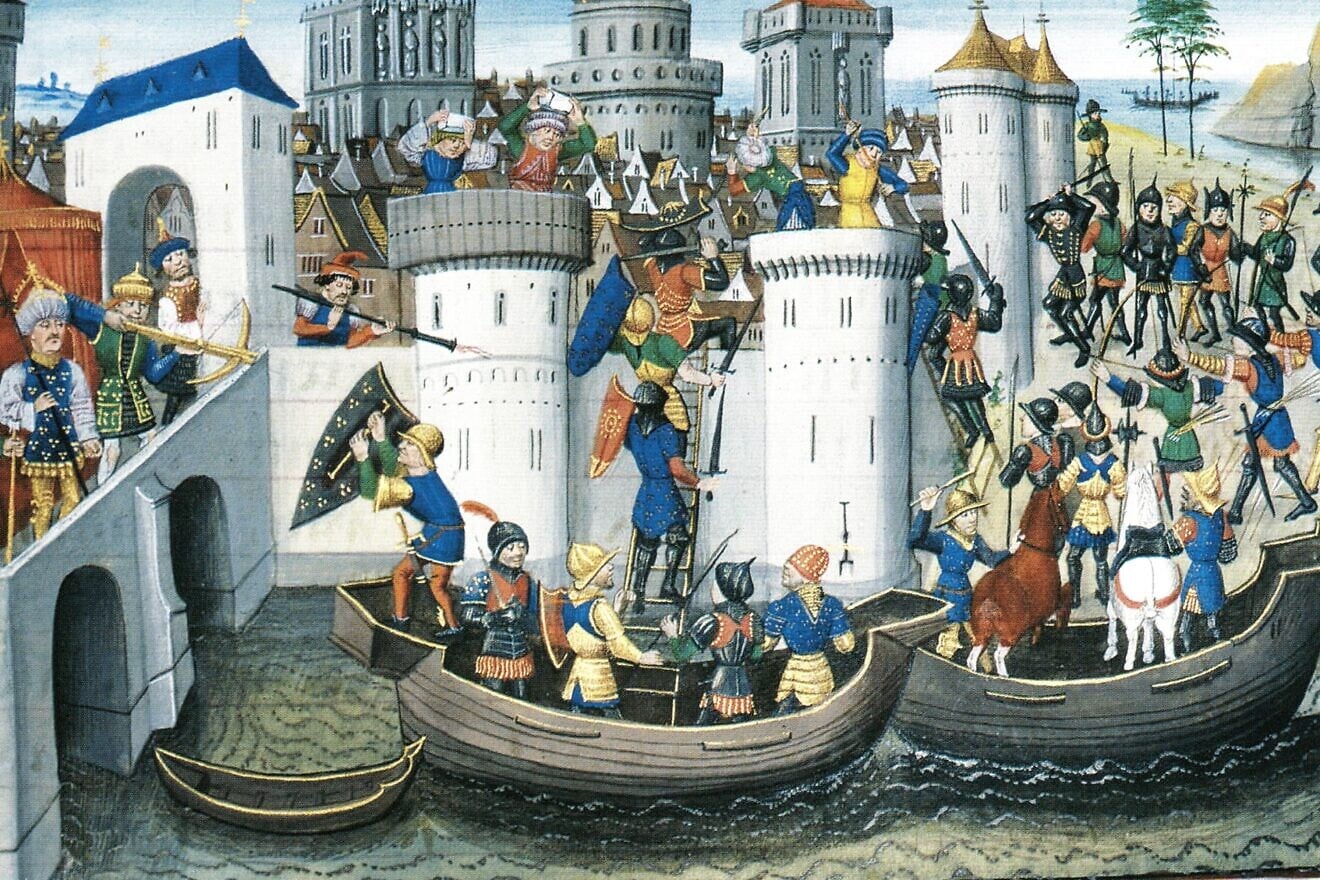
Alexander the Great ushered in Greek rule. Following another Jewish period, Rome took control, subdued Jewish uprisings and renamed the region Syria Palestina to insult the Israelites by recalling their mortal enemies, the Philistines. The Byzantine era followed, then centuries of Arab-Islamic conflicts with Byzantine and Crusader forces.
Mamluks drove the Crusaders out, paving the way for the Ottoman Turkish Empire, which lasted until the end of World War I, when the British and French established “mandates” and drew Middle Eastern boundaries similar to those that exist today.
Jewish immigrants purchased land from local and absentee Arab landlords before and after the World Wars. After World War II, Jewish immigration surged. Land ownership in the pre-1948 area that is now Israel was roughly 15% Arab, 9% Jewish, and 76% British Mandate land and “unregistered” plots.
At no point did Jews entirely disappear from the Promised Land. At no point in Middle East history was there a “Palestinian” nation or people. Some Palestinians now claim to be descended from Philistines, but they were killed or exiled by King Nebuchadnezzar, who sent the Jews into Babylonian captivity. Remnants of the Philistines assimilated into the Babylonian Phoenician populations.
Arab countries attacked Israel after it achieved nationhood in 1948. Some 700,000 Arabs left Israel, assuming they would return upon Arab victory, while 800,000 Jews were displaced from Muslim countries across North Africa and the Middle East. The 1967 and 1973 Arab-Israel wars also ended in Israeli victories and territorial expansion. (Today, Israel has less than 0.2% of the land area of Muslim countries across North Africa and the Middle East.)
Under millennia-long practices, norms and international law, victors win the lands and spoils of war. There is no “stolen” Palestinian, Syrian, Jordanian or other land in Israel.
Nor have any conquered or displaced people ever had a “right of return” to their former homes. And yet, Hamas, Hezbollah, the PLO and their supporters demand such rights for Palestinians. Indeed, the Hamas and PLO charters say Israel and Israelis must be driven out, “from the river to the sea.”
Wars have consequences, but they don’t include the “right of return,” a doctrine of “stolen land” or some precept of “once Muslim, forever Muslim” applied to Spain, Portugal, southeastern Europe or Israel.
Imagine the chaos that would erupt if the International Court of Justice began proclaiming “rightful returns” to lands “stolen” by conquests throughout history.
When Muslim Arab armies conquered the Middle East, sacking Jewish and other ethno-religious cities and forcibly converting millions, they claimed ownership of all those lands. Will the ICJ demand that those lands be returned to descendants of their “rightful owners” of yore?
Should DNA tests be used to settle claims by descendants of Aztecs and Incas—or tribes subjugated by them—to properties in Mexico, Bolivia, Ecuador and Chile? What about those who can trace their ancestry to Celtic, Saxon, Etruscan, Roman, Vandal, Dacian or other ancient Europeans who were conquered, decimated, exiled or assimilated throughout the ages?
Should Turkey be recognized as the current owner and governing authority of Greece? Will China end its “occupation” of Tibet? Will the “international community” boot Russia out of Crimea and Donetsk?
Why should only Israel be singled out for opprobrium? Why are countries demanding that it alone among nations return not only areas it took in wars it did not start, but lands Jewish immigrants purchased 80 to 110 years ago? And what happened to the original 1948 pre-war State of Israel created by the United Nations?
That absurd notion is the product of vacuous thinking by people who can sing and chant slogans, but have no grasp of even basic history. It belongs in the dustbin of irrational ideas.


No comments:
Post a Comment