Europe’s self-defeating anti-American reflex in confronting Iran
As the world’s largest aircraft carrier sails to the Middle East, the European Union drifts toward division instead of Western unity.
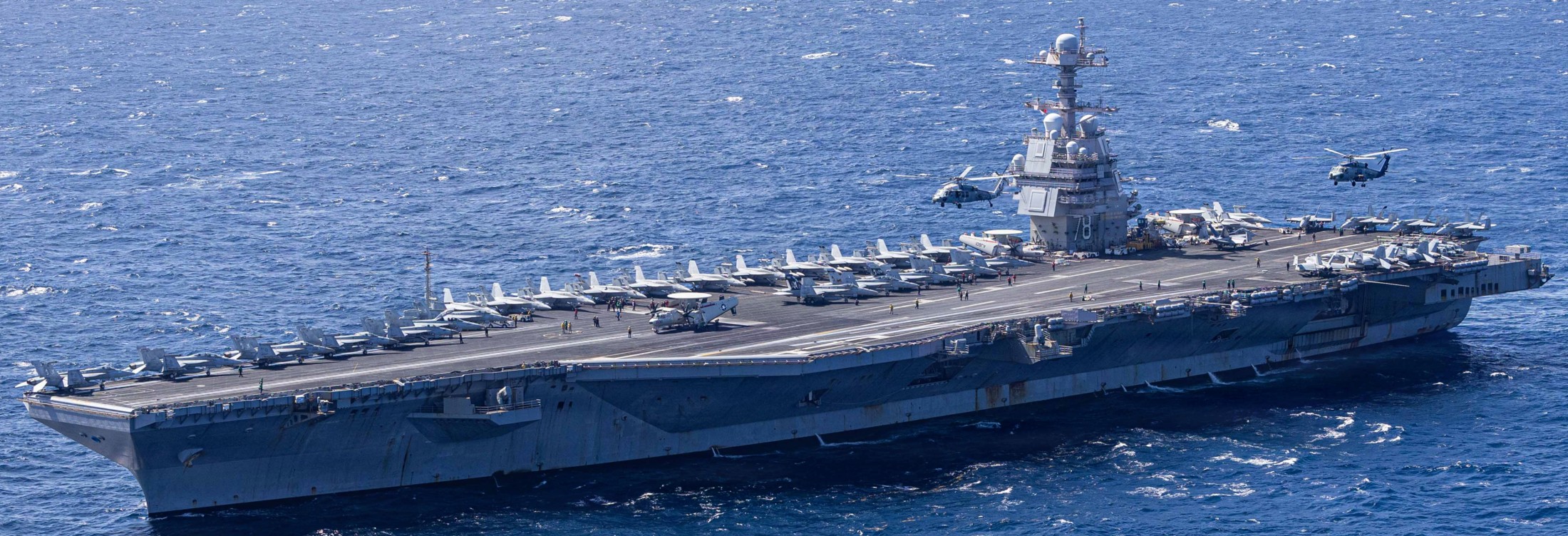
The USS Gerald R. Ford in the Caribbean Sea on January 19, 2026
“Challenge.” “Fracture.” Those were the headline words across much of Europe following the Munich Security Conference. Commentators spoke with a certain self-satisfaction about a virtuous “Europe of Peace,” in contrast to the supposedly bellicose posture of U.S. President Donald Trump.
From the Financial Times to Spanish and French dailies, an old reflex resurfaced: Europe’s revival, we are told, will be built on distancing itself from Washington. Anti-Americanism, that familiar comfort, has once again become fashionable.
Yes, one may recall U.S. Vice President JD Vance’s sharp criticism a year ago, when he accused Europe of complacency and inertia. But it is intellectually dishonest to ignore that Secretary of State Marco Rubio subsequently softened the tone and reaffirmed the value of transatlantic cooperation. What matters now is not past rhetoric but present reality.
And reality is sailing toward the Arabian Sea.
After the USS Abraham Lincoln and the USS George H.W. Bush, a third American aircraft carrier—the USS Gerald R. Ford, the largest and most powerful warship ever built—is now en route from the Caribbean to the Middle East. This is not theater; it is strategy.
Over the weekend, Trump publicly given Iran’s ayatollahs 30 days to accept or reject an American proposal. Negotiations are set to resume, with American negotiators Steve Witkoff and Jared Kushner heading to Geneva. The president has made clear that if no agreement is reached, the consequences will be “traumatic.”
Washington’s demands are sweeping: an end to Iran’s nuclear ambitions, the dismantling of its ballistic-missile program, and the cessation of its support for terrorist proxies. Trump has also reiterated that it would be better for the murderous regime in Tehran—responsible for countless deaths at home and abroad—to disappear altogether.
These are near-impossible objectives. And Trump knows it.
The ayatollahs and the Islamic Revolutionary Guard Corps do not view their mission in transactional terms. They believe they are fulfilling a sacred destiny: the advancement of Shi’ite Islam toward the apocalyptic return of the Mahdi. Nuclear weapons, missiles, regional proxies and the promise to destroy Israel are not bargaining chips—they are pillars of ideology.
This is not rhetoric. Tehran has repeatedly demonstrated that it will risk a catastrophic confrontation to pursue its aims. Europe knows that in such a scenario, its own capitals—well within range of Iran’s expanding missile arsenal—would not be spared. The Vatican, too, lies within reach.
Iran has never pursued diplomacy as an end in itself. It has used it as a tactic—what Islamic jurisprudence calls taqiyya, sanctioned deception when necessary to defeat the enemy. Europe knows this. It knows Iran’s regime is morally abhorrent, that it has pursued nuclear capabilities in defiance of international commitments, that snapback sanctions were triggered for cause, and that Tehran stands aligned with Russia in its war against Ukraine.
When the European Union designated the Revolutionary Guards a terrorist entity, Tehran responded by calling it a “strategic mistake.” That was not the language of partnership.
Europe, Israel and the United States face a common strategic reality. Iran does not distinguish between Tel Aviv, Brussels or Rome in its long-term worldview. Yet as the Gerald R. Ford steams closer to the region, Europe congratulates itself for rhetorical distance from Washington.
Is this wisdom? Or illusion?
At a moment of profound geopolitical danger—when Iran and Russia increasingly coordinate their ambitions—the Western alliance cannot afford symbolic fractures. Europe is struggling with internal political and economic crises. An anti-American banner will not restore its strength.
Europe’s honor and security were rebuilt after World War II with American partnership. The so-called “vacation from history” was not a moral lapse but a hard-earned period of reconstruction made possible by transatlantic unity.
The telescope is available. The Gerald R. Ford is visible on the horizon. The question is whether Europe chooses clarity—or comfort.


1 comment:
We were considering a Danube River Cruise in 2026. I'm uncomfortable in visiting Europe at this time. Maybe The Grand Tetons? Last trip we saw an idiot try to approach a Moose. Now that's entertainment!
Post a Comment