Saudi Arabia’s MBS seeks to weaken Israel
Riyadh’s shift to Islamism is inspired by Qatar and Turkey, whose Muslim Brotherhood-aligned policies expanded their regional influence without triggering alarm bells in Washington.
By Joseph Puder
JNS
Mar 3, 2026
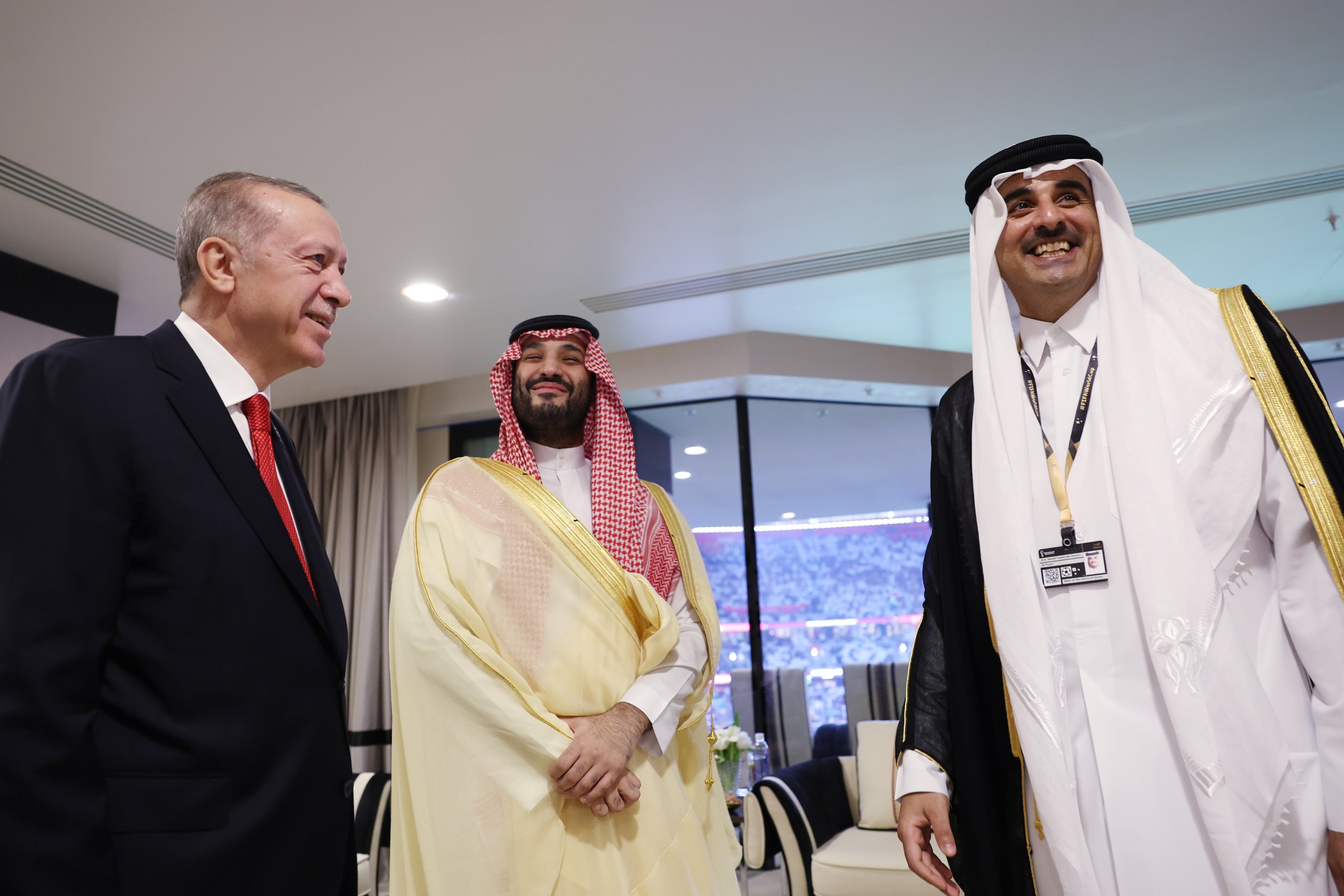
In recent months, Saudi Arabia and its de facto ruler, Crown Prince Mohammad bin Salman (MBS), have taken an increasingly anti-Israel stance and turned away from the expected normalization with the Jewish state that U.S. President Donald Trump has sought to achieve by adding the Middle Eastern nation to the Abraham Accords.
Riyadh shifted significantly from what was perceived to be imminent normalization with Israel to open diplomatic confrontation, partially due to the ongoing conflicts in Gaza and Lebanon.
Apparently, Israel’s emergence as a Middle Eastern power, following the debacle of Oct. 7, 2023, and Israel’s subsequent successful campaigns against the Islamic Republic of Iran’s proxies—Hamas, Hezbollah and Iran itself—concerned MBS. He has thus taken a chapter from the late Henry Kissinger’s 1954 Ph.D. dissertation titled “Peace, Legitimacy and the Equilibrium.” It was republished in 1957 as a book titled A World Restored.
Kissinger, the former U.S. Secretary of State under presidents Nixon and Ford, focused his thesis on two conservative 19th-century European leaders: Habsburg Austria’s Chancellor Klemens von Metternich and Britain’s Foreign Minister Robert Stewart, better known as Viscount Castlereagh.
These two European monarchical leaders searched for peace and a way to restructure Europe following the bloody Napoleonic wars, followed by the Congress of Vienna (1814-15).
For Metternich, the fear of the emergence of another revolutionary power, as Napoleon’s France was, necessitated a balance of power.
Both Metternich and Castlereagh were assessing Russia’s territorial gains against the Ottoman Turks, as well as its growing power and confidence. Metternich, an astute diplomat, sought to form a coalition against any too-powerful continental state. Britain and France would eventually fight Tsarist Russia in the Crimean War (1853-1856).
Like Metternich, MBS is seeking to weaken Israel’s influence and power in the region. The Saudis perceive Israel as competing with them for regional hegemony. By bribing U.S. President Donald Trump with promises of billions in investments, MBS hopes to replace Jerusalem as the U.S. strategic ally in the region.
Although MBS is no Metternich, by any standard, he is nonetheless seeking to build a coalition ostensibly against Israel. On Jan. 9, Bloomberg reported that Turkey was likely to join the defense pact between Saudi Arabia and Pakistan, and that talks to do so were in an “advanced” stage. Later that month, Pakistan’s Minister for Defense Production told Reuters that a draft defense deal between the three countries had been prepared.
It is rather ironic that the two Sunni Muslim powers—Turkey and Saudi Arabia, who have been bitter rivals over leadership of the Sunni-Muslim world—would now seek an alliance. One still remembers the murder of Washington Post journalist Jamal Khashoggi in Istanbul, Turkey, and the bitter recriminations between Turkish President Recep Tayyip Erdoğan and MBS. But this partnership can be seen as an opportunity to threaten Israel. And, it is also meant to provide Turkey and the Saudis with Pakistan’s nuclear umbrella.
Iran, Saudi Arabia’s chief adversary, responsible for having orchestrated an attack in 2019 on the Saudi ARAMCO oil processing fields, has been debilitated by the combined American and Israeli attack on its nuclear facilities last June. The Saudis, in assessing Iran’s current situation of largely neutralized proxies and an economy in shambles, are pleased that “the dirty work” was done for them.
They are, however, reluctant to support regime change in Iran that might allow for a democratic, pro-Western regime to emerge. They would rather see a weakened regime in Tehran than a new regime that might make peace with Israel. A democratic, pro-Western Iran might diminish Saudi Arabia’s luster in today’s Washington.
Naturally, the Saudis have expressed little sympathy for the repressed Iranian people. Riyadh prefers the diminished power of the mullahs, their domestic challenges and their being isolated internationally over the plight of civilians. In fact, the Saudis, along with the Qataris, and Erdoğan’s Turkey have notified Washington that they will not allow the United States to launch attacks on Iran from their territory. It simply shows how unreliable these supposed U.S. “allies” actually are.
Saudi Arabia wants to replace Israel with Syria as the transit country for a fiber-optic cable designed to connect the Saudi kingdom to Greece through the Mediterranean Sea. Riyadh’s insistence that it be connected to Greece through Syria—and not Israel—underscores how regional alignments are shifting as Riyadh looks to bolster Damascus’s standing in the region and potentially isolate Israel.
MBS has publicly accused Israel of committing genocide against the Palestinians in Gaza, despite previously shunning Muslim Brotherhood-affiliated Hamas terrorists. Now it seems that he is seeking to make peace and ally himself with forces, including Qatar and Turkey. Riyadh is also at odds with the United Arab Emirates, Israel’s closest Arab partner. In an interview, former Saudi Shura Council member Ahmed Al-Tuwaijri accused the UAE of being “Israel’s Trojan horse.” He added that Abu Dhabi is implementing Israeli ambitions.
Seemingly, the failure of MBS’s Vision 2030—an ambitious plan to diversify Saudi Arabia’s oil-dependent economy, reshape its society and position the kingdom as a global investment hub—has resulted in MBS’s abandoning the Emirati model of economic transformation, moving from an oil economy to services. It seems that he has replaced Neom (MBS’s futuristic city) with a Turkish-style approach: masking economic trouble with populist appeals to restored Islamic glory, beginning with hostility toward Israel.
Saudi Arabia’s shift to Islamism is inspired by Qatar and Turkey, whose Muslim Brotherhood-aligned policies expanded their regional influence without triggering alarm bells in Washington, thanks in part to the strength of Doha’s and Ankara’s lobbying operations in the U.S. capital.
In the end, it is the old balance-of-power game that nations play that seems to be a major factor in aligning the Saudi regime with former rivals to block the perceived rise of the Jewish state.


No comments:
Post a Comment