A battle to make America great again
Yet a motley crew on the left and right are not happy about the idea that national decline is a choice the president firmly rejects.
By Clifford D. May
JNS
Mar 4, 2026
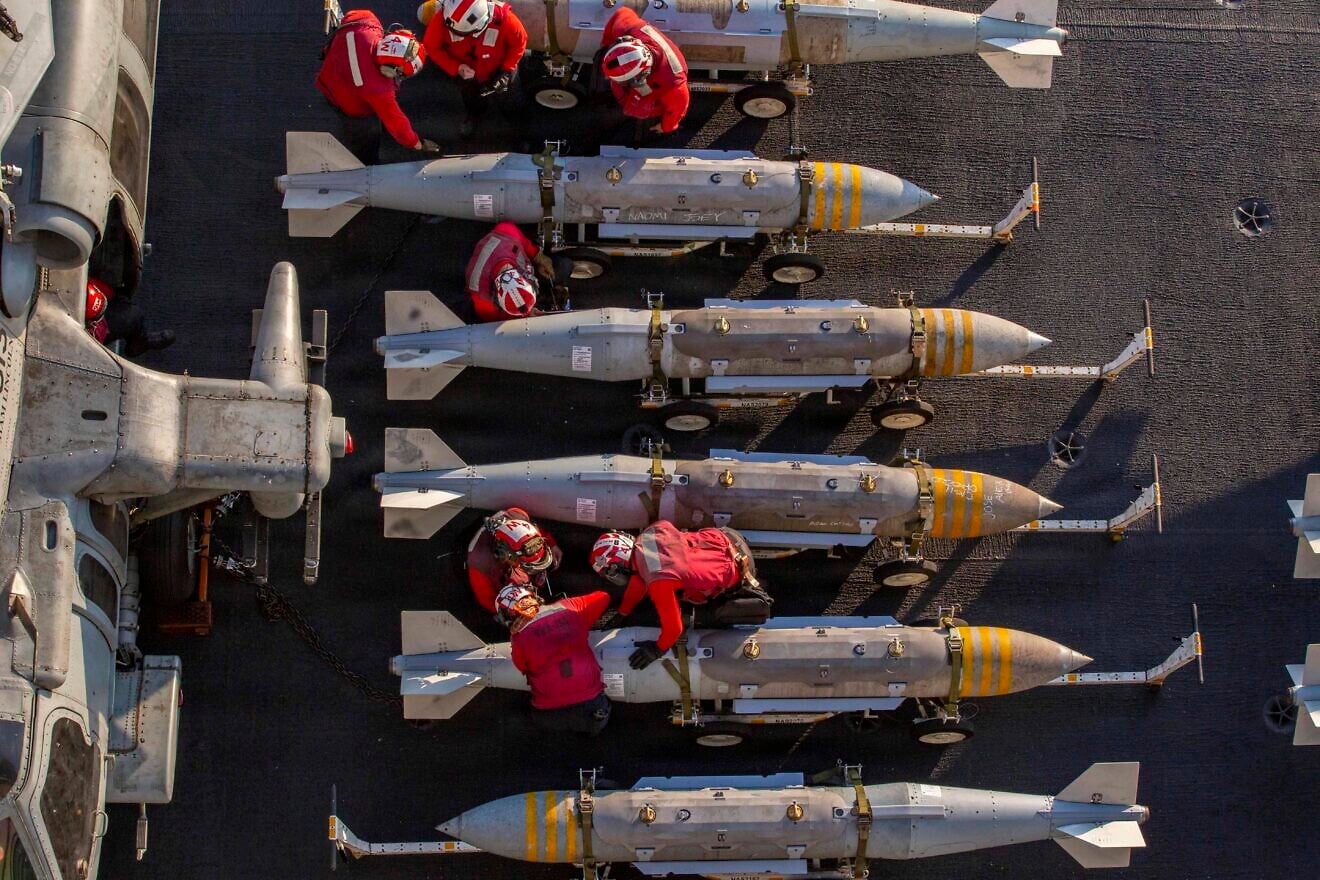
On Feb. 28, U.S. President Donald Trump made one of the best—and, at eight minutes, briefest—speeches of his career.
The objective of the combined U.S.-Israeli operation, he explained, “is to defend the American people by eliminating imminent threats from the Iranian regime. … Its menacing activities directly endanger the United States, our troops, our bases overseas, and our allies throughout the world.”
He added: “For 47 years, the Iranian regime has chanted ‘Death to America!’ and waged an unending campaign of bloodshed and mass murder, targeting the United States, our troops and the innocent people in many, many countries.”
If that’s not “America First,” what would be?
It also should be obvious that Trump is making America great again by orchestrating extraordinary U.S. military power in close coordination with what the Pentagon has called America’s “model ally,” and doing so with such unprecedented precision that ordinary Iranians have literally been dancing in the streets, confident that the bombs were only targeting their oppressors.
Yet a motley crew on the left and right isn’t happy about the idea that national decline is a choice the president firmly rejects.
The ladies of Code Pink were apoplectic, their usual disposition. Sen. Bernie Sanders (I-Vt.) called the strike on Iran “premeditated.” Would he rather it had been impulsive and spontaneous?
Socialist Democrat Zohran Mamdani, mayor of New York City, and Rep. Rashida Tlaib (D-Mich.), apparently reading from the same talking points memo, denounced Trump’s intervention as “an illegal war of aggression.”
Russian President Vladimir Putin, taking a brief break from droning Ukrainian kindergartens, called the elimination of Ali Khamenei, the world’s leading terrorist master, a “cynical” assassination in violation of “all norms of human morality and international law.”
Political commentator Candace Owens posted on X: “I STAND AGAINST ISRAEL,” echoing the party line of Hamas, Hezbollah and the Muslim Brotherhood.
Former Fox News host and current podcaster Tucker Carlson called the intervention “absolutely disgusting and evil.”
It’s reckless anthropomorphizing to speculate about what “history” will say. But future historians will have to acknowledge that Trump made arduous efforts to mitigate the menace from Tehran diplomatically.
He couldn’t succeed because the Islamic Revolution of 1979 was not, as its leader, Ayatollah Ruhollah Khomeini, said, “about the price of watermelons.” It was about jihad against the West: Islam über alles.
Even after the 12-day war against the regime last June, the mullahs were determined to reconstitute the country’s nuclear-weapons program and build missiles capable of delivering them to the “Great Satan.”
So, what’s next? Trump told the Iranian people: “When we are finished, take over your government. … This is the moment for action.”
In other words: Regime change is your job. We’re helping you now, and we’ll help you later, but we can’t do the job for you.
An easy job, it will not be. The regime does not want to be changed. The surviving members of the Islamic elite are not, so far at least, laying down their weapons at home or abroad.
They’ve been launching missiles and drones at Israel, where at least 12 people have been killed, and at eight other Middle Eastern neighbors, not one of which was participating in the military operation. According to U.S. Central Command, six American service members were killed in an Iranian drone attack against Kuwait.
On Sunday, Ali Larijani, the head of Iran’s Supreme National Security Council, said that Israelis and Americans would soon face a “force they have never experienced before.”
The commanders of what the Pentagon has dubbed “Operation Epic Fury” and the Israelis call “Operation Roaring Lion” must take such threats seriously. Military operations are inherently risky.
If, however, over the weeks ahead, the Americans and Israelis can succeed in crippling the theocrats’ military capabilities, that will constitute a historic victory.
Additional achievements are possible. For several years, the scholars at my think tank have been arguing that a second Cold War against the United States and its allies is being waged by an “Axis of Aggressors.”
Four regimes belong to this unholy alliance: Beijing and Moscow, since 2022 in a “no-limits” partnership, along with Tehran and Pyongyang, where—due to failed diplomacy by previous American presidents—a third-generation anti-American dictator is in possession of a nuclear arsenal.
If the Islamic Republic of Iran’s war-making machinery can be demolished, how great an impact will that have on the Axis of Aggressors?
Consider what happened when the United States took on the original Axis, the one between Nazi Germany and Fascist Italy, announced by Benito Mussolini in 1936, and joined by Japan four years later.
On July 10, 1943, the Allies launched an amphibious invasion of Sicily. Within two months, Italy had surrendered—a major psychological blow to Berlin, demonstrating that the Axis was breakable.
Hitler responded with “Operation Axis,” diverting to Italy troops and resources that he badly needed on other fronts. The Allied invasion of Normandy began on June 6, 1944. Germany’s unconditional surrender was formalized less than a year later.
Could the collapse or even just the enfeeblement of the Tehran regime have a similar impact on the Axis of Aggressors? As you know, history doesn’t repeat, but it often rhymes.
Final point: Iran’s rulers have long been the primary destabilizing force in the Middle East, funding and arming the Houthis, Hamas, Hezbollah, Palestinian Islamic Jihad and Shia militias in Iraq.
Without Tehran’s backing, these groups will struggle. That will give the Lebanese, Iraqis, Yemenis—maybe even the Palestinians, who knows?—a once-in-a-lifetime chance to become free and independent, rather than vassals of a blood-soaked Islamic empire.
If only that is achieved, wouldn’t Trump deserve the Nobel Peace Prize?
I think so. I doubt Bernie, Candace, Tucker and the distressed damsels of Code Pink will agree.
Originally published in “The Washington Times.”


No comments:
Post a Comment