Oct. 7 and history in stratospheric motion
The world is moving down a path toward war or peace unlike anything we have ever known
By Fiamma Nirenstein
JNS
Nov 21, 2025
Oct. 7, 2023, had a strategic clarifying effect that may ultimately help humanity embark on a completely new path. From that moment of absolute horror—an unprecedented awakening to the jihadist element of Islam and its alliances—there opened a path toward war or peace with abnormal, never-before-seen characteristics. The blender of history began spinning at stratospheric speed.
Until now, wars—even when ideologically stretched beyond their geographical boundaries—retained some limits. Globalization has now brought them everywhere. In the past, wars reached clear conclusions: victory on one side, defeat on the other.
After World War II, peace was achieved through the defeat of Nazi Germany and Fascist Italy (and later authoritarian regimes in Spain and France). The democracies fighting Hitler and Mussolini were even, at that moment, allied with the communist world, which later built its own front. But for those who fought the fascist forces, the war ended decisively: victory. Even amid disputes, the victorious powers moved toward a future of democracy in the West, leading to the formation of NATO.
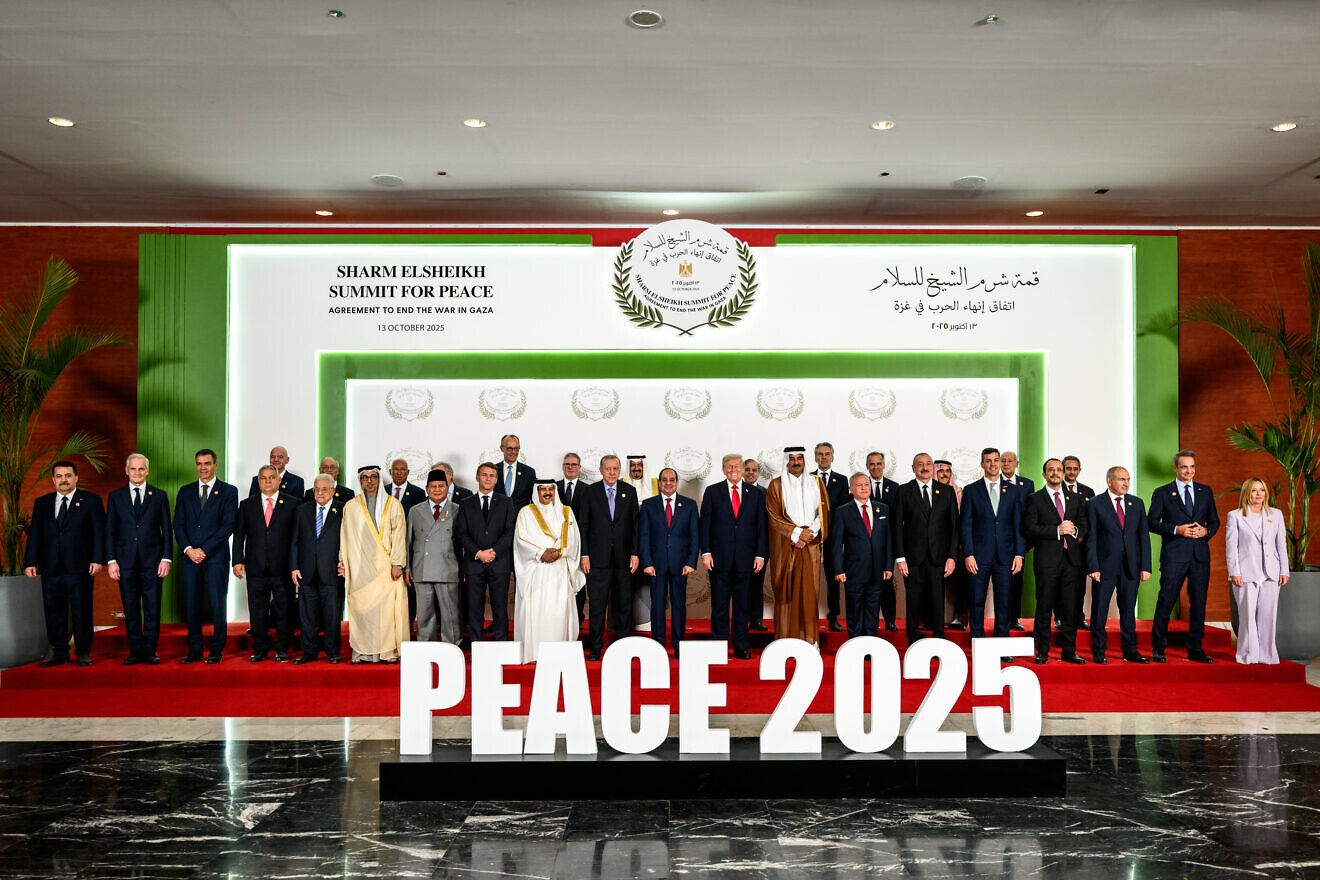
Today, however, the war following Gaza’s Black Saturday seems headed toward a conclusion that is simultaneously promising and problematic, tangled with divergent interests. Countries united by the Sharm el-Sheikh agreement often hold conflicting aims—and in some cases even hatred—such as Egypt and Iran.
Sometimes they share common interests, such as restraining Iran and its allies, including Hamas. At other times, they differ sharply on the idea of a Palestinian state, such as Jordan or France versus Israel. And now, the U.N. Security Council has approved a 20-point plan for peace, stability and security, signed by U.S. President Donald Trump and the states represented at Sharm el-Sheikh on Oct. 13.
Israel, a main actor in the conflict, shares certain security goals with some involved states—those of the Abraham Accords and those with peace agreements, from Egypt to Jordan to the UAE and Morocco—but it knows well that Turkey and Qatar remain its bitter enemies. These two states—with vast political and economic resources—have driven, and continue to drive, the ideological and practical campaign of the Muslim Brotherhood.
They have fueled global anti-Israel and antisemitic sentiment and armed Hamas. Erdogan leads a Sunni movement that divides the world into the zone of “harb” (war) and the zone of “salam” (peace through Islamic conquest). According to the Brotherhood, the first step is the destruction of Israel. Turkey and Qatar have temporarily set aside Sunni-Shiite hostility to cooperate with Iran and its proxies.
Now, under Trump’s plan, the second step after the hostages’ release is the disarmament of Hamas—something Turkey and Qatar approach with dangerous ambiguity. Hamas has even proposed handing its weapons to these states for “safekeeping.”
Predictably, they will act ambiguously, maneuvering to bypass Israel’s refusal to allow their active involvement in Gaza, yet risking exclusion by Trump from the pact. If they block disarmament, Israel will intervene directly, creating consequences for Doha and Ankara with Washington, which insists Hamas must leave the field—by force, if necessary.
This is the first major contradiction: Even with Trump’s forceful leadership, deeper jihadist and geopolitical games may ultimately surface.
It is notable that Russia did not veto the recent Security Council resolution, despite voicing criticism. That distance does not break Trump’s game; in fact, it proves the strength that all major players now recognize, each maintaining its own interests. Putin may be maneuvering toward a risky European alignment.
The core problem remains: There is an irreducible religious and territorial drive that draws boundaries the U.S. seeks to break in the name of global security and prosperity. The most radical states, foremost Iran, are left out. Russia and China must now choose their future path, having invested in Iran’s nuclear and military strategy.
At this moment, peace in the Middle East looks like a daring poker match, with Donald Trump as the clear number one, Israeli Prime Minister Benjamin Netanyahu at the table and Saudi Crown Prince Mohammed bin Salman recently joining. Trump and bin Salman’s strength derives from undeniable realities: Saudi Arabia is a major Islamic and economic power.
For Israel, the situation is different. Netanyahu had to regain his position after Oct. 7 turned Israel into a wounded nation in shock—something Israel had never experienced since 1948, having survived and won every war of aggression launched by the Arab world, later rebranded as “the Palestinian cause.”
The Oct. 7 attack, as is increasingly clear, was not a typical terrorist raid. It was the apex of a carefully planned campaign, outlined in Hamas leader Yahya Sinwar’s letters and supported by vast theoretical and strategic documentation in Arabic and Persian sources.
The goal: occupy Israel, terrorize it, invade the south and trap it in a vise with Hezbollah from the north. Sunni Muslim Brotherhood ideology and Shiite Iran remain united in this objective—clearly expressed in Hamas’s charter, Iranian Supreme Leader Ayatollah Ali Khamenei’s writings and longstanding religious doctrine.
Israel then made its first strategic leap—attacking Hezbollah in a war of survival despite the threat of 250,000 missiles. Israel restored its international strategic position, demonstrating the military capability that has ensured its survival for 80 years.
Killing Hezbollah leader Hassan Nasrallah defied all expectations. Meanwhile, Israel advanced into Gaza despite international pressures, neutralizing much of Hamas’s force; carried out a stunning dual strike inside Iran, including with U.S. participation; and impeded the Houthis in Yemen and the dangerous drift of the Syrian regime, which is now even a potential partner.
Against all odds, Israel maintained economic and technological stability while suffering heavy casualties. Trump forced a framework in which his sparring partner could dictate credible security terms—while expanding the Abraham Accords and drawing rival powers toward participation in a great geopolitical transformation that Trump seeks to lead.
The horizon is clear: expand the Abraham Accords. Europe should finally join.
The project is risky but could benefit all sides, including the Palestinian Authority, which is promised an eventual Palestinian state—after rejecting terrorism, reforming education, ending antisemitism and developing accountable governance. Mahmoud Abbas is 90 and ill; change may soon be inevitable.
Trump wants even bitter adversaries like the Saudis and Iranians to cooperate—beginning with unity in Gaza. The immediate test is the disarmament of Hamas. Yet Iran has recently delivered new weapons to the group abroad. The Islamic Republic is trying to rebuild Hezbollah while expanding its ballistic-missile arsenal, even as uranium enrichment has become harder.
Russia and China remain lurking antagonists. In all of this, one thing is clear: Europe must wake up. It must defend Western values with its full strength—something it has shamefully avoided while tolerating a tsunami of antisemitism. It must defend Ukraine and Israel, and confront autocracies and the terrorism, violence and mass antisemitism threatening its own streets.
We are no longer in a “clash of civilizations.” We are in a moment where democracies across oceans must understand that their own survival depends on a united front for freedom. For once, even the U.N. has voted in that direction—an extraordinary turn in history.


No comments:
Post a Comment