Trump’s UN victory is a path to a stalemate in Gaza
Though Palestinian statehood remains a non-starter, the U.S. scheme is likely to result in part of the coastal enclave remaining in the hands of Hamas, not an era of peace.
By Jonathan S. Tobin
JNS
Nov 19, 2025
President Donald Trump got his way at the U.N. Security Council on Monday when it unanimously approved his 20-point plan for the future of the Gaza Strip. The resolution endorsed the deal that secured a ceasefire in the war that followed the Hamas-led Palestinian Arab terrorist attacks in Israel on Oct. 7, 2023. With Russia and China abstaining rather than vetoing the measure, Trump received the world body’s endorsement for, among other points, the creation of an International Stabilization Force to police Gaza and a Board of Peace to govern it.
The president celebrated the vote in typically hyperbolic fashion, declaring: “This will go down as one of the biggest approvals in the history of the United Nations, will lead to further peace all over the world, and is a moment of true historic proportion.”
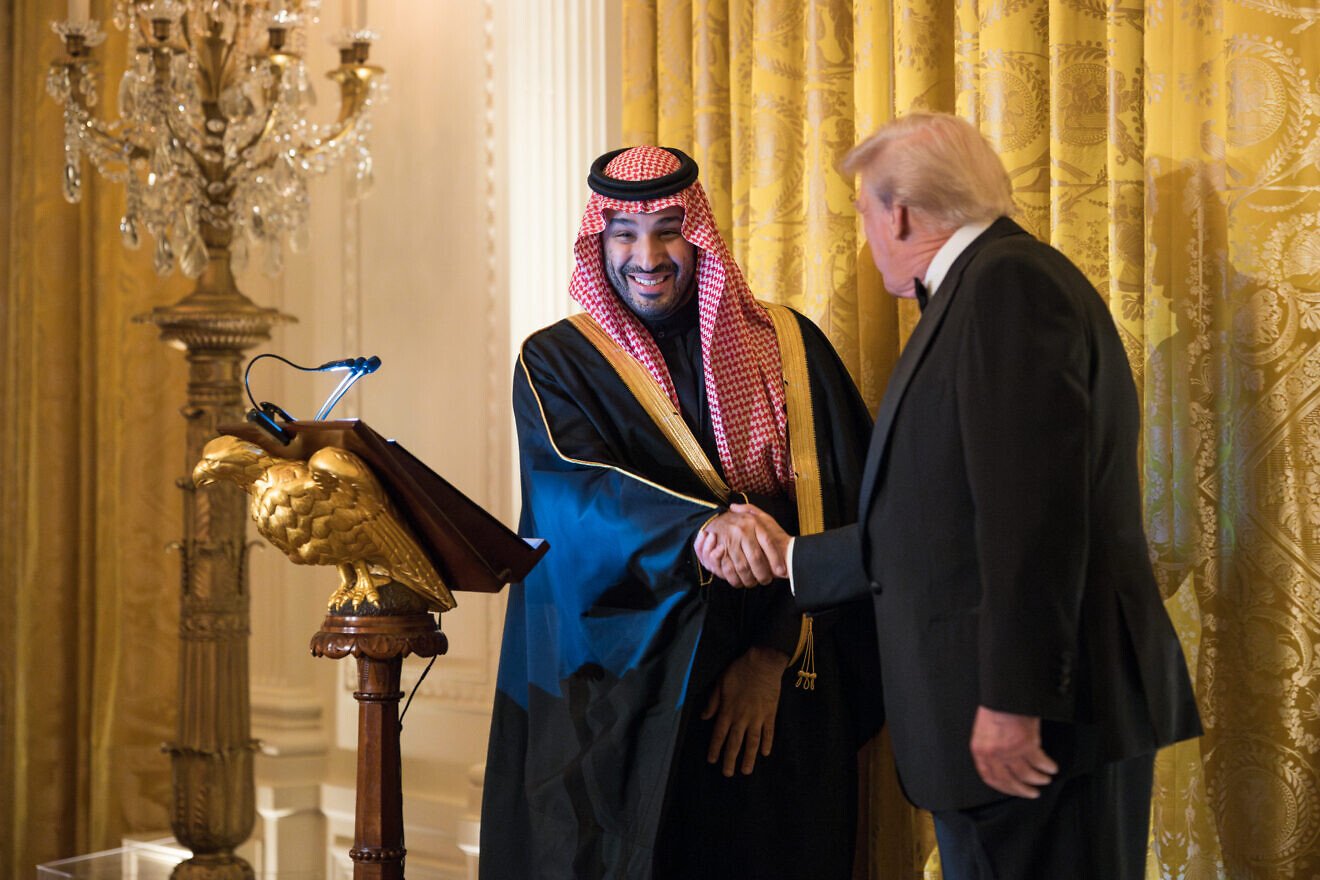
Trump is also pleased with the closer relations that he has achieved with Saudi Arabia. The kingdom’s de facto leader, Crown Prince Muhammad bin Salman (known as MBS), arrived in Washington the next day for friendly meetings with Trump, discussing, among other things, a major arms sale, and then a gala state dinner where memories of the hostility of the Biden administration toward Riyadh and its royal family were officially buried.
But the notion that Trump’s effort to end the war in Gaza will lead to the Saudis joining the Abraham Accords and recognizing Israel could be as fanciful as the chances that Trump’s plan will succeed in transforming Gaza into a prosperous and peaceful place.
Magical thinking
Had the Security Council rejected the scheme, it would have embarrassed the White House and undermined efforts to maintain the ceasefire-hostage release deal that proved a triumph for American diplomacy. The notion that this is going to lead to peace there or anywhere else, however, isn’t just overoptimistic. It’s divorced from reality.
The truth is that despite the optimism coming out of Washington about what will happen in Gaza, it’s already painfully obvious that the Trump plan, which now has the U.N.’s seal of approval, isn’t going to achieve the two things that might give peace a chance: the disarmament of Hamas and its surrender of those parts in the Strip where it is still in control.
That’s not what we’re hearing from the administration.
The president and the members of his foreign-policy team continue to insist that Hamas will disarm. They say that one way or the other, the agreement’s utopian scheme for Gaza’s reconstruction, which also hinges on assembling an entirely mythical civil service of non-political Palestinian technocrats, is going to be implemented.
It may be premature to give up on the plan. After all, the ceasefire went into effect only five weeks ago. The United States has been able to get Indonesia to commit to send troops to join the Gaza force while a number of other nations, including Azerbaijan, Pakistan, Turkey, Egypt, Qatar, the United Arab Emirates, Jordan, Saudi Arabia, Malaysia, Cyprus, Australia, Canada and France, have expressed interest in also participating in some way or helping to finance the scheme.
Still, it’s hard to imagine any of them being willing to do what is necessary to disarm Hamas and evict it from the Strip. None of them wants to be accused of acting as collaborators with the Jewish state. Nor are they likely to be willing to absorb the inevitable casualty toll that goes with seeking to root terrorists out of their remaining tunnel strongholds. To assume otherwise is magical thinking.
And far from preparing to give up, Hamas and its terrorist allies have used the last several weeks since the shooting stopped to dig in even deeper in those parts of Gaza, including Gaza City, that remain under their control.
And that is the basic conundrum that those celebrating with Trump need to acknowledge.
Only Israel has the will or the ability to defeat Hamas. Trump sometimes talks as if he is prepared to give Israeli Prime Minister Benjamin Netanyahu the green light to finish off the terror group. But doing so would blow up the ceasefire and erase Washington’s diplomatic achievement, sending all the countries that have endorsed the Mideast plan running for cover. And that includes his good friend MBS. And so, for all of his tough talk, the threats made by Trump about ensuring Hamas’s surrender are ringing hollow.
Nor is it certain that Netanyahu’s own stirring pledge that his government is still committed to the complete defeat of Hamas is credible. One basic fact of Israel’s current security dilemma is that Jerusalem will be reluctant to cross Trump by restarting the war in Gaza without his express permission.
If so, what happens next?
The most likely scenario is that the so-called “yellow line,” which divides the part of Gaza occupied by Israel after a partial withdrawal from the front line at the time of the ceasefire from the portion now held by Hamas, may well become a permanent addition to the lexicon of the Middle East.
On one side of the line, the U.S.-backed reconstruction plan will, as Washington has already signaled, probably begin to be implemented. And on the other, Hamas will reconstitute the terror state that existed throughout all of Gaza before Oct. 7.
The good news is that compared to the situation prior to the attack on Israel, this scenario is one in which Hamas’s ability to fulfill its vows to go on killing Jews—let alone repeat the Oct. 7 attacks again and again—will be greatly diminished.
The bad news is that it falls far short of achieving one of the two goals of Israel’s post-Oct. 7 war: eradicating Hamas. At best, it merely puts Israel in a somewhat stronger position the next time Hamas is built up enough to resume the fighting.
Nor should we expect that the situation will go smoothly in the non-Hamas-controlled part of Gaza. Palestinians are likely exhausted from the price they were made to pay for supporting Hamas’s continued commitment to destroying Israel and achieving the genocide of Israelis. But the expectation that ordinary civilians will be eager to support a non-Hamas government and the U.S. reconstruction effort is wishful thinking. They will also be under great pressure to back a guerrilla campaign against both the Israelis and anyone else sent there to keep the peace.
‘No’ to a Palestinian state
Like other elements of the plan, such as the unspecified reform of the Palestinian Authority that governs Judea and Samaria as a prerequisite for them participating in the reconstruction of Gaza, the belief that moderate Arab and Muslim governments will sacrifice blood or treasure to ensure the end of Hamas remains a fantasy.
This is not a prescription for peace, but rather, one for a new stalemate between Israel and the United States on one side, with Hamas, which can still count on support from Iran as well as America’s Turkish and Qatari frenemies, on the other.
Does this mean, as some Israelis fear, that what will sooner or later unfold is a scenario in which an independent Palestinian Arab state in Gaza will eventually become a reality? Probably not.
There is language in both the 20-point plan that Netanyahu signed off on several weeks ago, which the Security Council resolution is based on, that speaks of a theoretical future in which a Palestinian state will be created there.
It says that after an unspecified reform of the P.A., and after Gaza is rebuilt and rid of terrorists, “the conditions may finally be in place for a credible pathway to Palestinian self-determination and statehood, which we recognize as the aspiration of the Palestinian people.”
That will be interpreted by some as a legally binding obligation to create such a state. Indeed, far-left Israelis and American Jews—like the leaders of the left-wing J Street lobby—are, as they told The New York Times, already fantasizing about Trump imposing a Palestinian state in Gaza, and then doing the same in Judea and Samaria, empowering the same groups that threaten Israel.
None of that is going to happen.
Great expectations
The acceptance of Hamas remaining in part of Gaza, as it was before Oct. 7, may be as close to a state as the Palestinians will get. No Israeli government—whether headed by Netanyahu or one of his political opponents—will accept the creation of a sovereign government in any part of the government that might have the ability to threaten or invade the Jewish state as the Hamas state did on Oct. 7. And the achievement of the conditions placed on Palestinian statehood in the Trump plan is a possibility so far-fetched as to render it more a matter of science fiction than a policy proposal.
Like past generations of Palestinian leaders, the criminals running Hamas and their corrupt counterparts that lead the Fatah Party (which controls the P.A.) remain unwilling and unable to accept statehood under any conditions but Israel’s elimination. As was true in 1948, 1967, 1993, 2000 and 2008, and any other time when they could have compromised and received a state, their only goal remains Israel’s destruction. They don’t want a state next to Israel. They want one instead of it—and that is something they can never have.
Nor should Americans or Israelis be entirely sanguine about Trump’s optimism about relations with the Saudis.
As much as Trump is right to try and cultivate this alliance, he ought to be listening to Netanyahu and conditioning any major upgrade of its war-making capacity, such as selling it greater numbers of the same high-tech F-35 Jets Israel has, on its willingness to make peace with Israel.
The administration’s “America First” foreign-policy goals include creating a situation where the Saudis will join with the Israelis to oppose Iran and safeguard the West’s interests in the Middle East while the U.S. pivots to Asia to deal with the threat from China.
However, the belief that MBS is interested in exchanging his country’s current close under-the-table relationship with Israel for one involving open recognition, normalization, and the exchange of ambassadors and embassies—as was true for those who joined the 2020 Abraham Accords—has little foundation. He wants Israel and the United States to act as counterweights to the threat that the Saudis still face from Iran, even after its defeat in the 12-day war it fought with Israel and the Americans last summer.
But his moderation has its limits. And, as guardian of the holy Islamic cities of Mecca and Medina, even MBS is always going to worry more about angering the Islamist fundamentalists that are part of his nation’s governing elite than he will about pleasing Trump or the Israelis.
Neither peace nor nightmare
All of which means that the American plan is neither a pathway to peace nor the nightmare scenario that some on the Israeli right fear it will turn out to be. Sadly, the enormous sacrifices made by Israelis during the two years after Oct. 7 will, barring a dramatic and unlikely acceptance by Trump that his peace plan is a flop, turn out to have not achieved the removal of the deadly threat to their nation.
Still, by gaining the release of the last hostages being held by Hamas, Trump again earned the gratitude of Israelis. It’s also true that thanks to the successes achieved by the Israel Defense Forces in the war, as well as Trump’s commitment to smashing the Iranian nuclear program, the current strategic equation in Gaza and the region is one in which Israel has been strengthened since Oct. 7, while its enemies are weaker.
But unless the president is ready to let the war begin again, his plan is looking as if it is just one more waystation on the road to the inevitable next round of fighting between democratic Israel and genocidal Palestinian Islamists.


No comments:
Post a Comment