'Smart Wall' border technology planned for Big Bend National Park area
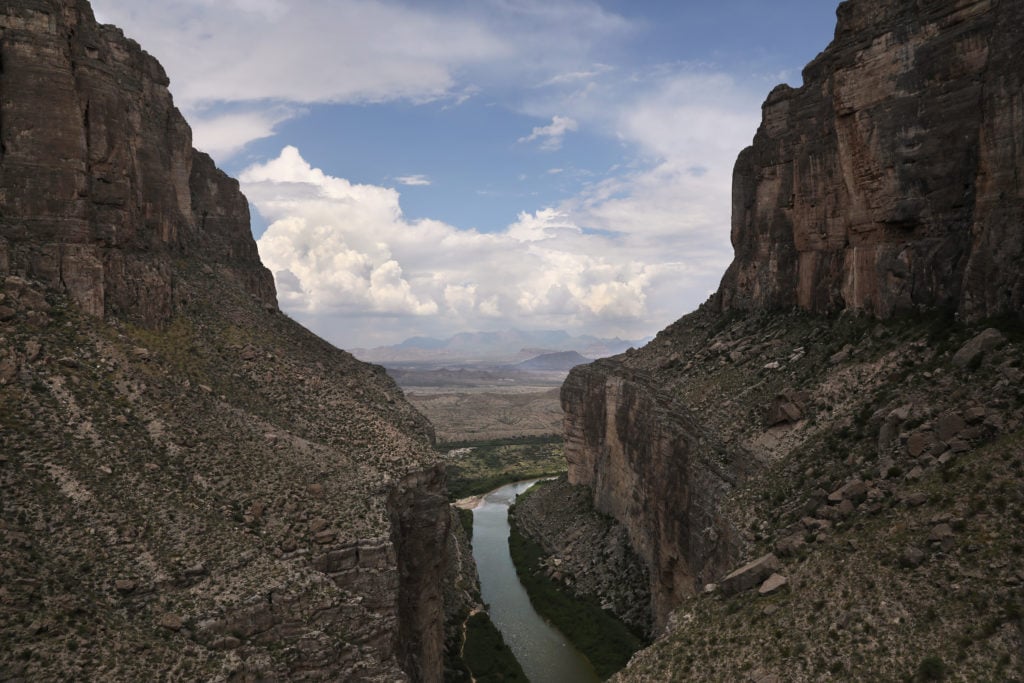
The Rio Grande forms the US-Mexico border while winding through the Santa Elena Canyon in the Big Bend region in Texas.
The Big Bend region of Texas, including Big Bend National Park, could soon have new border security measures under the federal government's "Smart Wall" initiative.
U.S. Customs and Border Protection calls the smart wall a system that combines "steel barriers, waterborne barriers, patrol roads, lights, cameras, and advanced detection technology."
Officials awarded $4.5 billion in contracts last month that will add 230 miles of smart wall and 400 miles of "new technology," according to a release last month.
Border impacts on Big Bend National Park
A map on the CBP website shows a section of border security measures that runs directly through Big Bend National Park. Though the map lists the project as a "detection technology" project with "BBT technology only," but doesn't define BBT technology, indicating that a physical wall will not be built in the park.
The 363-mile section is part of 535 miles of border that will be covered by detection technology because of unfavorable terrain and remoteness, CBP said.

What they're saying: "For years, Washington talked about border security but failed to deliver. This President changed that," CBP Commissioner Rodney Scott said. "The Smart Wall means more miles of barriers, more technology, and more capability for our agents on the ground. This is how you take control of the border."
Change to the area could be coming sooner rather than later.
In an Oct. 15 notice, Homeland Security Secretary Kristi Noem said certain laws, regulations and legal requirements regarding construction were being waived to "ensure the expeditious construction of barriers and roads."
Environmental impacts of new border wall construction
The new border wall construction will have an impact on wildlife and the area's ecosystem.
Russ McSpadden, southwest conservation advocate with the Center for Biological Diversity, said previous wall construction across the southern border impacted the habitats of nearly 100 threatened and endangered species.
The other side:
"These waivers set the stage for a continent-wide ecological fracture unlike anything in human history," McSpadden said. "Decades of ecological research shows that walls fragment habitats, block migrations, sever gene flow and destabilize wildlife populations. A continent-wide wall would splinter ecosystems, bisect wildlife populations and push many species toward extinction. No society has ever attempted to wall off an entire continent. The consequences would be existentially devastating."
In Noem's notice, she said the waiver in the Big Bend region would include all aspects of wall construction, including excavation, site preparation, cameras and lighting.
"Imagine 2,000 miles of beautiful desert, river valleys, and coastal plains lit up like a sports stadium, every night, forever," McSpadden said. "This would create a continent-wide secondary wall of light blasted into the sky that would devastate nocturnal wildlife across entire ecosystems and extinguish the stars over some of the most beautiful, biologically rich places on the continent."
Border crossing numbers
Noem claimed the Big Bend region was an area of "high illegal entry," stating that more than 88,000 undocumented migrants were apprehended between fiscal year 2021 and July 2025. The Big Bend Border Patrol sector covers 77 counties in Texas and all of Oklahoma. The sector includes 517 miles along the Rio Grande.
"Because the Big Bend Sector is an area of high illegal entry where illegal aliens regularly attempt to enter the United States or smuggle illicit drugs, and given my mandate to achieve and maintain operational control of the border, I must use my authority under section 102 of IIRIRA to install additional barriers and roads in the Big Bend Sector," Noem said.

Data from U.S. Customs and Border Patrol shows an 84.5% decrease in border encounters in fiscal year 2025, compared to 2024.
Data from Border Patrol shows the Big Bend region has the fewest number of border patrol encounters amongst the agency's nine southern border sectors with just 3,096 encounters in fiscal year 2025. That number is down 37% from the previous year.
Overall, U.S. Border Patrol reported an 84.5% decrease in encounters with 237,538 encounters in fiscal year 2025 compared to 1.5 million in 2024.
The Source: Information on "Smart Wall" construction comes from U.S. Customs and Border Protection. Information about bypassing regulations for border wall construction comes from a memo to the Federal Register from Homeland Security Secretary Kristi Noem. Information on environmental impacts of border construction comes from the Center for Biological Diversity. Information on border crossing numbers comes from U.S. Customs and Border Protection.


1 comment:
There is nothing in Big Bend. Even if you cross into the area, the mountainous, hot, unforgiving terrain is a huge obstacle. There is very little vehicle traffic that can be effectively monitored by the Feds. After several attempts to colonize the area with multiple Forts for protection from Mexican Bandits and Indians most people wouldn't stay. Some say it's beautiful. I say it's ugly and unforgiving. That's why it's still referred to as the Frontier.
Post a Comment